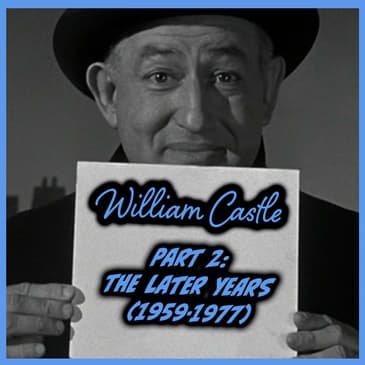
Charlotte and Adam dive deep into the gimmick years of William Castle. They explore his biggest triumph, and most people have no clue that he was even involved. They even take a quick peek at his final film as director, the uniquely bizarre Shanks. Adam even has a few fun stories about his final film as producer, Bug.
Contact Us At:
www.perfdamage.com
Email : perfdamagepodcast@gmail.com
Twitter (X) : @perfdamage
Instagram : @perf_damage
Letterboxd : Perf Damage
Check Out our Youtube Channel:
https://www.youtube.com/@PerfDamagePodcast
William Castle Pt. 2
Adam: All right. Welcome
Charlotte: back for part two of William Castle. All Things William Castle. Well, half the
Adam: things. This is the
Charlotte: gimmicky years. The gimmicky years. And the latter years. After the gimmicks are done, yeah. So if you haven't listened to the first part of this two-parter, there's William Castle.
Charlotte: The early years start there. We like to tell stories chronologically around here. So we tell you all the stories about William Castle that you might not have heard before because most biographies or little film photographies on William Castle always start around.
Adam: Or documentaries. They all start right here where we're about to start on this
Charlotte: one.
Charlotte: Yeah. And they just sort of go over all the other stuff and he's got some fantastic tales. Run-ins with the law buddies, with Orson Wells. Crazy stories about Err Flynn.
Adam: Bela Lagosi,
Charlotte: Bela Lagosi. And him. Where
Adam: dude, he's got Draculas in there. Draculas. Pretty
Charlotte: awesome. Yeah, there's a lot of fun stories. So if you haven't listened to that one, check it out.
Charlotte: Check it out. Worth your time, for sure. Yeah. I mean, stop now. Just go back, Listen to, part one first. I mean, well definitely come back to, Yeah. I mean, we're glad you're here. We're not, we're not telling you to leave . Please don't leave. You know, you could listen to this one first. You, you do whatever you wanna do.
Charlotte: Whatever order you wanna listen to these in. Yeah. I
Adam: mean, if you're down with the tingler and you really want to hear about that, that's, Yeah. I mean, we're really not gonna talk this, We're not gonna talk all that much about the Tingler. How do you know? I mean, we might talk a little bit more about the gimmick.
Charlotte: I mean, we can ramble on. We get going. It's true of some fact. It's true. And then we just take on, Take some hilarious story. Some hilarious
Adam: story. Hilarious dude. Drunken a Flynn. Come on. I know. Like burying people at sea, like that's awesome. Yeah.
Charlotte: Putting people in duffle bags and throwing 'em overboard.
Charlotte: Yes. That is in part one people,
Adam: but stopping to get a drink first. Yeah. Cause you know when someone dies, the first thing you do is pour yourself a drink. .
Charlotte: It's as if this had happened before .
Adam: I could see that. I could actually see that. Yeah.
Charlotte: He has his emergency kit. He went and broke the glass. It's got the booze and the duffle bag.
Charlotte: It's, And the duffle bag is hanging out. Ready to go. Yep. He's prepared on the Zaca. . Wanna know what the zaca is? Part one? People .
Charlotte: All right. So last week we left off with Macab. The very first film that William Castle produced himself as an independent
Adam: producer.
Charlotte: Did he mortgaged his home? Took a chance. His wife said, Okay, let's do, took a chance on himself.
Adam: Took a chance on himself, and guess what? He won.
Charlotte: He did. He did. So he did macab. He had the gimmick, the life insurance policy. It worked. People loved it. Nobody died.
Adam: So how do you follow up Macab? After the huge success, the lines around the block, all the young people that came out to see his movie, he accomplished what he wanted to do. He wanted to bring out the young people to see his film, and he wanted to scare the pants off of him. So what do you do?
Adam: How do you follow that up?
Charlotte: Well, one thing that McCobb didn't have was a big star. So the next thing he wanted to do was find a big star for his next picture. And he did.
Charlotte: So he gets a star. He gets Vincent Price to sign on to do House on Haunted
Adam: Hill.
Adam: Yeah. House on Haunted Hill is probably one of my favorite ones, the year. I
Charlotte: think it's one of his best known films, if not his best known. Well, because
Adam: of the remake too. I mean, it's true. And that was a really good remake too.
Charlotte: What I love about this one is that William Castle's first film There was a life insurance policy taken out on everybody. And then in house on Haunted Hill, it's a millionaire that's offering to give people money to stay the night at his house and survive. So it's kind of, in a way, it's kind of the gimmick of his first
Adam: film a little bit.
Adam: Yeah, I could see that for sure. Yeah. So what's the gimmick on this one? How do you bring people into the seats?
Adam: He thought, Hey, what if the movie actually came out at you and it wasn't 3d? It was actually real. Yeah.
Charlotte: He's, He's making a 4D film.
Adam: Yeah. Yeah. He's making a 4D film. What if I broke the wall and something actually came out of the screen at you , so what do you call a skeleton that shoots out of the screen into the theater with you? I call that meo . Yes, you do. .
Charlotte: The first film ever presented in Eio also, because again, it's the fifties and you gotta have, you gotta have a name for the thing that you're.
Adam: And it's also the last film ever presented in Marjo
Charlotte: They couldn't top it. So what is MEO ?
Adam: The studio built a black box on the side of the screen. And at a certain point when an skeleton emerges from a vat of acid, the box opens up and a glowing skeleton shoots down the line from the front all the way to the back of the house, and then back into the box
Adam: So
Charlotte: a skeleton dangles above the top of , the. And depending on how high the ceiling was, , the skeleton was either very close to you or way
Adam: high up there, the ceiling. You might miss it if you weren't looking real high. Yeah.
Charlotte: Yeah. And this became a favorite of younger audience members who would start throwing things at it when they knew it was coming.
Charlotte: Well, they
Adam: would go over and over again to the movie so they could throw things out. Yeah. They waited for that moment. Kids
Charlotte: would throw popcorn and and cups and things like that at the skeleton. That became
Adam: a thing. Yeah. Emergo wasn't a highly successful gimmick.
Charlotte: No, but the thing about William Castle was he didn't care if people were genuinely scared.
Charlotte: I mean, he wanted to scare people, but if they had a good time, if they laughed and they enjoyed it, they were buying a ticket so he didn't care. Yeah. You know? Yeah. It was dumb, but it was fun. And that's what people went to his movies for.
Adam: Yeah. During the first screening of the house on Haunted Hill, the Emergo didn't work, of course.
Adam: And the box opened up and the skeleton just kind of fell forward out of it. And as it was supposed to go back and forth across the thing, it just kind of like dangled out of the box and then the box shut and it, it never actually came out. , apparently there was a lot of faulty Oh, I'm sure. Skeletons.
Adam: Oh, I'm sure across the nation. . I would've loved to have seen that though. Yeah. It would've been a lot of fun.
Charlotte: House on Haunted Hill. Yeah. The re bank didn't have that.
Adam: Did not, No Emergo in the Rema.
Charlotte: No. Emergo also allied artist put that one out. Nice. So, yeah, he did well. Did he finance this one himself?
Adam: I don't know that he had to do that ever again. He wasn't an independent producer, so it was basically like he had a deal with these places. They paid for the movies and he still shared in the profits. And they paid for his overhead to have an office and all that kind of stuff. Kind of your normal producer deal now. Right.
Adam: They did not put out all of these films though. No. So how do you follow up on Marjo then? Well,
Charlotte: with another gimmick, of course. and you keep
Adam: your star. Well, yes. I mean, who wants to let go of Vincent Price? Nobody. I put him in everything that I do. Yeah,
Charlotte: I would too. So he follows it up with the Tingler.
Charlotte: My personal favorite. Tingler is great.
Charlotte: So the synopsis for the Tingler, if you haven't seen it, an obsessed pathologist discovers and captures a parasite creature that grows when fear grips. Its hosts. So the whole concept is there's a creature living in all of us on the back of our spine, and it can only be subdued by screaming. It grows and sort of takes over you when you're scared or you're fearful and it, it feeds on your fear.
Charlotte: So it feeds on your fear. And the only way to stop it is to scream, which is just great because you want people screaming in a theater when people are not in that theater. Cuz then the people not in there are gonna hear it and say, what is, what is happening
Adam: there?
Adam: Yeah. What is happening? What is going on? I need to see this. I have to see this. Yes. Yeah. So what is the gimmick in this one? How do you get butts and seats? Well, the tingler
Charlotte: kind of looks like a giant centipede slash lobster. Like a lobster centipede. Yeah. Lobster peed or whatever it is. We actually have, we have one when,
Adam: when he created the tingler he said, No one's gonna eat lobster for three months after this by three months.
Adam: I don't know. That's what
Charlotte: he said. All right. Yeah. So it's this creature thing, and somehow it gets out of somebody's body. I think there's an autopsy and they, he takes it out. That's a price. Removes one. . And then it gets loose.
Adam: That's the best part of the movie. Yeah.
Charlotte: It gets loose and it's crawling around the lab.
Charlotte: And you can actually, if you look close enough, you can see the strings pulling the little tingler in the movie. But the gimmick, not director intent.
Adam: No, no,
Charlotte: no. But the gimmick is the tingler. All of a sudden you're watching the movie and then the Tingler ends up in a movie theater in the projection booth, and you see it crawling on the projector, and then all of a sudden the projector goes out.
Charlotte: And Vincent Price's voice
Adam: scream over complete darkness,
Charlotte: says everybody the tingler is loose. So at the same time, when this happens, William Castle had installed some buzzers on the bottom of some of the seats that were de-ICERs that had come off of old World War II aircraft and they kind of buzzed, or I think it was like a little mild
Adam: shock.
Adam: I think it was a slight voltage. It was tiny.
Charlotte: Yeah. So I think they actually sort of shocked people a little bit, but they were installed under select seats in the theater and at the same time that the lights went down, Vincent Price tells you to scream, Select seats would get a shock.
Charlotte: Startle some people into screaming. Apparently John Water. Was a huge fan of this film. And he would go to the theater and he figured out what was going on, that it was just some of the seats. And he started looking under the seats to find where , where the percept, which is what it was called, where they were installed, so that he could sit in one of the buzzy seats.
Adam: Yeah. So the percept is actually the Tingler going underneath your seat and that's what you, what you're feeling.
Charlotte: William Castle, he had a great trailer for the Tingler where he tells you that you, for the first time, are going to actually experience what the actors on the screen are experiencing.
Charlotte: Just to get you ready for the gimmick,
Adam: well, thank God that his movie didn't have the willhelm in it. . I wouldn't wanna experience the willhelm. Why not get shot with an arrow in the leg? Oh, ah. You gotta work on your willhelm. No, it's more like a,
Charlotte: i, it's like a,
Adam: something like that. It's like he goes higher. Yeah. Yeah.
Charlotte: It's like, ugh, I can't do it. Cause I'm not a dude.
Adam: Anyways, I would've loved to have experienced pro percept.
Charlotte: I hope that maybe one day TCM festival will install 'em. Will do that.
Charlotte: Yeah. I think that would be fun. I love that to happen. The thing is, you'd sort of want it to be under everybody's seat. You wouldn't want to select people.
Adam: Well, everybody's in on the gimmick now, so Yeah. You would
Charlotte: have to like, Well, actually it would be more fun if you didn't know if it was under your seat.
Charlotte: TCM Festival, you should do that. , please. They did smell a vision one year.
Adam: Yeah. That's very cool. Yeah, that was
Charlotte: funn of Mystery, right? Yeah. Scent of Mystery. One of my favorite experiences at a, Didn't they
Adam: have polyester last year too? Did they hand out Ooma cards? I don't know.
Charlotte: So Tingler is a lot of fun
Adam: and probably the peak of his gimmicks, I think, too.
Charlotte: Yeah. And nobody can deliver crazy lines of dialogue about a situation or a medical scenario like Vincent. I think second to him is William Castle delivering it in his trailers and his own advertising because he's so serious about whatever it is that he's talking about and explaining to the audience, he's genuinely warning you about what's going to happen and the danger that you're in going to one of his movies.
Adam: Oh, I want to also mention that William Castle referred to Vincent Price as Vinny in the book. It seemed like a Vinny I, not at all It took me a minute while I was reading to understand that that was Vincent Price that he was referring to.
Charlotte: Yeah, well it's like people calling him Bill Castle.
Adam: Yeah. He's always gonna be William Castle. I know. Yeah. But Vinny Price, really? Hey, Vinny. Buddy Price. What's up? Yeah.
Charlotte: Well he is from New York, so , he is your guy.
Adam: I also wanted to mention that house on Haunted Hill and the Tingler both came out in 19 so he wrote and produced two movies in 1959, and both of them were smash hits. That's pretty impressive. Mm-hmm. . Yeah. I mean, I guess it's a step back when you consider he was making six movies a year for Columbia.
Adam: So what's next? So
Charlotte: next was 13 Ghosts. Oh. And for that one, he had the illusion was his gimmick because by that time he was known as the guy, the gimmick. So he couldn't let the people down. If it's a William Castle film, you gotta have something extra.
Adam: So Iuso doesn't really roll off the tongue though. Not like Percept, iuso, Iuso, Yeah.
Adam: So what is Iuso?
Charlotte: So Iuso, It was kind of like 3D glasses, the aiff ones in a way. Only it was a card that was kind of longer. So you could. Through the card and look through the red screen, or you could look through the blue screen and depending on which one you looked through, you would see the ghost in the film.
Charlotte: So if you look through the red one, I think it's the red one, you would see the ghost, but you could also like look through the blue one if you were too scared. Oh, nice. You would have to hold up your glasses when the guy in the movie does. Oh, somebody, somebody puts on glasses and then you know, you're supposed to put up your little viewer.
Adam: It's a way for the audience to participate. Like they're in the movie.
Charlotte: I like that. Fun makes you connect with the film, but I hear that this one didn't really work you could see the ghost even if you didn't hold up the thing
Adam: Yeah. Honestly, the execution for him wasn't the important part. It was no, people find tickets.
Adam: The sales. Yeah, the sales aspect of it and having fun.
Charlotte: All right, so what's next? So after 13 ghosts,
Charlotte: he went on to homicidal 1961.
Adam: He had the greatest idea that he would give you your money back,
Charlotte: right? Yeah. It was a money back guarantee. Guarantee on that film.
Adam: Yeah. If you were too afraid there was a fright
break.
Charlotte: Yes. There was a one minute fright break right before the big climax of the. Right before the end.
Adam: And if you were too scared at that point, you could run to the front and get your money back. You could report
Charlotte: to the coward's, corner in the theater, which would be like a little cardboard kind of standy.
Adam: Yeah. So there was a yellow demarcation line too, right around it. And then some, in some theaters, they put up yellow lights above it.
Adam: So you were bathed in yellow light as well, and . And in order to get your money back, you had to sign a card that said, I am a certified coward.
Charlotte: Yeah. And you had to stand in the coward's corner until the movie was out so that everybody could see that you were a coward and
Adam: laugh at you on the Yeah. Yeah. I wonder
Charlotte: if anybody did that.
Charlotte: I heard that. I bet people
Adam: on repeat news. It was like 1%.
Charlotte: Yeah.
Charlotte: I love that coward's corner. .
Adam: I think it's, it's great you get, you shame people into not wanting their money back.
Charlotte: You go because you wanna see, okay, what would people be so afraid of? But you also go, cuz you wanna see if anybody actually goes in the coward's corner. . Yeah. That's a good one. I like that.
Charlotte: The freight
Adam: break. This is the one where he hired an unknown actress too, and had her play two roles in the film. Mm-hmm. , She played a male and a female. It was really interesting. They did a lot of makeup work on her to make her look like a male for the first half of the shoot.
Adam: And then did her as a female in the second half. He literally had her shave her head into and get it cut into a male haircut. Wow. I didn't know that. Yeah. Very cool. And he named her Jean Les because he thought that that could be either a male or a female name.
Adam: Love it. Yep. All right. So what's next?
Charlotte: Well, next he went on to Mr. Sardon who? And I think this one's fun because it's sort of a choose your own adventure kind of film. So the gimmick in this one was that people would get handed cards before they walked into the theater that had a thumbs up on the cards.
Charlotte: So you could turn it, you could have a thumbs up, or if you turned it upside down, it would be a thumbs down. So towards the end of the movie, there'd be like a
Adam: voting break type of thing.
Adam: Mm-hmm.
Adam: He filmed two endings to this film. I heard.
Charlotte: Supposedly I heard he didn't actually film the other ending, although he swears he did.
Charlotte: But it's never been
Adam: found in his book. He. That the original ending that he shot the studio wasn't happy with. And so they made him go and shoot another ending. And that's what gave him the idea of having two endings. So technically and letting
Charlotte: did shoot another ending. Yeah.
Adam: All right. One where he lives and one where he dies.
Adam: And that's where he came up with the idea of letting the audience actually pick. And he said that the blood thirstiness of an audience always voted it down, always voted him to die.
Adam: Yeah. They
Charlotte: didn't actually have the
Adam: other ending. Yeah. I I don't think it ever shipped with it. No, But that's the story he told in his book. Yeah. Was that the idea came from having to shoot another
Charlotte: ending. Did this one have a name? I don't think so. It was just you, you're deciding
Adam: the fate. , also the appliance that Mr. Sardon had to wear that they made for that mouth. The actor could only act for an hour with it on before it caused great pain to his face. Oh wow. Yeah.
Charlotte: Did he do a gimmick
Adam: on Zottz? Yes, he printed coins and had them distributed.
Adam: The story of Zos was that he bought a book.
Charlotte: Yeah, so this, So Zottz came out in 1962 and it was the first one that he didn't do a gimmick for. He was kind of taking a turn into the comedy fantasy realm in that one. Yeah. And it's not very well remembered.
Adam: No, I've never seen it. But he couldn't help himself and he did print thousands of coins. Yeah,
Charlotte: he did do that.
Charlotte: So coins,
Adam: there was sort of a gimmick. I mean, you got something when you went and so it's
Charlotte: not really gimmick, but so you could zottz, he just couldn't help himself. The book
Adam: said that there were a bunch of kids tsing people all the time when they went to go see that movie. The coin gives you powers over people.
Adam: And so they would hold the coins and pretend to like zottz people where you get one of them coins. I don't know. They gotta exist. Zos, I'm on a Zottz coin. Yeah. I wanna get one of. And then the, what the next one is 13 frightened Girls. Yep. Yeah. 13 frightened girls. His big gimmick on this one was an international
Charlotte: gimmick.
Charlotte: 13 frightened girls from 1963.
Adam: Yeah. He decided that he was going to hire a girl from every major country and he would hold a contest and the girl that was chosen would then be one of the 13 stars of the film. It's about a bunch of girls that go to a boarding school and all of their parents work for embassies.
Adam: And so when they go to school, they trade information that they've overheard from their parents. Right. And they've their spies, the cool thing about this one is that depending on where it was distributed, the opening scene. Had the girl from that country driving the bus in and the voiceover was her in her own tongue talking about what's gonna happen in the
Charlotte: film.
Charlotte: So he was doing that for a couple years with 13 Frank Girls, and then he did the Old Dark House. But then in 1964, he got a real. To be in a film straight jacket. And who was that star? Joan Crawford.
Adam: Nice. Yeah. This was fresh off of whatever happened to Baby Jane.
Adam: I don't think any studio needed a gimmick when he had a big star like that. No.
Attached
Charlotte: to it. No. So, And this is
Charlotte: written by Robert Block?
Adam: Yeah. The guy that wrote Psycho.
Charlotte: Yeah, I wrote Psycho. So actually got a real writer on this one.
Charlotte: So this one is about, I'll just read the synopsis really quick. After a 20 years stay at an asylum for a double murder, a mother returns to her estranged daughter where suspicions arise about her behavior.
Charlotte: This one's fun seeing Joan Crawford just
Adam: freak out with an ax. Oh yeah. She over acts so hard in this film. Yeah, it's great. Yeah, I think this would actually be kind of hag exploitation, you know? I
Charlotte: was gonna ask if you thought that it was like that.
Adam: Yeah. I mean, she's not quite haggy enough. Yeah. Like, but it's like pre hag.
Adam: It's definitely kind of riding that line. It is because she's Pastor Prime and just overacting like crazy losing it. I mean, I think that it was really cool of her to do this film. She saw the opportunity to star and she actually had a lot of control over the movie too. She had control over her cameraman, the cast.
Adam: In fact, she got the original girl that was playing her daughter in the film fired cuz she didn't think she could bring it. I guess the girl was intimidated by her and during rehearsals she kept telling her to speak up. Can't hear you. How am I supposed to act against you
Charlotte: if I can't hear you?
Charlotte: Well, she probably had tons of vodka on set cases.
Adam: Oh. And then, what was it, Pepsi, was she the Yeah. Yeah. I bet there was a ton of Pepsi there too.
Charlotte: Probably. Was this one a big hit for
Adam: him? I think that was the last one that did really well for him for a little bit.
Charlotte: Yeah. The follow up to that one was the Night Walker with Barbara Stanwick, which was Barbara Wick's last feature film that she did. She did some TV work after that, but that was her last one. And also written by
Adam: Robert Block. Really well thought of too. Like that one. People really like, .
Adam: Yeah.
Charlotte: This one, a Synopsis. A woman is haunted by recurring Nightmares, which seemed to be instigated by her late husband who supposedly was killed in a fire.
Adam: Well, I, I assume he's probably not killed in that fire.
Adam: Who's the male lead in that?
Adam: There's somebody else. Robert Taylor. I think we watched that thing Trailers from Hell Right. With Joe Dante and he was talking about this and he said it got really good reviews when it came out. It just didn't do box office.
Adam: Yeah. And now it's just kind of a forgotten film. Mm-hmm. .
Charlotte: The one after that was I saw what you did. I love the synopsis or the whole plot for this one.
Adam: Yeah. This, this is a really good idea.
Charlotte: Yeah. In 1965. Yeah. I think.
Charlotte: Right. For remake too.
Adam: Yeah. I think you could probably do this.
Charlotte: Yeah. So what's the, what's that one about?
Adam: The premise is two young girls make a lot of prank phone calls and they'll do like creepy whispers and they'll tell the people on the other end, they know what they've done. They saw them and they been watching them
Adam: But they do it to the wrong person. Yeah, of course. Yeah. They call a guy that just murdered his wife , and they tell him that they saw what he did. Saw he did, and they're going to notify the police. And so he hunts them down. Yeah. He believes them. He thinks this is not a prank call.
Adam: Yeah. Because he's the one person that actually did something that he whoop needs to whoop worry about. Whoops. I think it's a great premise. Yeah. And Joan
Charlotte: Crawford's in it
Adam: for. Yeah, she a bit, he called in a favor and she came in and did like a, it's a, five to 10 minute Camio type thing.
Adam: But so he got a name in it and I think this one did really well because I know he was telling stories in his book about how he ran into a bunch of problems with the telephone companies after it came out that all these teenagers that went to go see the film were jamming up all the lines by making prank calls all the time.
Adam: And they actually threatened to take away his telephone permanently from him
Charlotte: the castle stories that, I mean, that's a castle story, so that sounds very embellished.
Charlotte: like maybe someone that worked for Bell said, Oh, we gotta take your phone line away. Right.
Adam: Like it was a real threat. Yeah. Anyway, So yeah, this this one was actually pretty successful. Yeah.
Charlotte: So he did a stint of films for Universal. That's one of the ones we were just talking about. Let's Kill Uncle in 66 And then he got a deal with Paramount and he did the Busy Body in 67. And then the spirit is willing, but none of. Successful
Adam: box office wise, They were all comedies too.
Adam: Yeah. In the book, he said that teenagers had stopped going to thrillers at that point and had shifted towards come. So he shifted all of his interests towards comedies. Yeah.
Adam: So he's at Paramount. He's reading scripts, he's looking for material. He has an office there, he's got a production deal with them. He's kind of in this in between area
Charlotte: right now where Yeah, he's been doing comedies, haven't been doing that
Adam: well.
Adam: He's looking for something that's gonna be successful and connects again.
Charlotte: So is he going back to that sort of thriller shocking horror?
Adam: Well, at this point he doesn't know there's a galley left on his. He doesn't know what it is. No one told him. What's a galley? A galley is an early version of a book.
Adam: It's before it's published. Okay. So his agent says he has this thing. They start playing phone tag back and forth. He doesn't really know what it is. His agent tells him he has to read it. He calls him back. He's like, I'm not gonna read this. I'm tired. I just write a book last night.
Adam: And his agent's like, You really gotta read this one. It's time sensitive. I, I gave it to two different people and you're one of them. And later he finds out the other person was Alfred Hitchcock.
Charlotte: So what? Well also had a
Adam: deal at Paramount at
Charlotte: the time. So what's the name of the,
Adam: of the book? So the name of the book is Rosemary's Baby.
Adam: And. By the title. William Castle thinks it's a pregnant teen movie . And he is like, I really don't wanna read a pregnant teen movie right now. Yeah. It's just not what I'm looking for. Right. But his agent left a message and said You had to read it so well if Alfred Hitchcock got it too. He didn't find that out until afterwards. Oh, okay. He just said he gave it to one other person. So he goes home, his wife's like, You should just read it. Just read it. You know, your agent tell you to read it. And then it was time sensitive if it wasn't.
Adam: And so he goes, Okay, I'll read it. So he sat down and he said three hours later he finished the book. It was that good. And he's like, I need this book. This book is amazing. This is gonna be a best seller, hasn't come out. It's perfect. It's already perfect for a movie. Very little change has to be made for adaptation.
Adam: This is gonna put me back on the map as a director. Like this is the movie. So he calls and he's frantic. He can't get ahold of his agent, and he wants this book so bad, and he's afraid this other person's gonna snap it up. So eventually he calls him up and he gets him and he's like, I, I want this book.
Adam: I need it. And he's like, $250,000. That's way too rich. I cannot afford $250,000 for this book. That's too much. He's like, I'll give you $50,000. And then points on the back end one. Once we make it a film, There's no way. This thing is gonna be so hot. So he hangs up on him and.
Adam: Now, William Castle's, like, what can I do to buy this? I need to own this. I have to have it. This is my project.
Charlotte: Kinda like he was with the lady from Shanghai.
Adam: If I Wake before I die.
Charlotte: Yeah, yeah, yeah. That's what it was called, that book.
Adam: Part one People.
Adam: Yeah. So, you know, he knows good material apparently, he's like, Okay, well I can make an offer for $150,000. That's the most, there's no way I can make any more. So he, he puts in the offer, the guy goes, He's an agent. Goes, I'll, I'll give them, I'll forward the offer, but I don't know if you're gonna get it for this.
Adam: And so then the next day he hears back and they accept his offer. And so he's got Rosemary's baby. And about 30 minutes after he got the call that he received it, that he won. Robert Evans from Paramount calls him up and he goes, hey Mr. Castle. I hear you have Rosemary's baby.
Adam: We really wanna make that picture. and you're part of the family. So how about a meeting tomorrow at lunch? And so when he goes into this meeting, Robert Evans meets him in the lobby, like to his office, and he goes, Charlie Bjorn's here and he wants to talk to you. Charlie Bluehorn is the owner of Golf and Western who had just bought Paramount at that time.
Adam: Wow. Yeah. And he was there to make this deal directly. So William Castle walks in Charlie Blue Darn. Who was Austrian and very direct, he was like a very direct guy and a very shrewd businessman. And He goes, So how much is it gonna take for us to buy this book from you? And he goes, I, well I bought it from me cuz I wanna direct it, you know, with my deal here.
Adam: I hope you guys will put it out afterwards. And he goes, Well, no, no, no, that's not what I'm talking about. How much money is it gonna cost me to buy this book from you? And he goes, Well I'm not gonna sell the book. This is, this is my book, this is what I'm gonna do. This is gonna put me back on the map. I'm very excited about it.
Adam: And he goes, How much is it gonna cost me to get you to direct and produce this film then for Paramount? And he goes, Well I can't, You know, you'll have to talk to my agent. He's like, Oh, well if I have to talk to your agent, you're gonna have to talk to my businessman. That Businessman's gonna have to talk to me after you make the offer, then I'm gonna have to talk to that guy and he's gonna have to talk to that guy and he is gonna go back and forth for a really long time.
Adam: We can end it in this room. He's like, You and me, this is the one time you've got me in this room. We're gonna make this deal before I leave. And he goes, I'll give you $250,000, $250,000 to produce and direct this film. So $250,000. He's already made a hundred thousand dollars on this book in less than 24 hours. That's amazing. So he goes, Sure thing. I'm super happy that I will be, I will do that. $250,000, no problem. So he shakes his hand and then the second he shakes his hand, Charlie Bluehorn looks him in the eye and he goes, So you heard of this guy, Roman Polansky?
Adam: And he goes, Oh yeah, he's a genius director. He's really good. I've seen both his films and propulsion and knife in the water. And he goes, I think he would be a great director for this. And then instantly he. Oh, no way. I'm directing this we just made that deal. And Charlie Bluehorn goes to him.
Adam: He goes, I made that deal. You're gonna make this same amount of money whether you direct this film or not. You could either produce it for $250,000 or you could produce and direct it for $250,000. Which way do you make more money? . And so he agrees finally to meet Polanski. And at first he hates him.
Adam: He hates Polanski cuz Polanski's so into himself. He's constantly printing and looking in the mirror and he refers to himself in the third person and he's like, This guy's a dick. There's no way. There's absolutely no way I'm gonna make this movie with him. But then they start talking about movies in the movies that they like and how he asks them three questions about the about how this book will make a movie.
Adam: And he nails every single one. And he's like, I can't, I can't not make this movie with this guy. This guy's brilliant. He's gonna make a better film than I am. Right. So he ends up okaying Polanski, and then they start,, making the film and he's a producer on this film, so he's the money man and the go between, between the studio and Polanski.
Adam: And Polanski wants absolutely nothing to do with the studio. Yeah. The studio's like, You gotta hurry up, you gotta hurry up. Polanski will wait all day for one shot. He goes over budget and over time in his first week , and they're like, Oh my gosh, what is happening? It's like Orson Wells all just like, yes, he got another Orson Wells, but you know, the end result like Orson Wells is a brilliant movie that people still talk about to this day.
Charlotte: And I don't think many people know that William Castle. Even really associated with that. Yeah. Especially not to the degree that he is associated with
Adam: that. He was the onset producer. Yeah. Every single day.
Charlotte: Well, and he optioned the book and
Adam: he brought the material to Paramount. There's a lot of funny stories.
Adam: Roman Polansky wanted him to act in the film, and he refused. He's like, I don't act anymore. I don't want to. So he hired a guy that looked just like William Castle and then on a day that they were shooting a scene where Mia Farrow's character is in the phone booth. In a phone booth, right? Yes. And she thinks she sees the doctor character that he wanted him to play.
Adam: Right. The cast Castle lookalike William Castle go home and change into the same suit that that guy was wearing, and then he put him in front of there and shot him. And So William Castle's actually in the film.
Charlotte: Yeah. He turns around and she thinks it's gonna be the
Adam: doctor. It's not. It's not. It's William Castle.
Adam: Complete with Stoy in mouth he said he got along really well with Robin Polansky, and he always saw his brilliance. The speed he worked at, was infuriating to him. Yeah. But he also said he was a absolute perfectionist. He told a story about how one day on set one of the characters walked in and their suit was a little wrinkled.
Adam: And he goes, Oh no, this has to be pressed. You have to go and press this suit. This character would never have a wrinkle in their suit. This is a guy that presses his suit three times a day and it shows his detail is amazing. Mm-hmm. , they also ran into a lot of problems with the studio, with the nudity in the film, the witch scene mm-hmm.
Adam: when all of the old people are naked. They were like, Oh, well, can you at least put bottoms on them? And he's like, No, this is the new cinema. This is reality. We see ugly things and we embrace them. That's how Polansky was talking to them. And William Castle knew that that was true.
Adam: And so he would try to appease them saying, Oh, well it's dark. You're not gonna see a whole lot. The way he's shooting is very tasteful. There's a lot of, I'll have him shoot closeups so that we can get coverage and we can cut around it. And then Plansky just did whatever he wanted to do, right? Yeah.
Charlotte: Yeah.
Charlotte: Well, at that time the studio was going over budget on almost everything it was doing, And the movies weren't doing that well, especially in 68 and 69. They were really close to bankruptcy. Bankruptcy, Yeah.
Adam: Tell love story.
Charlotte: Love story changed at all. And the Godfather sealed the deal.
Charlotte: . Romeo and Juliet. Another one.
Adam: But Rosemary's Baby was a gigantic success. Mm-hmm. . Thank you. William Castle. Massive success. A success that almost killed William Castle again. Again. Every time he reaches that pinnacle of success, he almost dies. , what happened this time? This time he started getting death threats and it caused a lot of stress in his life.
Charlotte: Oh, is it because of the content
Adam: a lot of religious groups
Adam: He would get piles and piles of death threats a day saying that he was a satanist and that he was, corrupting people and, and that he was gonna die for it.
Charlotte: Had the book come out
Adam: by that point, had it been really? Oh, yes. It was a bestseller. By the time they started shooting the film, it was already number one in the bestseller.
Adam: Okay. Yeah. So yeah, and he kept receiving that for years and years after the film. The stress level, caused him to form tons of kidney stones that needed surgery. So for a long time he was in the hospital. Almost didn't make it.
Charlotte: So what happened after Rosemary's Baby?
Adam: He produced a bunch of films for Paramount. He did Bug. He also wrote the story for Bug. They wanted him to do outta towners. That was what happened. When he got sick, he had just gotten the offer to produce the Neil Simon movie out of towners. And he was supposed to go to New York, but was hospitalized. He collapsed that night.
Charlotte: Yeah, he jumped in and did TV for a little bit. Circle of Fear. He was a producer on that TV show.
Adam: So he produced a couple films. He produced that movie Riot. Yeah. For Paramount. And he got one, one more Chance at bat as director. It's a movie that I really like, but it's a weird one.
Adam: It's definitely flawed in a lot of ways. What's the film? It's called Shanks 1970. It stars Marcel. Marcel. Yeah. The only time he ever speaks on screen. Here's the synopsis for shanks. It's a 93 minutes. A mute puppeteer uses a deceased scientist invention to control dead bodies like puppets. Yeah, I mean, it's a, it's a bizarre film. I don't really know how to describe it. Malcolm Shanks is a sad and lonely man, deaf mute, and living with his cruel sister and her husband who delight making him miserable.
Adam: His only pleasure it seems, is in making and controlling puppet. Thanks to his skill, he has offered a job as a lab assistant to Dr. Walker, who is working on ways to reanimate dead bodies by inserting electrodes at key nerve points and manipulating the bodies as if they were on strings. When the professor suddenly dies one night, Shanks gets the idea to apply their experimental results to a human body and then to start exacting some revenge.
Adam: So this is his final film. It's an odd one. Mm-hmm. . But it's interesting. I, I mean, I don't really know what else to say about it. You've seen it too. Do you have anything to say about it? That's weird.
Adam: I don't have any fun facts or anything about it.
Charlotte: So Alex North did the music for this one. He did part of the soundtrack for 2001 in Space Odyssey, and he used some of his rejected music cues that Stanley Krick did not want or didn't choose for 2001.
Charlotte: He used them in this film.
Charlotte: Yeah. The main title Music for Shanks was originally composed for the space station sequence in 2001. That's cool. I didn't know that.
Charlotte: Alex North speed of him. He never won an Oscar. He was nominated 15 times, but he was finally awarded an honorary Oscar in 1986.
Charlotte: This score was actually nominated. Oh,
Adam: was it really?
Adam: Mm-hmm. . Yep. Oh, this is also the first time that Marcel Meau appeared on screen without his white makeup on too, That I did not know either.
Adam: I guess, you know, I guess he went to William Castle, went to go see him perform and approached him after the show saying that the script for shanks dealt with similar themes that were in his show, Youth Maturity, old age and death, and signed him then and there to Star in his film.
Adam: This is a really odd one to get pushed through production at a major studio. I would love to have seen how he was able to get that done. There's no way this movie would get made today.
Charlotte: Yeah. This film also, like Psycho had the no seating after the film starts. Oh, really? Film, yeah. The rule.
Charlotte: Yeah. There's a, a quote that appears on the title card says, Come let us shut up the box and the puppets for our play is played out. That's really weird. Originally called Shock.
Adam: Wow. William Castle died three years after this was made, 1977 from.
Adam: Heart attack. Hey, did you know he's in Forests Lawn? Mm-hmm. I didn't know that either. I wonder where that is.
Charlotte: So, yeah, so Shanks was the last one he directed. I know he's a favorite of quite a few filmmakers.
Charlotte: John Waters, He's one of his favorite. Yeah.
Adam: Yeah, we mentioned him. He's, Yeah. John Waters actually said here, I have a quote. William Castle was my idol. His films made me wanna make films. William Castle was a God, I hope
Charlotte: he got to tell William Castle
Adam: that I'm sure he met him. You know, John Waters actually sought out a lot of his, Yeah.
Adam: Oh no, probably not. 1977. Yeah. I don't know. Oh, I doubt he did then. Unless he met him as a kid. I
Charlotte: hope that people told William Castle that he was their idol. I hope that
Adam: happened. I hope so.
Adam: Robert Eckes, he was one of his favorite filmmakers. Oh yeah. Yeah. And he was the co-founder of Dark Castle Entertainment, which was created solely to remake his films
Charlotte: Dark Castle After Yeah.
Adam: William Castle. And that was the late nineties. His daughter Terry Ann Castle paired up with Robert Eckes and they, she Coproduced House on Haunted Hill in 1999 and 13.
Adam: Ghosts in 2001. And then they made a sequel to Ho Returned House on Haunted Hill. Mm-hmm. . And then they also did a movie called Ghost Ship, which wasn't based on another one of his, but Yeah, I saw that one. Yep.
Adam: It was formed by Joel Silver, Robert Ek. Gilbert Adler and Susan Downey, that's Robert Downey Jr's wife.
Charlotte: So his legacy lives on his movies are still being remade.
Charlotte: He cemented Vincent Price's character as sort of a
Adam: Icon. He became a horror icon.
Charlotte: Yeah. And a lot of B pictures and stuff like that. Yeah. Because of his successes in the William Castle films. I mean, it started with House of Wax in the early fifties, but it wasn't until he did all the William Castle films that he really found himself in those kinds of films. Oh,
Adam: I forgot to. Mentioned this weird little thing. Dark Castle Films also ended up remaking House of Wax in 2005. Mm-hmm. with another Vinny. We're talking about Vinny Price. So yeah, that just popped into my head.
Adam: Yeah. Vinny, Vinny Price. Hey,
Charlotte: Vinny. Price, What's up? No, no, no. Not that guy again. No, that guy. No, that guy's cut off
Adam: Vin Price.
Charlotte: Hey, does he ever have conversations with a account ?
Adam: He should. I hope not. I hope not. Actually. Hope not. No, no. I love Vinny Price too. No,
Charlotte: no. don't ever do that. People are dropping like flies,
Charlotte: Yeah. And he's known and he's jumped his career and still fondly remembered.
Adam: And not just as the gimmick man. Yeah.
Charlotte: He's so much more than just a gimmick, William Castle. And I hope that if you'll listen to part one, maybe have a better appreciation for William Castle than maybe you had before. Or maybe you already knew. All this stuff, I don't know. Could be right. What'd we say That's wrong? We probably screwed up some facts here. I'm sure we said some stuff wrong on accident.
Charlotte: Hey, man, it's hard when you're recording yourself talking. Sometimes I even listen. I'm like, why'd I say that?
Adam: I, I think that all the time. Honestly. , Why did
Charlotte: she say that when I'm talking right now? Why did I just say that? . Anyhow hope that you've enjoyed hearing about William Castle. If you wanna get it in contact with us, we are perf Damage podcast@gmail.com.
Charlotte: We're also on Twitter at perf damage. Can check out our letter box account where Adam creates lists for every single episode that we do. And it lists every film that we talk about, whether in passing or, Or even just reference. Yeah. Yeah. So if you're wondering, Oh, what all vampire movies did they talk about?
Charlotte: Well, there's a list for that. And the two that I didn't include that I included elsewhere, for my Mom, those are also on a list on William Castle. Part one. Yep. So there's a list. Good resource if you're looking for a movie to watch.
Adam: Oh, and I'm so proud of myself cuz it's up to date. It's up to date.
Charlotte: We're all very happy that it's up to date. Everyone, the whole, the whole studio audience we have here. . Thank you. All right, you guys, it's just
Adam: Ripley and Asta actually. Yeah. Yeah.
Charlotte: Any. Hope you've enjoyed hearing us ramble about some William Castle about some gimmicks, Mr. Gimmick, and hope that you'll join us again next week when we explore something else
Charlotte: who knows what we'll talk about. It could be anything. It could be anything. Could be sci-fi.
Charlotte: Just have to stay tuned and find out.
Adam: Thanks for joining us here on Perv Damage.