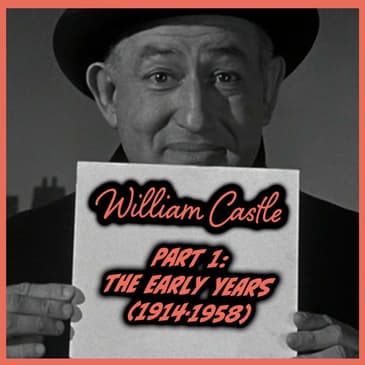
In this exciting episode of Perf Damage, Adam and Charlotte examine the remarkable life of director William Castle. This episode focuses on his early life and career in the theater and as an executive at Columbia, before he became the independent king of gimmick films.
Contact Us At:
www.perfdamage.com
Email : perfdamagepodcast@gmail.com
Twitter (X) : @perfdamage
Instagram : @perf_damage
Letterboxd : Perf Damage
Check Out our Youtube Channel:
https://www.youtube.com/@PerfDamagePodcast
William Castle Pt. 1
Adam: So Charlotte, we're back. We are Here we are again with another exciting episode of Perf Damage.
Charlotte: I'm super excited about today's episode. Yeah, me too.
Adam: I can't wait to talk about
Charlotte: this.
Charlotte: We've been wanting to talk about this for a month.
Adam: Yeah. At least since we started talking about October for sure.
Charlotte: Well, actually I think it started with a 3d. Oh yeah. Back when we did our episodes, our two-parter on films and 3D and the technology behind 'em. If you haven't listened to that,
Adam: they're good listens.
Adam: You should definitely go back. Stop what you're doing now. Go back, listen to 3D part one, and then 3D part two before continuing
Charlotte: this episode. I mean, honestly, you really don't have to
Adam: do that. I'm just saying you should though. , It's my
Charlotte: recommendation.
Charlotte: Today we are talking about William Castle. Dun, dun dun. I feel like it should be more of a, the kind of Yeah,
Charlotte: Most of the time when people talk about William Castle, it really starts in 1958 with Macco, his first film that he produced with the gimmick.
Charlotte: And that's where people began his career usually. Sometimes they might go back a little bit further when he was doing some other things when he was at Columbia, but you don't really hear a lot about. His life story or his early career. Yeah. Yeah. And he's got some fantastic stories. And we'd like to share
Adam: them.
Adam: Yes. We definitely want to share some of these. They're pretty incredible. Yes, they are. The things this guy accomplished in his lifetime and The audacity he had to pull them off was Oh, I know. Amazing. He had some coones. He did. . And a chin. Oh, that chin. A stellar chin.
Charlotte: Yeah.
Charlotte: Watch out. Jay Leno. Yeah. William
Adam: Castle had it first. Oh yeah. And it was way cooler. .
Charlotte: And that's cigar we'll learn all about it.
Adam: And where he picked that cigar up. Yeah. We'll,
Charlotte: we'll hear the stories that, and more so stay tune. Ooh.
Charlotte: So, let's start at the beginning.
Adam: Yeah.
Adam: Let's do this chronologically.
Charlotte: You know, I love a good chronological tale. It all just makes sense that
Adam: way. Yeah. All right. . Where does William Castle begin? Well, he was born
Charlotte: William Schloss Junior. Schloss is a German word for a manner, or a palace, or a castle.
Charlotte: Mm-hmm. , which is where he got
Adam: his.
Adam: Yeah, he changed his name. When he started acting on the stage. People thought that William Schloss Schloss was a strange name. Yeah. It kinda gets lost. So he changed it himself. And I think he did a great job cuz William Castle is such an iconic name now. I
Charlotte: always thought that it was a stage name
Adam: and technically it is.
Adam: It
Charlotte: is. ,
Adam: That's the translation. Yeah. The rough translation. So yeah. It could have been
Charlotte: William Palace , William Manor.
Adam: William Palace. Sounds like Jack P though. So
Charlotte: yeah. Castle's good. Yeah, castle's strong. It kind of sums up his career too,
Adam: he started off as William Schloss in New York City. He had a sad upbringing. Yeah, he did both his mom and dad died within a year of each other from separate diseases yeah.
Charlotte: He was an orphan by age 11 and was raised by his older sister, Mildred.
Adam: And he got his love of movies by going to the movies. Mm-hmm. . He would sit all day at the movies. He
Charlotte: also became a huge fan of the theater, and when he was 13, he saw Dracula for the first time on stage starring Bela Lugosi he fell in love with the play and he went over and over and over again and he would stand outside in the alleyway just say hello.
Charlotte: And it got to the point where Bela started recognizing him. So they sort of, had a little friendship there. Yeah.
Adam: Sidewalk rapport type of thing. Mm-hmm. . Yeah.
Charlotte: But that rapport turned into a little bit of something more because when they were taking Dracula on the road, Bela actually recommended William Castle as the assistant stage manager.
Charlotte: He was 15, which is crazy. , right? Yeah. But he knew the play so well that it just seemed like a natural fit. So William Castle dropped out of high school to go on the road with Dracula. Never looked back. Never
Adam: looked back, Yeah.
Adam: This is in his autobiography. I read it. And he said that the first time he saw the play Dracula, he knew what he wanted to do with his life. Yeah. He wanted to scare the pants. Scare the pants off
Charlotte: America. America, Yeah. His
Adam: famous quote. He had become quite popular as a, assistant stage manager. And he moved his way up to stage manager on a bunch of productions, met a lot of actors and actresses, and eventually worked his way into becoming an actor. And he acted in multiple very popular stage plays.
Charlotte: Interesting that he would choose to be an actor and not stay, behind
Adam: the scenes. He said he always craved attention. He told a story at the very beginning of his book when he was a kid.
Adam: He was double jointed so he could put his legs behind his head, and he called himself the Spider Boy . And he wasn't popular until he started doing that for kids and shocking them. And that attention, that that created caused a constant need for attention in him. That
Charlotte: makes so much
Adam: sense.
Adam: William Castle, the Spider Boy. Yeah. So he's rolling along, he's doing really, really well. He's young, he's successful. And then the great depression hits and he hits hard times like everybody else did. Acting jobs dried up and he realized he had to do something else with his life.
Adam: So
Charlotte: instead of relying on other people to hire him, he wanted to be the one in charge of hiring other people so that he could rule his own destiny. Yeah.
Adam: He wanted to be creator of his own destiny. Exactly. Right. That's very well put. Yeah.
Adam: And in addition to that he had a good fortune in that his father's estate started paying out when he was 25, 19 39. So he received the first of three $10,000 checks from the estate. And he decided he wasn't just gonna spend this money frivolously, he was gonna do something with it.
Adam: So what did he do? So he went to a party and he ended up meeting Everett Sloan at this party. Who, who's, who's that? Everett Sloan was part of the Mercury Players, Orson Welles. Oh, very famous. Yeah. I've heard of them. Repertory group of actors that put on plays and they basically owned New York City Right.
Adam: So he got talking to Everett Sloan and Everett Sloan let it slip that Orson Wells had just gotten a job directing his first movie and was going to vacate the space that he and the Mercury players always tested out their new plays in, which is in Connecticut.
Adam: Yes. It was called the Stony Creek Theater. And so he saw an opportunity. Yeah, he did, He saw an opportunity. He was like, Wow. I could make a name for myself by. Putting on plays in this space.
Charlotte: And people would look at that and think, Oh, that's where Orson did his plays. So this must be a good play too.
Adam: Yes. And he can draft off of the popularity of that house for all the plays and things that were put there. Smart move. Yes. So Everett Sloan is leaving the next day and before he leaves the party, he tells him that he has misplaced Orson Well's personal phone number and would Everett mind.
Adam: Giving it to him so that he could call him, because he's gonna do business. Oh,
Charlotte: William Castle misplaced the number. Yes. William Castle. Oh, you know, like you do, Right? Because it would've been written down in his little book
Adam: and, you know, Yeah. He misplaced it, you know, he, he definitely had it. Oh, absolutely.
Adam: So Everett Sloan looked at him funny and he said, You know, what's it matter? I'm going to Hollywood anyway. Right. So he gave the kid a break and he gave him his personal phone number.
Charlotte: 25 year old William Castle,
Adam: 25 year old William Castle, Producer of Broadway. Producer Broadway.
Charlotte: Yes, of course. I'm sure that's what he said too.
Adam: That is exactly what he said, . He had never produced anything in his life. So hot in his hand with the phone number. He calls Orson Wells on his personal number first thing in the morning, the next day.
Adam: Of course he does. And he says Mr. Wells, please don't hang up. I'm a producer here in New York. I produce plays and I would like to rent your space. I would like to make an appointment with you as soon as possible to talk about renting the Stony. He says, Okay, no problem. I'm leaving later today, so can you be here by lunch?
Adam: So he goes and he waits for an hour waiting for Orson Wells to arrive from lunch, . So he meets with him and they get talking about their passion for plays and, and theater. They're both about the same age too.
Adam: Yes, they are. And so they really get a good rapport going, and this is where he gets his first cigar. Orson Wells always had a Churchill in his mouth, so he offers William Castle a Churchill . William Castle has never smoked a day in his life. He said, I bet he said he had though. He never, and he graciously accepted and lit up right away.
Adam: And that began his love affair with big cigars.
Charlotte: Which he would always have later on in life.
Adam: From that point on, he smoked cigars because his, idol, Orson Wells did it. So funny that your idol would be your same age.
Adam: Who else would be a better idol than someone your age?
Adam: Yeah. Look, they do it. They've done it. So maybe I can too, you know? Yeah, yeah. Makes sense. So they strike up a deal and he rents the Stony Creek for 500 a week, for 10 weeks and Orson and him Handshake, and he's like, I'm really happy to meet you. I hope everything is successful. And he takes off in a car and they're done.
Adam: And now he has a theater, but he has no play, no play, no
Charlotte: actors.
Adam: And he spent 5,000 of the $10,000 in his pocket. Right.
Charlotte: So what does he do?
Adam: He proceeds to and successfully licenses a play called,
Adam: Seventh Heaven. It was a semi-popular play
Adam: So now William Castle has a place to put a play on. He's got a place, he's got a play. He's got the play, but he has no lead.
Adam:
Adam: So he's at another party because. He's happy, he's flying high. He's got, gotta meet people clicking into
Charlotte: place. Yeah. that's how you gotta meet people, get ideas. That's how we got Orson Wells number Worked once. Let's
Adam: try again. Work fun's. Gotta work again. Guess what? It works again. I'm so happy to hear that.
Adam: he runs into this drop dead beautiful woman, Ellen Swanky, a German actress
Charlotte: who had just fled the Nazis in Germany.
Adam: Yeah. This is 1939. They had just invaded Poland. Mm-hmm. things were going down over there. Yeah.
Adam: . So he runs into her at a party. He had seen her in, a movie. In a movie, in a German film. Yep. At least he said he did, or at least he did.
Adam: He said he did. Anyway, he's probably seen all of her film . So he approaches her, . . And he tells her about the play and he tells her about the place that he's gonna put it on and probably drops
Charlotte: Oron Wells'
Adam: name, Definitely drops Oron Wells' name.
Adam: And she agrees to be in the play. So now he's got an actress, he's got a play and he's got a place to put it on so everything's click into place, go wrong. Well, you know what goes wrong? Is that he didn't think about the unions. He gets a call from equity as soon as he starts running around saying that he's making this play, and he's hiring all the rest of the actors to be in the play.
Adam: It gets back to equity that, hey, the lead is this German lady that isn't in equity. She hasn't paid dues. So is that like the theater union? It's the theater union, yes. Gotcha. And he gets a phone call and they say, Hey, listen no Alien can be in a summer stock play because it takes away jobs from American actors unless. You can show reason that they have to be in the play because the role requires it because it was written in that original language. So William Castle, being William Castle.
Adam: Wonder how he found that out. I think the guy let something slip and he read into it. , because this all happens in one conversation. He goes, Oh wait, we're not doing seventh heaven. . We're doing this play called Dos East Neat for Kinder
Adam: It means this is not for children. Not for children. So he just came up with that on the fly and the guy goes, Oh really? I've never heard of that play. And he said, Oh yes, I brought it back with me from Germany. ,
Adam: William Castle has never been to Germany. He's never been out of New York ,
Adam: So the guy goes, Well, you know, it's Friday.
Adam: Can you have this to me by Monday or Tuesday so I can see the play and verify its origin? And he says, Oh, of course. No problem. So now he's got a problem because it's William Castle though.
Charlotte: He's, he's got a solution.
Adam: William Castle always has a problem and he always has a solution. He's got
Charlotte: a problem in his front pocket, a solution in his back
Adam: pocket.
Adam: So he now has to write a play in two days. A German play, no less.
Adam: Correct. And it has to look like it came with him from Germany on a plane. Oh, so it can't be on freshly type.
Adam: Oh, it can't be just freshly typed out. It's gotta look like it's lived a little bit. What does he do? He makes it happen. He sits down. He writes the play in 18 hours and then his solution to have it in German is to give it to the little kid that lives in the the apartment downstairs and pay him 10 bucks to have him translate it.
Adam: To have him translate. And the kid said, sure that's no problem. I'll have it for you in two or three days. And he goes, No, I need it tomorrow. And he goes, For an extra 10 bucks, I'll do it. . Love it. So he stayed up all night and he translated it for him.
Charlotte: William Castle had to love that.
Charlotte: Okay. So he is got the play translated to German, written by a. Eight year old
Adam: or whatever, translate as translated by an eight year old. Perfect. Yeah. Well, so now he's gotta make it look like it's been around a little bit. So he grabs coffee grounds, he starts rubbing 'em into it.
Adam: He jumps up and down on it. He throws it in the trash and moves the bin around. So it has that lived in, Look, it probably smelled awful. It probably looked pretty gross.
Charlotte: I wonder if the guy even read it then.
Adam: Who knows if the guy could even read German. Yeah. He just had to verify that there was probably didn't wanna touch that.
Adam: So he drops it off at the office. He gets called back the next day. He got away with it. Awesome.
Charlotte: But now he's got a play translated by an eight year old. Did he actually put that play on? That is
Adam: the play that he put on. He had to,
Adam: so now, he hires out the rest of the cast. They all go to Connecticut where the Stony Creek is, and they start rehearsals. And four weeks into rehearsals,
Adam: Ellen Swanky pulls William Castle aside and she says, Hey, I've got a problem. And she's holding this Golden Boss invitation and he goes, What's the problem? And she says, I got an invitation from Hitler to come to this celebration. And all the greatest actors and actresses in Germany are gonna be there in Munich.
Adam: Yes. So she has to go back to Germany and William Castle he's just sunk everything that he has into this play. And if she leaves, he's got nothing, right? And he says, Do you really wanna go to Germany? Do you wanna go do this for Hitler? And she says, Well, how can I not? And he goes, Just say, no,
Adam: And she goes, I never thought of it like that. And he then says, Don't worry about it, I'll handle this
Charlotte: he takes it upon himself to send a telegram to Hitler.
Adam: He sends it. Attention. Adolf Hitler, Cable to Adolf Hitler, Munich, Germany. Dear Mr. Hitler, ellen Schwake turns down your invitation. She has positively said no. She wants nothing to do with you or your politics. She will not return to Germany as long as you remain in power. Signed William Castle, Producer, director, Stony Creek Theater, Connecticut. PS she's working for me now.
Adam: Isn't that amazing? So he sends out to Hitler and for good measure, he also sends it to Bels
Charlotte: and he also takes a copy of it to every newspaper.
Adam: Yes. He got several copies of it and he would go and talk to people and if they didn't take it themselves, he would accidentally leave it on their desk.
Charlotte: Right. So she became known as the girl who said no to Hitler.
Charlotte: That became the story.
Adam: Yes. So, Basically he saw this opportunity cuz he hadn't sold any tickets. He said, Oh my gosh, this is how I do it. You drum up some
Charlotte: controversy and someone saying no to Hitler. It's a big deal. Oh yeah. At the time.
Adam: Well, it made her a hero too. Yeah.
Adam: So his phone was ringing off the hook. They were sold out instantly. But that wasn't enough for him. No, of course not. This is William Castle we're talking about. So the night before the play opens, he sneaks out he spray paints swastikas all over the Stony Creek ,
Charlotte: just adding to it, and then
Adam: sneaks back home, sensationalism, and then gets a call like first thing in the morning.
Adam: And they're like, Oh my gosh, we've been vandalized. And he's like, This is horrible.
Charlotte: He's probably still got the red paint on his hand.
Adam: Exactly. He's gotta call the police. And he's like making a big deal outta it. We need all this police presence here. The American Nazis might do something. Right. She's in danger.
Adam: So not only is it the story of the moment, because the girl who said the Hitler said no to Hitler, got vandalized by Nazis.
Charlotte: Amazing . He kicked it up and I He didn't even have to do that.
Adam: Yeah. And then so now all the social elite from New York drove out to Connecticut to see this play because it was such a big deal.
Adam: And it got rave reviews. Of course, everything. Worked out well for him. After the play premiered he received a telegram from Orson Wells congratulating him on his success so that telegram would create a camaraderie they would communicate through telegram and telephone call periodically throughout their careers. Which would actually lead up to a point where their two careers intersected once again.
Adam: He was prepping a horror. When Hollywood came knocking, ah a guy named Samuel Marks who worked for Harry Cohen, the head of Columbia. Columbia, he came and said, Hey, Harry Cohen would like to meet you.
Adam: Can you come out to Hollywood? Hey,
Charlotte: when Hollywood calls
Adam: you answer. And this was, the moment that William Castle had been waiting for? , Yes, I will drop everything I'm doing right now. He wasn't very happy with the play that he was working on. Some of the actors he said weren't working out very well, and it wasn't going anywhere.
Adam: But he had all these props and things like that. And he was frugal guy. Well he's
Charlotte: financing the stuff himself.
Adam: Correct? Yeah. So he had all the props and he wouldn't let him go. So he packed them all up. And this is the really funny thing Samuel Marks said, Hey, I just got called by Harry Cohen.
Adam: I got a fly outta here. Do you mind driving my car back to Hollywood? And of course William Castle goes, Sure, no problem. And as soon as Samuel Marks walks away, he goes, Oh man I don't know how to drive .
Charlotte: he's from New York. Yeah. He doesn't know how to drive.
Adam: So now he's got another little bit of a problem. He's gotta get to Hollywood problem in the front pocket. Exactly. , what's his solution? His solution is he hires one of those guys that drive cars from one place to another.
Adam: All right. Some guy he doesn't know. So the two of them load up into the car, he loads all the props in the back of the car. Okay. , he's moving with, with his props. It's like fake guns and, you know, axes and shackles and what's that with? Because he's William Castle. He can't just let it sit.
Charlotte: And he thought, if I'm gonna make a movie by damned, I'm gonna use these
Adam: props.
Adam: Right? So those guys are bumming across the country. You know, he's disheveled looking. He's got a beard for the first time in his entire life. He grew a beard cuz he was on the road.
Adam: They both wanna go to Hollywood. He's not paying for a hotel, he's definitely not paying or a hotel. So anyway, they get into Cheyenne, Wyoming and they get pulled over by the cops and the cop , calls in and the next thing he knows, the cops pointing a gun at him and pulling him outta the car and cuffing them.
Adam: William Castle and the driver. Yes. William Castle and the driver are now in cuffs and being escorted to jail. For what?
Charlotte: What were they doing?
Adam: They weren't doing anything. So they weren't speeding or anything? No, but the car make and model was just like a car that was involved in a armed robbery at a bank
Adam: And it was two suspects. They were disheveled looking beards. Oh, that's so perfect.
Charlotte: And how weird would it look that they've got all these fake guns and stuff like that in the
Adam: back of the car. Well, that was the other thing. They were very suspect because of that too. I forgot about that. Yeah. There's all these prop guns, which were real guns. That shot blanks, you know,
Adam: And so they got locked up. And William Castle's, like, I work for Columbia now. Harry Cohen knows me. Yeah. Don't know who that is . Come on. So he gives them their number and they call and Harry Cohen's secretary's.
Adam: Like, Who the heck are you? We don't know any William Castle. Yeah. Haven't
Charlotte: started here yet. Yet. We haven't even met
Adam: with you. We don't know William Castle .
Adam: So anyway, he sat there for like two or three weeks and then that guy Samuel, well Marks gets back to Columbia and he goes, Hey, Where's William Castle? He was supposed to be here weeks ago and Yeah. Where's my car? Yeah. The guy has my car. Yeah. And, the secretary over hears this and goes, Who did you say? He goes, William Castle, this guy I found, I was gonna introduce him to Harry.
Adam: I think he could be a real asset to us. And she goes, Whoops, . And so they called and they worked it out and they got him outta jail and. And so he finally gets to Columbia. That's incredible. Yeah. Amazing. Only William Castle could do that, right? Yeah. ,
Adam: That's amazing. Yep. So they got in some serious trouble there. But of course, Harry Cohen worked it all out. Right? That's great. Got his car back. So he gets to Columbia Hollywood. He meets with Harry Cohen.
Adam: And Harry Cohen offers him this dream job.
Adam: He is basically in a training position where he is gonna teach him every aspect of filmmaking. It's a trainee program. You're a dialogue director. One week you're an assistant director. The next week you're writing scripts.
Adam: Eventually you're going to be directing films for the studio. You'll start low in the, quick programmer ones. Right. You know, those serial series type things? Yeah. The
Charlotte: programmers, the B sides of the double feature.
Adam: Right. So it's a dream job. So what's his first job? At Columbia? I don't know. He gets hired as a dialogue director for George Stevens film. Penny Serenade.
Charlotte: With Carrie Grant. With Carrie Grant, Yeah. Actually just worked on that film. Did you? Nice. I did, yeah. New transfer and cleanup and made it look all pretty on
Adam: HD for the first time. Right.
Charlotte: Yeah. The film has the most incredible earthquake sequence about 20 minutes in.
Charlotte: It's pretty spectacular. But the message of that film is weird. If you've ever seen the film , it's about a couple who gets married. They wanna have a baby, there's an earthquake, she's pregnant, she loses the child, so then they adopt a child, . And I don't wanna spoil it if you haven't seen it, but let's
Adam: just say it doesn't go well for the child.
Adam: Here's the
Charlotte: thing, The second child dies off camera and you only find out in a letter that they write to someone and then they just go and get another one. So in the film it's like the message of the film is, well, if you lose a child, you just get another one. You can always get another
Adam: one. It happens twice.
Adam: Wow. Very strange. It's a strange film. Yeah. But, but early Carey Grant, this is before early. Yep. Before he was a real star, like a superstar. Yeah.
Charlotte: And George Stevens, great director. And his son, George Stevens Jr. Super nice and carrying on his father's legacy.
Charlotte: So he worked on that. But he's not in
Adam: the credits? No. He was uncredited dialogue director. A lot of them didn't get credit, but Okay. Yeah, cuz I worked. Plus he was a studio guy. It was like, for a long time studio executives never got credit for the movies that they worked on.
Adam: Right. You worked for the studio. Well,
Charlotte: it was up to the producers back then who would get credited and who wouldn't. That's why there's so few credits. It's not that there were less people per se, in the departments, which of course there were, there's way more people working on a production now.
Charlotte: But the producers would decide who gets credit and who
Adam: didn't. Right. So anyway, his first job, Penny serenade. , working for George Stevens and I did not know that. Guess what happens? ?
Charlotte: Well, I'm gonna guess he had a problem.
Adam: He's William Castle, after all,
Charlotte: Don't know what could go
Adam: wrong his first day on set.
Adam: His first day. Yeah, his first day. He's working with Cary Grant. and, During a take he makes a little bit of a mistake. Little Oopsy. He says, Cut on George Stevens set. Why did he say cut? Because he thought that Cary Grant screwed up the line.
Charlotte: Oh. So he thought he was saying, Nope, this is wrong. Yep. Cut. He probably thought that was his job to do
Adam: that. Well, guess what? After that he never thought that was his job to do that again. . So what, Short Stevens comes off this crane that he was. He takes him over into a corner and he screams at him and he says, No one calls cut on my set except for me.
Adam: You're fire
Charlotte: Oh,
Adam: that's so great. This is a few after first day. First day, a few hours after reporting to set , he screws up majorly poor William Castle. So luckily Carrie Grant being a good guy, says, Oh, no, no, no. Hey, that was my fault. I did screw up the line. I screwed it up., George, hire this guy back.
Adam: He's good. He's good. I've really enjoyed working with him. I think he's bringing something to the Oh, so nice. And so Carrie Grant intervened and saved his job.
Charlotte: That's so nice.
Adam: Carrie Grant. What a nice guy. That is so great. Archibald Leach. Archibald Leach.
Charlotte: That's Carrie Grant's real name.
Charlotte: If you didn't know. Wow. Well, that's a way to start your career in Hollywood. first getting jailed on the way out.
Adam: Yeah, William Castle was always getting into trouble too. Yeah. One time he took a vacation. He'd been working there for two years. He hadn't had that vacation, and he's like, You know, , I'm working on editing now.
Adam: No one's gonna miss me. So he just decides to leave for two weeks and he goes back to New York and he doesn't tell anybody. Doesn't tell anybody. He doesn't tell, His boss doesn't Tell Harry Cone, most importantly. And so he goes to this play that opened up, and he really wants to see really popular in town.
Adam: So he goes to Columbia's office there in town, and he gets a comp ticket from them. And he shows up and he's sitting there and there's an open seat next to him. Guess who comes and sits right next to him. Who? Harry Cone
Adam: Of course, they're the studio seats, of course. somebody from the studio is gonna show up and bust him. Right. But guess what? It's his big boss that bust him. Go big or go home. Yeah. All he could do is beg for forgiveness. At that point, he's like, Look, I didn't think you would miss me. And he's like, You can't be here.
Adam: He's like, Can I at least stay until the intermission?
Adam: But Harry Cohen ended up letting him stay for the whole show. Yeah. Yeah. Oh, that's so funny. Is that hilarious? He just decided on his own that he was just gonna go take a two week vacation like he did, and that no one would miss him. But I think in a way those are the things that Harry Cohen started to like him for mm-hmm.
Adam: was that he was ballsy and took chances to Yeah. And he took his own initiative and did things. Everybody else was too afraid of him, Right. To do
Charlotte: that kind of stuff.
Adam: So they became really close friends. Like he became kind of like one of his right hand men.
Adam: There's another really funny story too, about how he gets his first job directing. So there's an executive dining room, and Harry Cohen would feed all of his people in this executive dining room because he could keep all his executives to a one hour lunch. . It was a mandatory one hour lunch with him, and after 60 Minutes was up, he would stand up, push his seat out, and he would tell everybody to get back to work.
Charlotte: He could probably control the whole
Adam: two martini lunch. The two martini lunch. Yes. Wasn't that a thing?
Charlotte: Oh yeah. Yeah, he could probably keep that under control.
Adam: But I guess the dining room was amazing from what William Castle said, wonderful steaks and beautiful French food so what he would do, because he wasn't actually important enough to be in the meetings, is he would go in before the meeting and have the guy cook him food and he would eat it in the kitchen with that guy while those guys had their meeting so he could eavesdrop, right?
Adam: And so the funny thing was Harry Cohen found out about this because the cook eventually told him this guy eats with me every day and he's just listening to you guys. And so he sets him up, He tells the cook. You tell him to sit in my chair. And you know, he's here early so I won't be in here.
Adam: There's no way that I'll bust him in it. Just sit in my chair. So the chef laid out only one space in the dining room and he's like, you know, Harry's busy. I heard he's not gonna be here 'til late. So you sit in his chair today, you know, it'll be fun, it'll make you feel good. And so the second he sits down and has his first bite and he's putting it up to his mouth, Harry Cone burst in Ireland,
Adam: And he goes, I see a major self comfortable Castle . And that's how he told him that he was getting his first directing assignment was he , played a joke on him to make him feel like he was gonna get fired. And then he is actually getting his first job. Aw, that's awesome. Isn't
Charlotte: that great?
Charlotte: That's a great story. Yeah. Yeah. I mean, you kinda have to wonder how many of these stories are actually true. You know, how many Hollywood stories.
Adam: Yeah, I feel that a lot of them are maybe embellished, he has a lot of stories where he runs into this famous person or this famous person.
Adam: You gotta embellish the story, but I have a feeling that these Harry Cohen ones are pretty real. Yeah. They had a really good relationship and he ended up being his right hand man towards the end of the, They seem grounded in reality. They do. And that's definitely something that would happen.
Adam: I mean, I got busted in the big bosses office playing rock band once, ,
Charlotte: Do you tell?
Adam: Yes. At the studio that I worked at I was in a rock band group when rock band was popular
Charlotte: there was a contest, right? Yes.
Adam: There was contest coming up. So we were practicing You're rock band. And he was never there until later, later the head of the studio, the head of the studio was never there until later in the day.
Adam: So I was in a group with his two assistants and so we were all practicing. In his office, in the head of the studio, the head of the studio walks in on us early unannounced. And he says, Oh, so this is what happens in my office when I'm not around. Of course
Charlotte: you're in his office too.
Adam: Well, it's a huge office. The space was perfect. So what happened? We instantly stopped playing and I started packing things up right away and apologizing and things like that, and he started cracking up and he was very gracious about it. Yeah. But We got busted like cold.
Charlotte: So that's your own William
Adam: Castle story?
Adam: That's my William ca. Well, I didn't get a job directing a movie after that though, so No. Well, you didn't srop enough. That's true.
Charlotte: So what was his first directing job?
Adam: His first job was a movie called Black Marketing 1943. It's pretty quick. . Yeah. I mean, you know how he works. He's pretty fast guy.
Charlotte: No, I mean from getting to Hollywood to then directing your first film.
Adam: Well, I mean, that's the position they put him in though. Yeah. They, they wanted him to direct.
Adam: Yeah. Since he was directing plays, plays and things. They wanted to teach him all of the ins and outs, Right. First, but ultimately it was always for him, he was on the path to write and direct. Right. By the end of his career at Columbia, he was directing six pictures a year for, for them.
Adam: So what kind of movies did he
Charlotte: direct there?
Adam: He did a lot of those b pictures and a lot of series. He did several of the Whistler, The Whistlers, right? Yeah. The Whistler films. He did a lot cheap westerns and things like that. He actually directed a 3D film.
Adam: Really? Yeah. .
Adam: Four T 1953. That was not one of the movies that we covered in our 3D episode though. No, it was not.
Charlotte: He directed a film with Robert Mitchum. Oh
Adam: yeah. At Columbia. Was early in Mitch's career.
Charlotte: Yeah. 1944 when strangers.
Adam: It was one of the pictures he was most proud of during that period.
Charlotte: That was the first big role for Mitchum
Adam: Yeah. He had a pretty good Eye for talent,
Adam: but a lot things, were films that there were like $70,000 movies that he would shoot in a week and a half. Right. I didn't realize that even back then on , the cheapies, they only had like 13 days to shoot a film.
Adam: That's what a lot of these independent films are shooting right now.
Charlotte: Republic Pictures worked like that. Yeah. They would start production on a film in one month and it would be released the next month.
Adam: That's pretty amazing. It is, Especially when you look at some of the stuff the lie Deckers were pulling off in that time period, you know?
Charlotte: Yeah. They were the effects Ws that worked with Republic Pictures and did all their miniatures and special effects works. And they really elevated those movies.
Adam: Yeah.
Adam: So there's another story that happened while he was at Columbia. Is it a good story? It is a good story. So during his tenure at Columbia, after he'd been directing for quite a while Harry Cohen decided that he should start looking for new material too, because he started complaining about the scripts that he was getting,
Adam: harry Cohen said to him, Well, if you don't like the scripts I'm giving you, go out and find your own. So
Charlotte: which is sort of a shut up and , take it. But he took it literally.
Adam: Of course. It's William Castle. Yeah. So he's cruising around New York and a buddy of his is reading this book and he hands it to him. He's like, I just finished it. It's a great book. You gotta read it. And it's called If I Die Before I Wake. And he read it and he was like, Wow, this is the exact kind of thriller that I'm looking for.
Charlotte: Was it one of those
Adam: little pulp novels? Absolutely. It was a dime novel. Yeah. So he calls up the publisher he gets it for a steal, and he takes it back with him and he writes a treatment and he shows it to Harry Cohen. He's like, This is what I want to do.
Adam: It's is great. And Harry Cohen reads it and he's like, Yeah, it's good. You know, I'll give you $70,000. Go, go off and make it. And he's like, No, I want a real actor. I want this one to be, an a picture. He doesn't wanna make a B picture. He doesn't wanna do a b pictures.
Adam: He thinks this material is better than that. And, Harry Cohen goes, No, not gonna do that. It's not that good. You didn't spend enough money to license it, so it's obviously not good enough. Right. So, he gets really mad. He calls up his good buddy, Orson Wells.
Charlotte: Oh. Who he's been keeping in contact with,
Adam: I'm sure. Yep. They've been keeping in contact. And he goes, you know, remember when you said you wanted to work with me somewhere down the line? And Orson Wells goes, Yeah. He's like, Well, I got this material, I'd love for you just to assess it. I wanna direct this picture.
Adam: So he sends him the book and he also sends him his treatment. Orson read the book. He goes crazy for it.
Adam: He's like, Oh, this is it. We're gonna work together. This is gonna be great. And he doesn't hear from him for a couple weeks. Then he goes back to. Harry Cohen and Harry Cohen goes, Oh my gosh, you won't believe what I just did. What? I signed Orson Wells for his next picture. And he goes, What? Yeah, he's got this picture.
Adam: It's called Lady From Shanghai. And he goes, Okay, great. So then Orson shows up in his office and he's like, Hey, I just signed this big deal. It's an a picture. I got $2.5 million for this thing and we're gonna do it. You're gonna produce it. And he goes, Oh yeah, what's it called? He's like, it's called Lay From Shanghai.
Adam: And he hands him his own treatment that had been expanded out to 35 pages and had Orson Well's name on it. And he had
Charlotte: retitled
Adam: it from, Yes If I Die before I Wake to Lady From Shanghai, and which is a better title. Anyway, So in that moment he was filled with Fury because he stole his project from him, the project that he found, cuz he wanted to direct it.
Adam: Right. But he also felt justified because he knew it was good. He knew it was good. And Harry Cone only signed him for that because he was Orson Wells. So he signs on to be the producer of Lady from Shanghai and he's like, Oh, I get to work with my buddy.
Adam: This is gonna be fantastic. And right from the beginning it is a nightmare. Well, it's Orson Wells. Yes. He was the boy genius for a while and then he was the on font. Terrible. Because he was just crazy. So Wells of course goes well, we have to shoot this in Mexico.
Adam: Why? Because we gotta shoot it on the Zaka, which is Earl Flynn's yacht . And he goes, Okay. So I want you to go tomorrow down to Mexico to rent Errol Flynn's boat for a month, and we're gonna live on the boat and we're gonna shoot the movie on the boat. How big is this
Adam: it's a yacht. It's a beautiful giant yacht. Giant yacht. Yeah. And a flyn basically lives on it at that point. Just going around and partying and listening to yacht rock. Yeah. Told Yacht Rock. Yacht Rock of the Day. Yeah. the yacht Rock of the Day. Well, would the yacht Rock of the day be, I don't know.
Adam: I'll have to get back to you on that. Also
Charlotte: Orson Wells was having marital issues with Rita Hayworth at the time, so I'm sure that
Adam: Oh, yeah.
Adam: He promised was gonna star in the film. Right. Which was another reason that Harry Cohen gave him so much money. Yeah.
Charlotte: I think they were split at the time, and this film is when they got back together for a, a few months.
Charlotte: Although that didn't go well, because they split right after the movie was done shooting. They split for good.
Adam: That's a bummer. Yeah.
Charlotte: Don't worry. They both remarried. .
Adam: So William Castle gets down to Mexico and he meets up with Earl Flynn. And a flynn's like you, what?
Adam: You're gonna rent my boat for a month? That's a really long time. And he quotes some exorbitant amount of money. I think it was like a hundred thousand dollars at the time and he calls Orson up. He's like, He wants a hundred thousand dollars for this. This is ridiculous.
Adam: In Orson goes, It has to be the zaka. Pay him whatever he wants. . So that really pissed William Castle off because a hundred thousand dollars is more than he got to shoot his last feature at Columbia. Right. And this is just for a paying it to rent a boat. And the other thing is AOL Flynn said that they can rent the boat for that amount of money, but he has to pilot the boat.
Adam: No one else pilots his boat. So he's the only captain. He's the captain now, . Okay. Basically cuz he wanted to party with Orson Wells for a month. Right, right. You know,
Charlotte: it's like you're not going out there without me.
Adam: on the za on the za. So they're on the za, they're what could go wrong, floating around in Mexico and .
Adam: William Castle starts keeping this diary . It kind of sets what kind of mind space Orson Wells was in at the time too. Uhhuh And it definitely shows that William Castle's like, Oh my gosh, I can't believe this guy.
Adam: He's absolutely nuts.
Charlotte: Well, this is his first big film, so he's coming to it with fresh eyes.
Adam: November 5th, hot and sunny. Orson changed his mind, his whims and demands many. He has spent the first week picking locations, then changing his mind and picking others . November 12th, Orson started rehearsing actors memorizing their lines, arrive on set to find wells, smoking his perial cigar, and doing a complete rewrite, November 17th, cloudy and the heat oppressive first day of shooting on Lady from Shanghai.
Adam: The dark clouds seemed like an evil omen. Orson was rehearsing a scene with Rita Hayworth on the af. We were 20 miles out in rough waters. Earl Flynn was at the wheel trying to keep the za on a straight course. Charles Lotton Jr. The cameraman. The cameraman. That's awesome. Charles Lotton Jr. Was the cameraman.
Adam: A filter to his eye was waiting for a break in the clouds. Orson was ready to make the first take. Sam Nelson yelled for quiet as Orson took his place next to Rita. The sun had now come out. I was standing next to one of the camera assistants. He was working bareheaded, and the sun was beating down with fierce intensity.
Adam: The mixer yelled, Speed, take one, and waiting a beat. Orson said his first line. The camera assistant started to stagger reaching out. I tried to help him horrified. I watched him turn blue as fighting for breath and clutching his chest. He dropped to the deck. Oron and crew members rushed to his aid, but it was too late.
Adam: The assistant cameraman was dead, a fatal coronary. a Flynn as captain, took instant command, pouring himself a stiff drink. He took a hefty swig. bring me a duffle bag. He ordered what? And swaying against the pitching. Zaka announced we'll bury him at sea, opening the duffle bag. He staggered toward the dead camera assistant, put him in the bag and sewed it up.
Adam: Orson ordered me to go ashore as fast as possible and notify the Mexican authorities.
Charlotte: So wait, are you saying a Flynn threw the guy overboard?
Adam: A Flynn threw the dude overboard. He buried him at sea. The hero assistant got tossed into the Mexican ocean
Adam: Isn't that amazing? First day of shooting, not even a single , take in the can. Someone dies on a plane immediately.
Charlotte: Drunken Captain a Flynn .
Adam: I love that. He took bag, I took immediate command by pouring himself a drink. . Oh wow. Sounds amazing. And it, it just gets better from there.
Adam: That's some diary. Yeah. He almost died on the set. Who? William Castle. At a certain point they're finally done shooting. They spent two or three months on the ship cuz it went over budget. And overtime, that's tos and wells. Course of the, it's and you know, the budget balloon.
Adam: Unbelievably. And that was only the first part of the film that they were shooting on there. Right. There's still a lot of the film to shoot. So Orson goes back to Hollywood and leaves William Castle to do a bunch of second unit.
Adam: He's like, You're gonna direct second unit. And he's like, In a way that's cool. I'm directing second unit, but this sucks cause I want to go home. And he started drinking from this brook and he got a bug in his stomach and he almost died.
Adam: He was hospitalized. So after almost dying, William Castle decides that he needs to make a change, That something that Columbia's not working out for him. He's tired of being in the B pictures.
Adam: He got
Charlotte: a script
Adam: stolen. He got a script stolen by his supposed friend.
Adam: So he goes back after making this movie lady from, she. The biggest movie of Columbia for the year. Mm-hmm. And then instantly goes right back to making Whistler Part 10 or something like that. Right.
Charlotte: Goes back to the same, Same, Yeah. So it, it didn't change his,
Adam: it didn't change his trajectory at the studio.
Adam: Right. Cause Harry Cohen saw him as his faithful guy. They could pump out all these
Charlotte: pictures. Well, , people talk about actors getting typecast, but I think that we all get typecast, especially by your bosses. You know, if you get hired on as someone's assistant, it's really hard for you to break out from under that person because they will always see you as their assistant, no matter how much you grow or learn. It's hard, you know? I think everybody kind of has that, it's hard to see your younger sibling as an. , you know it's kind of hard to break that kind of thing. So the only way to break that is to leave. Yeah. And do something else, to start over somewhere.
Adam: Right.
Adam: Yeah. That dynamic is really set in too. Yeah.
Charlotte: So yet again, he wants to be the master of his own destiny and not be the bee movie guy for Columbia. He wants to do his own thing, find his own content, make his own films.
Adam: And he's proven that he can find that.
Charlotte: And he knows he can.
Charlotte: Yeah. Cause that was, you said Columbia's biggest film that year,
Adam: right? Yeah. Most expensive film for sure. Yeah. .
Charlotte: So you, when you got movies like Orson Wells. Yeah.
Charlotte: So he came back and he had big dreams, but
Charlotte: He kept renewing his contract every couple of years, every three years or so at Columbia.
Charlotte: And things never changed.
Adam: Yeah. He worked for another company too, he left Columbia for two years and then came back.
Charlotte:
Charlotte: He didn't wanna work for somebody else. He did to pay the bills but that all changed in 1955 when he was walking down the block and he goes past a movie theater and he sees a line around the block, huge line waiting for this movie, which was bunch of people were waiting to see it and he thought, What is this? This is the kind of thing I need to make. I wanna make this kind of movie where people are lining up.
Adam: And he saw most of them were kids too,
Charlotte: so he goes to see it and it's just a shock with his wife too. Yeah. Who loved it. Yeah. So they go see it and he thinks I can make this kind of
Adam: thing.
Adam: Yeah. Absolutely. He saw that it was made for a budget. Yeah. Inexpensive. He'd been making movies along that line. Yeah. For 15 years. Because it was French, they pushed the envelope on what they were showing too. Mm-hmm. , he saw that things were going a little bit different in other places and wanted to be on that cutting edge.
Adam: Right. Also, he saw that, things were getting a little more violent. And he saw that violence was getting the reactions that he wanted to be getting from audiences. Right.
Charlotte: And you also had TV out. So movies had to do different things to draw the crowds out of their houses.
Adam: That's probably one of the major reasons why movies started pushing the envelope from what they could show. Absolutely. It was formats. TV was safe and, Yep. Wholesome. Yep. And then now you could see more. dar things on screen. Mm-hmm. .
Charlotte: So he sees that movie and he goes home
Adam: he discusses with his wife.
Adam: He's like, Hey
Charlotte: If I find another thing, how would you feel about us
Adam: mortgaging our own, moring our
Charlotte: house to pay for a film? Yeah. Take a chance. Gamble. I know how to do this. I've been doing this for 15 years and you
Adam: know, I can bring it in on budget, so Yeah.
Charlotte: You know. Yeah. , you know William Castle's bringing in on budget?
Charlotte: Yeah. So she says, Sure. She
Adam: said, I'll gamble on you anytime. Yeah.
Charlotte: Yep. So he goes out and he
Adam: finds a book. Yep. The Marble Forest. Yep. And he options it and he hires a buddy to Yep. To co-write it with him. And they write a script based on that book. Mm-hmm. They put together $70,000. And they produce a movie called Macabre.
Charlotte: If you've never seen Macab
Charlotte: Animals share the synopsis really quick here.
Adam: Macab 1958 by William Castle. 72 minutes after his wife and her blind sister have died under his care. A doctor's small daughter is kidnapped and reported as buried alive, and he's given just five hours to find and rescue her.
Adam: Yeah.
Charlotte: So this film comes out but he can't just release a movie. He wants to stir up some controversy just like he did when he did his first play. So he's going back to his roots when he started. I need to get people to notice this.
Adam: Well, this is his own money he's gambling on here too.
Adam: Well, it
Charlotte: was with the play too. Yeah. And he knows there's no bad
Adam: press. Yep. Brings audiences in.
Charlotte: So he heard on the radio that Lloyds of London will ensure anything. So he gives him a call and he says, I want you to ensure everybody in the world.
Charlotte: And they hang up on it . So he goes to London, He actually meets with them and he is got a, much better pitch this time. So he pitches to them.
Charlotte: Originally they agreed to pay out 50 people
Adam: Worst case scenario. How many people, William, do you think are gonna die while watching your movie?
Adam: Yeah. So
Charlotte: it ended up being five,
Adam: yeah. That they came down to. They had to bring him up though. He's like, no one's gonna die. Then they were settle and then he said three.
Charlotte: And he was like, Yeah. So they settled on five and because he had spent all his money on the movie, he couldn't actually pay , the $5,000?
Charlotte: Yeah, the 5,000. So they split the payment over two years. So that he could make it back. So he's got this great gimmick now he needs a
Adam: distributor. Right. So he goes to all the big guys, He goes to the Warner Brothers, he goes to Columbia where he worked for years and years and years.
Adam: Mm-hmm. , They all pass.
Charlotte: Well, they
Adam: just offer him. They offered to buy it, Columbia offered to buy it, but they offered him $70,000, which would just bring him back to even minus the 5,000
Charlotte: for the insurance policy.
Adam: Yes. Minus the 5,000 out of pocket that he's already come.
Adam: So he's like, No, I think it's worth more than that. And they, they weren't gonna budge again. . So then he goes to Warner Brothers. He pitches them the whole gimmick and they pass. So he's still looking for a distributor and meanwhile, his agent calls him up and he goes, Hey, did you hear? Warner Brothers is using the same gimmick that you pitched them?
Adam: And he goes, What? Yeah, it's
Charlotte: some theater down in San Diego
Adam: was offering instead of Lloyds of London though, it said Warner Brothers, Warner Brothers would pay you. Right? Yeah. So he calls up Jack Warner and threatens to sue him. And Jack Warner goes, Oh, I'm sorry. I didn't know that was your thing.
Adam: Some, junior guy came to me and pitched me this idea and I thought it was great. So whoever he pitched his movie to right, for distribution at Warner Brothers was not one of the high up guys. It was one of the juniors. And that guy stole his idea and then pitched it as if it was his own to Jack Warner.
Adam: And Jack Warner said yes. So he offered to buy the film. For, 90,000 or something like that, which would've turned to profit instantly for him. Yeah. But he felt that it was worth more. And he said, No, thank you. And he didn't end up suing him? No, they, well, they stopped using the thing.
Adam: Right. So then he went to Allied artists, which wasn't a major at the time. And he pitched them the idea and they loved it. They're always looking for content and they said, How much money you have in this? And he lies to him and he says, $250,000. And the head of allied artists goes, Yeah, right.
Adam: I don't think so. But here's the deal. I'll pay you $150,000 for it and I'll cut you in on 75% of the profit. That's a lot. That is a lot. Yeah. And before he could change his mind, William Castle said, You got a deal. . And so yeah, Macab became a, major hit. He doubled his money on it.
Adam: Yeah. He
Charlotte: went and personally handed out insurance policies to people going in the theater.
Adam: Yeah. . No wonder he did so much personal promotion because the more money that movie turned, he had 75% of the profits. Mm-hmm. .
Charlotte: Well, and at the time one of his idols was Alfred Hitchcock, who, when television came out, became a personality.
Charlotte: With Alfred Hitchcock Presents appearing in it and branding it. So William Castle wanted to create his own brand, which makes sense. Yeah. Yeah. So that people would know. This is a William Castle. Right off the bat, He, wanted to be a personality PT Barnum was one of his heroes too, so, Right.
Adam:
Adam: It's all about the show. So he started inserting himself like Alfred Hitchcock did into the trailers for his films. Yep. And he would always appear at the beginning of his films. Mm-hmm. Actually in the film at the beginning, not as a character, but as himself. Yep. Introducing the film.
Charlotte: You gotta warn the people. And I think Hitchcock might have taken some cues from him because Macab had the whole gimmick in 58. Psycho came out two years later, and there was the whole, once the movie starts, you can't be admitted.
Charlotte: And he had some other things around it too, but not spoiling the ending and things like that, which are all very William Cassie things. Not something that Hitchcock had done before. Yeah. So,
Adam: Well, he always aspired to have the cache that Hitchcock did. I mean, everybody did the major backing by studios. The, you know, the, a tour kind of personality.
Adam: The genius label. Well,
Charlotte: Hitchcock was able to, walk that line of art and business.
Adam: So, how about we split this into two pieces? What do you think? Yeah, I mean, we, we only got up to, you know, the gimmicks. The gimmicks. We started the GIMs stuff that everybody knows already. Yeah.
Charlotte: Yeah. I didn't think that we were actually gonna do that, but we rambled on a little too much.
Charlotte: We don't like to keep people.
Adam: There's too many good stories
Charlotte: though. There are, so, yeah. Let's stop this here and pick it up next week. What do you say?
Adam: Yeah, I think so cool. We'll do that. We'll talk about his later years.
Charlotte: We'll go in depth about some of the gimmicks,
Adam: his deal with Paramount Pictures.
Adam: That's where he ended his career. He actually got a major output deal with a major
Charlotte: studio and there's a huge film that he made that I don't think a lot of people realize he had anything to do with.
Adam: Yeah. Oh, we gotta talk about that at length. And I really wanna talk about his last film Shanks.
Adam: Absolutely. Uh, Shanks is a really interesting film. .
Charlotte: Cool. Well, join us next week for William Castle, part two. Unexpectedly. Part two.
Adam: Yeah. This one ran on. This is good. I just got really into talking about what castle. Yeah. He's
Charlotte: just such a great character and again, he's got so much more to him than a lot of people give him credit
Adam: for.
Adam: Yeah. And I love how everything's an angle for him. There's always an angle. Well, when you're, There was a lot of stories I didn't tell about how he got acting jobs and stuff like that, we'll
Charlotte: tell of more problems in the front pocket and solutions in
Adam: the back. In back. Yeah. And if you get a chance, read William Castle's autobiography, Step right up.
Adam: I'm gonna scare the pants off of America. It's really, really good. And he's pretty humble in it, there's not a lot of those stories where you're like, Yeah, right. .
Charlotte: If you wanna get ahold of us, we have an email. It's perf damage podcast gmail.com. We're also on Twitter at perf Damage. Can check out our letter box where we list every film that we mention in every episode.
Adam: Oh, and by the way, it's up to date.
Charlotte: Wow. Let's give him a round applause, guys. He actually did it.
Adam: Hey, you've been on me to do that. So yeah. Hey, you were the one that
Charlotte: said you would not to it.
Adam: I would do it. Yes. You put it on
Charlotte: yourself. I did. Anyways, That's up to date has everything. The vampire ones. Oh man. Oh, Charlotte
Adam: got me good on that
Charlotte: one. Yeah. You know, and my mom actually yelled at me because I didn't include some of her favorite vampire films, so I'll include 'em now.
Charlotte: Those are Dracula. Dead and Loving it. Oh, Mel Brooks. Yep. Yes. Oh yeah. She loves Mel Brooks. And then the other, Love it. First Bite, 1979.
Adam: With George Hamilton. Yeah.
Charlotte: Dracula. Your favorite pain in the neck is about to bite your funny bone.
Adam: You know what's funny about that Dracula too? What is, He's got like the deepest tan anyone could ever have.
Adam: Yeah. George Hamilton is the most tan human being on the planet. That's, And he played Dracula. Yep. How do you get
Charlotte: the tan
Adam: self? Oh, you think so? Yeah. Yeah. Had to be right? Yeah. , it
Charlotte: turned you those weird dark colors. , weird orangey.
Adam: If you leave it on too long. I think he left it on, He just left it on.
Adam: He never washed it off. He wait me
Charlotte: too long. He just, he just kept reapplying,
Adam: reapplying. So what you're saying is that inside of his coffin
Charlotte: is a mess. Oh, it's, Oh, it's gross. Yeah. Actually the, his coffin could actually be a tan airing, you know, like UV light. Yeah. Can they, can they go under,
Adam: They can't go under UV light.
Adam: That's what kills them. Yeah.
Charlotte: Maybe it's like some kind of crazy moonlight thing that I don't know. It's a moon tan. It's a moon tan. So we're gonna off topic here. Anyways, thanks for joining us and tune in next week for William Castle, part two.
Adam: The later years.
Charlotte: The famous years. The big years
Adam: for that. The gimmicky years . All right. Well thanks for joining us here on, On Perfect Damage.
Adam: Who knows if the guy could even read German. Yeah. He just had to verify that there was probably didn't wanna touch that.
Adam: Yeah. So anyway, he gives it to the guy guys, the dogs are going nuts. Get out.
Charlotte: They love William Castle,
Adam: man. Come. You guys were sleeping five minutes ago. It's their gimmick.
Charlotte: One dog wants to shove their face inside the other dog's mouth, their whole face.
Charlotte: Fucking dogs. Okay