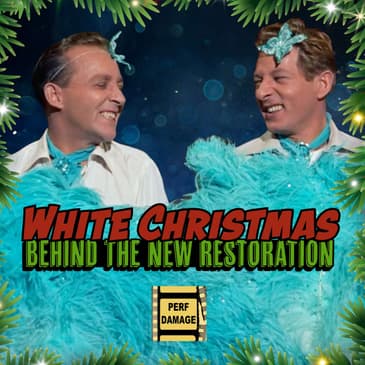
Perf Damage returns to White Christmas for a third time, but in this episode, we're diving deep into the dazzling 2024 restoration that breathes new life into this holiday classic. Join us as we unpack the unique challenges of restoring a VistaVision film, from tackling flickering and stabilizing stock shots to managing color breathing and other quirks of the original negative. We’ll reveal how crucial detailed notes from past transfers were in shaping this restoration, helping to capture every frame’s brilliance. And because this ambitious project involved so many skilled hands, we’re giving special shoutouts to everyone who played a part in making this restoration a reality.
Ready to uncover the secrets behind this restoration? Press play and celebrate White Christmas like never before!
Contact Us At:
www.perfdamage.com
Email : perfdamagepodcast@gmail.com
Twitter (X) : @perfdamage
Instagram : @perf_damage
Letterboxd : Perf Damage
Check Out our Youtube Channel:
https://www.youtube.com/@PerfDamagePodcast
[00:00:00] Welcome to the audio only version of the Perf Damage podcast.
[00:00:04] We highly recommend checking out our YouTube channel for the full experience where you'll see visuals and details that we might not fully explain here.
[00:00:12] Otherwise, sit back and enjoy the episode.
[00:00:16] Welcome back to Perf Damage.
[00:00:17] Welcome.
[00:00:18] This is the show where we examine the forgotten histories of Hollywood.
[00:00:22] And sometimes talk about restoration stories, which is what we are doing today.
[00:00:28] What restoration story are we talking about today, Charlotte?
[00:00:31] Today, we are going to talk about the restoration of White Christmas.
[00:00:35] One that I oversaw at the end of last year, spilling over into the beginning of this year.
[00:00:42] And we're just talking about it now because the...
[00:00:45] Disc is about to come out.
[00:00:46] Disc is about to come out.
[00:00:47] Yeah.
[00:00:48] So, I know what you're saying.
[00:00:50] They talk about White Christmas a whole lot.
[00:00:52] Yeah.
[00:00:52] If you are a subscriber to this channel, you may have heard about White Christmas once or twice before.
[00:00:58] What more could we have to say?
[00:01:00] Well, we're not going to do did you knows.
[00:01:02] We're staying away from those this time.
[00:01:04] I feel like we have them covered in the other two episodes on White Christmas.
[00:01:08] Yes.
[00:01:08] So, we're going to focus, laser focus, on the restoration this time.
[00:01:14] We'll talk about what sources were used, what problems we ran into, and all kinds of fun stuff.
[00:01:21] Maybe you'll learn some stuff.
[00:01:23] Maybe you won't.
[00:01:25] I don't know.
[00:01:26] Well, either way, if you want to know more about White Christmas, stay tuned.
[00:01:41] Hey, movie lovers.
[00:01:42] I'm Adam.
[00:01:43] And I'm Charlotte.
[00:01:44] And welcome to Perf Damage.
[00:01:47] We're a movie-obsessed husband and wife team who work in the film industry.
[00:01:51] I oversee film restoration at the oldest studio in Hollywood.
[00:01:55] And I bring the inside track from film development and production.
[00:01:58] And we love to explore the hidden tales of movies past and present.
[00:02:03] So, join us for a cinematic journey like no other.
[00:02:07] From classic gems to examining the art of the double feature, this is Perf Damage.
[00:02:15] Popcorn pop, wine at the ready.
[00:02:19] Let's press play.
[00:02:28] So, before we get into the nitty gritty.
[00:02:31] Yeah.
[00:02:32] You told me a story about what people would say to you.
[00:02:37] So, first question I get asked anytime I see people, they want to know about what restorations are in the pipeline.
[00:02:42] Yeah, what's going on.
[00:02:43] And all last year, anytime I saw people, I'd say, hey, I'm working on White Christmas.
[00:02:48] Because, of course, I'm going to brag about that.
[00:02:50] That's like the coolest project ever.
[00:02:53] And I swear, every single person would just pause and say, why?
[00:03:02] Why do you need to do a new restoration of that?
[00:03:05] Well, because the last one was so good, right?
[00:03:08] The last transfer of the Blu-ray is amazing.
[00:03:10] Blu-ray is beautiful.
[00:03:12] Why do you need to do a new transfer?
[00:03:15] And, honestly, at the start of the restoration, you know, I didn't really have a whole lot of good zing moments for him right away.
[00:03:23] Because I agreed.
[00:03:25] Beautiful restoration that was done before it was from 2011.
[00:03:28] They had used the 35mm VistaVision IP.
[00:03:32] It looked great.
[00:03:34] So, part of me going into it was kind of like, can I do?
[00:03:38] Can I make this look better?
[00:03:39] Can I do any better than this?
[00:03:41] So, you know, I was a little trepidatious going in.
[00:03:43] But, you know, okay, what drives a decision to do a restoration?
[00:03:48] Well, technology.
[00:03:48] Because if you're asking that question, you know, obviously there's some reason to do it, right?
[00:03:53] Well, first, we needed to scan the negative.
[00:03:56] The negative had not been scanned.
[00:03:58] We needed to scan it at 6K.
[00:04:00] Also, the anniversary was coming up.
[00:04:04] So, this year, we're in 2024 right now.
[00:04:06] The disc is about to come out.
[00:04:07] This is the 70th anniversary of White Christmas.
[00:04:11] Also, the 70th anniversary of VistaVision.
[00:04:14] You knew what I was going to say.
[00:04:15] Yeah, Charlotte's favorite thing to talk about.
[00:04:17] Buzzword.
[00:04:19] So, it was just the perfect time to do it.
[00:04:21] Technology has changed.
[00:04:24] It's changed a lot.
[00:04:25] And that's...
[00:04:25] You found out that's the big difference, honestly, between that and the...
[00:04:29] Well, and also the negative, being able to scan the negative.
[00:04:32] Yes.
[00:04:33] So, yeah.
[00:04:34] Like, I just answered my own question.
[00:04:36] All right.
[00:04:37] So, we're done here.
[00:04:37] I was like, hey, my next question was going to be, what is your source on this?
[00:04:42] Yeah.
[00:04:42] But we've already talked about that.
[00:04:43] Yeah.
[00:04:43] So, the source is the 35mm VistaVision original camera negative.
[00:04:48] And we were lucky that we didn't need to use any other elements in this.
[00:04:53] So, we had the negative inspected.
[00:04:56] That's how you start with these things.
[00:04:57] Part of the process.
[00:04:58] You pull the negative from storage.
[00:05:00] It's kept in a frozen vault.
[00:05:02] And then it acclimates.
[00:05:03] It acclimates slowly.
[00:05:05] You bring it out slowly.
[00:05:06] How long does it take...
[00:05:08] Well, it's a process.
[00:05:09] It's a process.
[00:05:10] You pull it out of the frozen...
[00:05:12] Yeah.
[00:05:12] ...in stages.
[00:05:12] You slowly acclimate it to room temp.
[00:05:16] And we sent it over.
[00:05:17] It's at ProTech.
[00:05:18] It's where we do our inspections.
[00:05:20] And a couple of the inspectors looked at the negative there.
[00:05:23] And they warned that it looked like it had some amount of color fade, which is a problem
[00:05:30] that we're finding with some of the VistaVision negatives from the mid-50s.
[00:05:33] And I was really concerned that we were going to have to look at additional sources to bring
[00:05:39] back the color.
[00:05:40] Fortunately, we didn't have to.
[00:05:42] You did not.
[00:05:43] We didn't have to.
[00:05:44] Yeah.
[00:05:44] It's really hard at the inspection stage to tell...
[00:05:47] Just how much.
[00:05:48] Just how severe the color stage is.
[00:05:51] Right.
[00:05:51] You don't really know until you scan it, until you get it into the color bay and you're
[00:05:56] looking at it, how bad it's going to be.
[00:05:58] There had been some color fades, so they weren't wrong.
[00:06:01] Actually, the negative, despite the little bit of fade that it had, was in really good
[00:06:07] condition, right?
[00:06:08] Yeah, it showed you the raw scan.
[00:06:08] Yeah.
[00:06:09] I was shocked at how good it looked.
[00:06:10] Yeah.
[00:06:11] And it scanned up beautifully.
[00:06:12] And we did all the work at Picture Shop.
[00:06:15] I worked with the colorist Mike Underwood, who's retiring later this year.
[00:06:20] Is it your fault?
[00:06:21] Did you do it?
[00:06:22] Is it my fault?
[00:06:23] Is it not my fault?
[00:06:25] Who's to say?
[00:06:27] I don't know.
[00:06:27] Did White Christmas push him over the edge?
[00:06:30] Yeah.
[00:06:30] I don't know, Mike.
[00:06:30] Mike was like, I was going to hold off for another five years, but you know, Charlotte,
[00:06:35] yeah, she's causing me to do it.
[00:06:37] He pulled the trigger.
[00:06:38] I may have.
[00:06:39] I may have not.
[00:06:40] I don't know.
[00:06:42] Who's to say?
[00:06:44] Anyway, so yeah, so you used the negative.
[00:06:47] That's your source on this.
[00:06:48] You didn't need a second source.
[00:06:52] I'm a magician.
[00:06:53] You're Mr. Jazz.
[00:06:55] Every time.
[00:06:56] The research aspect.
[00:06:57] You talked about how important research is beforehand.
[00:07:00] What were your references that you used for the final color on this film?
[00:07:05] For this one, one of the first things that I looked at was the 2011 transfer, which was released on Blu-ray.
[00:07:13] I also wanted to look at a couple prints because I believe that looking at prints is really important.
[00:07:18] Plus, in the research that I had done, I couldn't find any evidence that a print had been looked at for the 2011 version.
[00:07:27] And the film starts with a lot of nighttime scenes.
[00:07:32] The very opening of the film, they're, you know, it's nighttime and Bing is singing.
[00:07:37] It's Christmas Eve.
[00:07:38] And they're on a sound stage and it's really brightly lit in the last transfer.
[00:07:42] And I just wanted to see a print just to see how brightly lit it was.
[00:07:46] I assumed it was probably pretty well lit, but a print would give me a better idea of, you know, kind of how brightly lit that probably was.
[00:07:55] Right, because we talked before that prints are, none of the, you know, Michael Curtiz is no longer with us.
[00:08:01] No, no.
[00:08:02] Loyal Griggs is no longer with us.
[00:08:04] Loyal Griggs is not here, who is the director of photography on this film.
[00:08:07] Unfortunately, those are, that's the closest you're going to get.
[00:08:10] A print that was made.
[00:08:12] A vintage print.
[00:08:13] Yes, during that time.
[00:08:14] Yeah, if you can find a good one.
[00:08:16] That hasn't faded.
[00:08:17] Correct.
[00:08:18] It can be a very good clue.
[00:08:21] Guide.
[00:08:21] Or guide.
[00:08:23] You know, you're not following it exactly.
[00:08:25] It's just a very good indicator.
[00:08:27] It's like good notes that give you a good idea.
[00:08:30] So we had four prints in the archive that I was able to pull and look at.
[00:08:35] First ones that I pulled was a 1973 print.
[00:08:38] It was kind of too far away from what I wanted.
[00:08:42] Yeah, like what we were saying, we want to get it as close as you can to the origin of the film.
[00:08:45] Okay, well, we got that one.
[00:08:47] Good to know.
[00:08:47] Yep.
[00:08:48] So the next one, we found a 1968 print.
[00:08:51] Okay, getting a little closer, but it had vinegar syndrome and the color was not so great.
[00:08:56] All right.
[00:08:57] Well, but there were still two other prints.
[00:08:58] So the last two prints that we had, both turned out they were from 1954, which happens to be the year White Christmas was released.
[00:09:09] So we had two prints from the release year.
[00:09:12] One was a German print with German audio.
[00:09:16] Oh, interesting.
[00:09:17] The other was an English print.
[00:09:20] So the English...
[00:09:21] And that's kind of like the Holy Grail, right?
[00:09:22] Like you found the year of origin, like that's...
[00:09:25] Yeah, and both, the color was pretty decent.
[00:09:29] I mean, the one thing you don't want when you get a print, you put it up on the bench and you start winding through.
[00:09:34] The one thing you don't want to see is the color magenta.
[00:09:38] You just don't want it to...
[00:09:39] You start winding through and you just say, don't be pink, don't be pink.
[00:09:43] And they weren't.
[00:09:44] They weren't.
[00:09:45] They had this nice color to them.
[00:09:47] Now they're a little dark.
[00:09:48] Well, it's a print.
[00:09:49] You kind of expect that with a print.
[00:09:51] A print is so far away from the negative that it will be more contrasty.
[00:09:55] Yeah.
[00:09:56] So we had two pretty good prints that we could use as a reference.
[00:10:00] So I had both of them scanned just so I had something I could compare.
[00:10:06] What it showed was that the nighttime scenes there were all pretty brightly lit because, again, they were shot on a soundstage.
[00:10:13] So it gave a good guide that, okay, we don't need to bring this down and make this look darker.
[00:10:19] So both prints were a really good guide for that kind of stuff.
[00:10:24] What specific problems did you encounter with this restoration?
[00:10:29] And give us some specifics on those scenes, you know, something that would kind of specify.
[00:10:34] Well, this has some of the problems that are common with Fist Division.
[00:10:39] There was a lot of flickering in the negative.
[00:10:43] Right.
[00:10:43] Yep.
[00:10:44] I think we mentioned that in the last one.
[00:10:46] We did in To Catch a Thief.
[00:10:47] But this one had a lot of it.
[00:10:49] And you can actually see that in the old transfer.
[00:10:52] Pretty constant throughout, you said, right?
[00:10:54] Yeah.
[00:10:55] And you can see it.
[00:10:56] You can see it really well.
[00:10:57] And there's a party scene where if you're looking around the top of the frame, you know, you can see it.
[00:11:04] It almost looks like a candlelight sometimes just flickering a little bit.
[00:11:09] Right.
[00:11:09] You can see it throughout the film.
[00:11:11] If you're just looking, you just notice that it just looks like the light is kind of flickering.
[00:11:16] And it's one of those things that once you see it, you can't stop seeing it in different scenes throughout the film.
[00:11:23] Right.
[00:11:23] We were able to fix some of that stuff just because technology has improved so much since the last transfer was done.
[00:11:29] And now we're able to handle that stuff a little bit easier.
[00:11:33] They might not have been able to do it before.
[00:11:35] 2011.
[00:11:35] That's a long time ago.
[00:11:37] Yeah.
[00:11:37] So.
[00:11:38] Do you think that HDR brings that out more?
[00:11:40] Is it more evident because of.
[00:11:43] The brightness.
[00:11:44] Yeah.
[00:11:44] The brightness level.
[00:11:45] Yeah.
[00:11:45] So it might have been exacerbated.
[00:11:46] Yeah.
[00:11:47] By that.
[00:11:48] That's quite possible.
[00:11:49] Okay.
[00:11:49] This had some stabilization issues also, right?
[00:11:52] Mm-hmm.
[00:11:53] Yeah.
[00:11:53] Throughout the just being random spots of the film, there were different areas where the image was kind of shaky.
[00:12:00] And that could have been caused either in the camera or a number of reasons why the film might have been a little shaky or could have been in the opticals.
[00:12:09] There was one in particular that happened in an optical.
[00:12:13] Yeah.
[00:12:13] During the blue skies.
[00:12:15] Yeah.
[00:12:15] That I was showing you that.
[00:12:17] Yeah.
[00:12:17] That was in, you know, in the negative.
[00:12:19] It's very, very shaky.
[00:12:21] And that was something that was.
[00:12:23] Probably camera.
[00:12:24] Very difficult to fix.
[00:12:27] But because picture shop is amazing.
[00:12:31] We were able to actually stabilize it this time.
[00:12:34] So there's a shot.
[00:12:35] I'll put up the before here so that you can see it.
[00:12:38] And it's very shaky.
[00:12:39] If you watch the clouds in the background, you can see how much the image is just shaking and moving around.
[00:12:45] But in the new transfer, we were able to stabilize that.
[00:12:49] And now it is as smooth as silk.
[00:12:51] So when you're working on a restoration, you're not just sitting there passively watching a film.
[00:12:57] This is the kind of stuff you're looking for.
[00:12:58] You're looking to see, is the image stable?
[00:13:01] Is the color in the image, if you're working on a color film, is it stable?
[00:13:05] Is it breathing?
[00:13:06] There's a thing called color breathing sometimes where, you know, like if you have a white shirt,
[00:13:11] is it going kind of white and yellow and white and yellow that, you know, that blue sometimes that can happen if there's,
[00:13:18] you know, some kind of color fade that's happening in the negative.
[00:13:21] And we call it color breathing.
[00:13:22] And sometimes that can be really difficult to fix.
[00:13:24] And it's very subtle.
[00:13:26] Do you see any vignetting from the camera on the edges that maybe you need to fix a little bit by zooming in a little bit?
[00:13:33] Because you shouldn't see the vignetting from the lens.
[00:13:36] Right.
[00:13:36] Or sometimes you can frame it out because there's a little extra on the bottom that you can just move the image down a little bit, right?
[00:13:42] Yeah.
[00:13:42] Just little things like that.
[00:13:44] Those are the kinds of things you're constantly, your eyes are darting around the frame.
[00:13:47] And it's actually kind of exhausting.
[00:13:51] Yeah.
[00:13:52] You're not just sitting there watching a film.
[00:13:54] That's why I prefer to review stuff in the morning when my eyes are most fresh and not tired from staring at a computer screen.
[00:14:01] Yeah.
[00:14:01] I often ask you how you can watch a movie over and over again.
[00:14:04] You're like, I'm not watching the movie.
[00:14:05] I'm not just watching.
[00:14:06] I'm watching the frame.
[00:14:07] I'm not watching the actual film.
[00:14:08] Yeah.
[00:14:08] And you really, it's best to get the more eyes you can get on something, especially for a restoration, the better.
[00:14:15] Because, you know, I might be looking over here or I might remember that we had fixed some kind of warping thing over here.
[00:14:22] So I'm looking for that.
[00:14:23] And then I might miss something that was over there.
[00:14:26] So the more eyes you can get on something, the better always.
[00:14:30] Which is how I get to tag along to some of these.
[00:14:34] Like, great.
[00:14:34] Adam's here again.
[00:14:36] Oh, no.
[00:14:37] In the last transfer, there was a shot in here.
[00:14:41] It was a day for night shot.
[00:14:43] Oh, yeah.
[00:14:44] Yeah.
[00:14:44] That became an issue on their original release, but they ended up fixing it.
[00:14:48] Can we talk about that shot?
[00:14:49] Yeah.
[00:14:50] So let me start by saying what a day for night is.
[00:14:53] So sometimes on a film, they would shoot a thing called day for night, which is exactly like it sounds.
[00:14:59] They would shoot something during the day, which they would then print down to make it look like night.
[00:15:05] So.
[00:15:06] By printing down, you mean like.
[00:15:08] Make it darker.
[00:15:09] Darker.
[00:15:09] So during the, you know, printing of the print stage.
[00:15:13] So to do this, they would, to make something look like night, they would leave a porch light on in the shot.
[00:15:20] So yes, they were shooting it during the day, but the porch light would be on.
[00:15:24] So by the time that they printed it to make it look darker, that porch light was on.
[00:15:28] So it looked like night or headlights on a car were on.
[00:15:32] So when we're watching something, especially if a film doesn't have a print that we can review,
[00:15:40] like some of our older Republic films that don't have a print or don't have any kind of reference,
[00:15:47] you have to really keep your eyes open for visual and sometimes audible cues for things like that.
[00:15:54] So if you're watching something, because when you've got just the negative, sometimes you have to realize,
[00:16:01] oh, this is supposed to be made darker to make it look like night.
[00:16:06] So again, sometimes it's a visual thing.
[00:16:09] So it's a light on at a house or the lights are on, you know, in the background or car lights are coming on.
[00:16:15] Sometimes it's an audible thing.
[00:16:16] So it's, oh, there's crickets now.
[00:16:19] We need to, this is supposed to be nighttime.
[00:16:21] Or, oh, did someone just say good evening?
[00:16:25] This is supposed to be nighttime.
[00:16:26] Oh, dialogue too.
[00:16:27] So it's that kind of thing.
[00:16:29] So it's, it's all this kind of stuff that you're looking for.
[00:16:31] So there is a shot in White Christmas that has this.
[00:16:37] Right after they finished singing the song Snow, it crossfades to a shot of a train,
[00:16:43] you know, coming towards the camera.
[00:16:45] And the train has the light on in the front.
[00:16:49] In the negative, this shot was shot during the day.
[00:16:52] That shot then fades.
[00:16:54] It cross dissolves into a shot of another train.
[00:16:57] The same train coming towards the camera again, also during the day.
[00:17:02] And it kind of doesn't make sense.
[00:17:03] If you think about it, you're thinking, wait, are we dissolving into later in the day?
[00:17:08] Are we going from morning to afternoon?
[00:17:12] Is that what we're doing here?
[00:17:14] But then when you go back, you realize, oh wait, the light's on.
[00:17:17] So we must be cross dissolving into night and then night into morning.
[00:17:23] The only clue you have when, if all you have is the negative to look at, the only clue.
[00:17:30] Was that light.
[00:17:31] Ripley is so interested in this day for night.
[00:17:33] She is.
[00:17:34] She's so excited about this.
[00:17:35] It's that little light on the front of the train.
[00:17:38] So it's really easy to miss stuff like this.
[00:17:41] But there were copious notes that had been left in the archive attached to this title.
[00:17:47] We call them title notes that had documented this.
[00:17:50] Hey, you know, it had the time code.
[00:17:52] It had where this had been fixed in previous transfers.
[00:17:57] So when I sent my notes to the colorist about, you know, the assembly notes, putting the negative together in this order, blah, blah, blah.
[00:18:03] This was a note that I sent to them.
[00:18:05] So we were aware of it at the start, which was great.
[00:18:07] Because, I mean, that's one of the great things about the archive and preservation and restoration are the notes that people leave you.
[00:18:15] Right.
[00:18:15] And that's a whole concept of archiving is that, like, you're not always going to be in this job.
[00:18:20] Right.
[00:18:20] So what you have to do.
[00:18:22] You're just custodians of this collection for this amount of time.
[00:18:26] And you do the best you can with it.
[00:18:27] And you leave the notes to the future people that you wish the past people had left for you.
[00:18:33] Right.
[00:18:34] Exactly.
[00:18:35] That's what we try to do.
[00:18:36] So you think, what do I wish, you know, I would have had going into this project?
[00:18:42] Right.
[00:18:42] So whoever has Star Trek The Motion Picture going forward, you're welcome.
[00:18:48] I did so much work.
[00:18:50] You have no idea.
[00:18:52] No.
[00:18:53] Yeah.
[00:18:53] I mean, that brings up preservation reports.
[00:18:56] Okay.
[00:18:56] Yeah.
[00:18:57] I mean, my predecessor was really great about getting the whole team just in the habit of documenting, documenting, documenting.
[00:19:07] Yeah.
[00:19:07] Laura Thornburg was amazing with, like, you know, the notes for future.
[00:19:13] Yeah.
[00:19:14] Because a lot about preservation is the documentation about what was done, what was used.
[00:19:19] And she really drilled that into everybody.
[00:19:21] All right.
[00:19:22] So speaking of trains, you found some original negative that, you know, you were able to replace in the film, right?
[00:19:29] Yeah.
[00:19:29] So there is one shot when they pull into the train station.
[00:19:34] There is a shot that had been removed originally and put into the stock footage library.
[00:19:42] So...
[00:19:43] Which was common practice back then, right?
[00:19:44] Yeah.
[00:19:45] Common practice.
[00:19:46] They would go through a film and look for shots that would fit a stock footage library.
[00:19:53] Hey, this is a generic shot of a car coming into a train station.
[00:19:57] We can sell that to a future film or another, you know, for somebody else to use.
[00:20:03] And this being the first VistaVision film, there were not a lot of VistaVision stock shots.
[00:20:08] Exactly.
[00:20:08] Yeah.
[00:20:08] So that shot had been removed from the negative of White Christmas.
[00:20:12] And in its place, they put a copy of it.
[00:20:15] So we had a second generation or third or whatever generation it was, dupe stock that had been put in place.
[00:20:22] And so in previous versions of this, you've always had a lower quality shot of this car.
[00:20:29] It's a quick three, four second shot of this car pulling into the train station.
[00:20:34] So we're scanning the negative.
[00:20:37] We, you know, we see that.
[00:20:38] And there is a guru in the archive, Chuck Woodfill.
[00:20:44] I swear he can find anything.
[00:20:46] So I said, hey, Chuck, do you think you could find this VistaVision shot of a car pulling into a train station?
[00:20:57] And not just any shot.
[00:20:59] Do you think you could find this exact same take?
[00:21:03] This exact same shot?
[00:21:05] And he freaking found it.
[00:21:07] He found it.
[00:21:08] He found it in the stock footage library.
[00:21:11] We scanned it.
[00:21:12] So we were able to put that back into the timeline.
[00:21:15] So we were able to replace that digitally.
[00:21:18] So now you have a beautiful original negative as it was originally shot.
[00:21:24] Three second shot, four second.
[00:21:26] You're welcome.
[00:21:27] It looks more beautiful than ever.
[00:21:30] Shot of a car pulling into the train station in Vermont with no snow on the ground.
[00:21:34] So, yeah, we got to do that.
[00:21:36] Nice.
[00:21:37] Hey, I wish it was a cooler story, cooler shot, but.
[00:21:40] Hey, anytime, anytime you can restore negative back to it, that is, that is a triumph, right?
[00:21:46] Yeah.
[00:21:47] Let's talk about how 4K brings out focus issues.
[00:21:54] That's a rather specific question.
[00:21:56] Well, look, I mean, I've noticed it in a lot of 4K transfers that you notice now that a lot of shots in, in professionally made films in Hollywood are, are, are maybe not.
[00:22:09] I'm not going to say out of focus.
[00:22:10] But some of them are actually, but, uh, but they're soft.
[00:22:15] I never realized until we were working on the 4K, UHD, HDR, how many shots in this film are slightly out of focus.
[00:22:25] I saw tons of memos back and forth between studio execs discussing the focus issues that were found on the film.
[00:22:35] There's one famous shot of Bing and Danny Kaye when they're doing the sister's number that goes in and out of focus.
[00:22:43] Right.
[00:22:43] That's the one that they kept in the film, the first take that they did because it was the better take of the number.
[00:22:50] One of the shots that's really out of focus is the menstrual number.
[00:22:55] That scene where they're all lined up, you know, and they're kind of doing their whole thing.
[00:23:00] That shot is out of focus.
[00:23:01] Well, you notice it because it's a long shot.
[00:23:03] Yeah.
[00:23:03] And you notice it.
[00:23:04] And I didn't really notice it until we were cue seeing the DCP.
[00:23:08] The bigger you make it, the more.
[00:23:10] Yeah.
[00:23:10] Projection will bring out.
[00:23:11] People are going to really notice that there are more shots out of focus in this film than you may have previously thought.
[00:23:18] That brings up the elephant in the room again.
[00:23:22] DNR.
[00:23:23] Well, you already know the answer to that.
[00:23:25] I do, but they don't.
[00:23:26] So this is for them.
[00:23:27] I think they do.
[00:23:28] It's the same thing as To Catch Thief, only less because I didn't do any noise reduction on this one because it didn't need it.
[00:23:35] It's also, it's VistaVision and it's going to look probably, possibly grainier than the last one.
[00:23:41] I mean, I haven't compared it because I haven't seen what the disc looks like.
[00:23:45] So I can't compare what the Blu-ray and the, you know, the UHD or whatever.
[00:23:50] We're still waiting on our disc to come in too.
[00:23:51] Man, I got to order my disc just like you do and wait for it to come from Amazon.
[00:23:55] Okay.
[00:23:56] So I'm still waiting on it.
[00:23:58] So, you know, I'll be curious to see how it looks.
[00:24:01] So no grain management at all on this film.
[00:24:04] Nope.
[00:24:04] Not applied.
[00:24:05] No, but I, but I have enjoyed, um, to just jump back to, to Catch a Thief, seeing all the, the theories on which shirt.
[00:24:12] Oh, which shot was the one.
[00:24:13] And I have not seen anyone guess which one it was yet.
[00:24:17] Not correctly.
[00:24:18] Huh?
[00:24:18] No, not correctly.
[00:24:19] Oh, wow.
[00:24:20] Even though they're like, I know what scene it is.
[00:24:22] It's this one.
[00:24:22] And I haven't seen it.
[00:24:24] I mean, I haven't, I keep off the forums cause you know, they're kind of nasty.
[00:24:28] Um, but I just can't, but I, I didn't see anybody guess it yet, which was kind of fun.
[00:24:34] So anyhow.
[00:24:36] Okay.
[00:24:36] Well, we haven't talked about audio and I did, I did want to bring up Perspecta audio because it was part of this division.
[00:24:43] Yeah, this was, this was released with a Perspecta track.
[00:24:45] And when we did the audio restoration, which we did, we did a new, uh, restored mono on this one.
[00:24:52] We did a new five, one pass on this.
[00:24:55] And then we also did a 3.0, um, Perspecta on this, which I don't think was included on the disc, the Perspecta.
[00:25:04] Um, if you want, if you guys want, if you want Perspecta, it is up to you.
[00:25:10] You have to ask Paramount for it.
[00:25:12] To tell marketing that you want it on the disc.
[00:25:14] It is up to you because we can tell them that we have it and we do.
[00:25:19] Um, but they need to hear from you that you want it.
[00:25:22] It is your responsibility as the consumer to tell them.
[00:25:27] Consumers have to say, Hey, this is something that we need on our discs.
[00:25:31] Yes.
[00:25:31] Yes.
[00:25:31] I have a lot of people contact me and say, Hey, can you pass this along to the people?
[00:25:36] They don't listen to me.
[00:25:38] They listen to you.
[00:25:39] Exactly.
[00:25:40] You have the power.
[00:25:41] I'm telling you.
[00:25:42] So if that's the kind of thing, the Perspecta tracks that you want on your disc, you tell them
[00:25:47] you want it because we got them.
[00:25:49] Yeah.
[00:25:49] We got them.
[00:25:50] They preserved it.
[00:25:52] It's just not out there for consumers.
[00:25:54] It's not, it's not that they don't want it out there.
[00:25:57] Yeah.
[00:25:57] And I mean, and that's another thing too.
[00:25:59] There's this, there's this perception, perspective perception that, you know, just because it's
[00:26:04] not out there, that means it doesn't exist.
[00:26:07] Right.
[00:26:07] Yeah.
[00:26:07] That's not how archives work.
[00:26:09] Yeah.
[00:26:10] Okay.
[00:26:10] No, we have it.
[00:26:11] We have it.
[00:26:12] It's just, it's just not out there.
[00:26:14] So just let them know that you want it.
[00:26:17] Start demanding it.
[00:26:18] Demand it.
[00:26:19] If they know people will pay for it, they're going to put it out there.
[00:26:22] They want that money.
[00:26:23] Okay.
[00:26:23] That's what it's all about.
[00:26:24] Honestly, you demand it.
[00:26:26] It's definitely financially linked.
[00:26:27] Okay.
[00:26:28] Yeah.
[00:26:28] So look, let's start wrapping this up.
[00:26:30] Yeah.
[00:26:30] I have the question that I asked last time.
[00:26:34] What would you have fixed in this film that you either couldn't fix or...
[00:26:41] It's the optical scene, dude.
[00:26:42] You know the answer.
[00:26:42] It's the same answer every film ever.
[00:26:45] It's the stupid optical scene.
[00:26:46] And it's the one, it's at the beginning-ish of the film.
[00:26:50] It's Derbingle and Danny Kaye.
[00:26:53] Yeah, it's the musical montage sequence.
[00:26:55] Yeah, the musical, yeah.
[00:26:55] The bro musical montage.
[00:26:57] That's it.
[00:26:57] Yeah.
[00:26:58] It looks awful.
[00:26:59] We're having a heat wave.
[00:27:00] Yeah, yeah.
[00:27:00] Where there's the stabilization thing that we were able to fix.
[00:27:03] No, that's the blue skies.
[00:27:04] Blue skies.
[00:27:06] But yeah, yeah.
[00:27:06] Yeah.
[00:27:06] That you're right.
[00:27:07] That was blue skies.
[00:27:07] But the heat wave is in that same montage.
[00:27:09] Same montage.
[00:27:10] But it looks so beautiful.
[00:27:12] It's the Vista negative.
[00:27:14] It looks great.
[00:27:14] They're in the tent.
[00:27:15] And all of a sudden, it cuts.
[00:27:17] And you're like, what the heck?
[00:27:18] It looks awful.
[00:27:20] That's when the optical started.
[00:27:21] Yeah, leading into that.
[00:27:22] Yeah.
[00:27:22] And this isn't just an optical.
[00:27:24] This is opticals on opticals.
[00:27:26] Because it's not only a montage that's cut together and they're fading in.
[00:27:31] It's so bad.
[00:27:32] But there's all these newspapers coming out.
[00:27:34] And so it's like an optical over an optical over an optical.
[00:27:37] Yeah, and if you remember from the To Catch a Thief one where we were kind of going back and forth.
[00:27:41] It's not like that where it keeps cutting back and forth.
[00:27:44] But this one, it's just the cut to the optical is so jarring.
[00:27:49] Yeah, it's jarring.
[00:27:49] You're like, what the heck?
[00:27:51] Yeah, I figured that was it.
[00:27:52] But you know.
[00:27:53] You know that's what it is every time.
[00:27:55] It is.
[00:27:56] It's usually what it is every time.
[00:28:07] Probably final question here.
[00:28:10] Probably.
[00:28:11] Well, unless I think of another one.
[00:28:15] Did you discover anything on your journey during this restoration?
[00:28:19] It's a journey.
[00:28:21] Hey, it took you almost a year to do this one.
[00:28:25] So, was there anything that you discovered that you thought was kind of cool or that you would like to share with people that, you know, isn't out there?
[00:28:37] You know, one thing that I was really, really hoping to find.
[00:28:41] There are all these stories that say that because this was the first VistaVision movie that they were shooting, that they also shot with a regular camera alongside the VistaVision camera.
[00:28:56] So a 35 millimeter.
[00:28:58] Yeah.
[00:28:58] So that they were shooting with the eight per fist division, but alongside that they were
[00:29:02] shooting with a 35 millimeter, the regular four perf camera alongside just in case.
[00:29:07] Well, and the, I think the rumor is that they didn't have confidence in Vista vision, right?
[00:29:12] Like they didn't know that it was going to work as a format.
[00:29:14] The first one.
[00:29:14] Right.
[00:29:15] So just in case they were shooting alongside.
[00:29:17] So they shot the movie with like twice, you know, at the same time.
[00:29:21] Right.
[00:29:22] So I was really hoping for some kind of proof of this in the archive.
[00:29:28] There's no like B negative.
[00:29:31] There's no extra copy of this.
[00:29:33] There's no any kind of indication that there was ever this secondary negative anywhere.
[00:29:39] So we went to the Herrick.
[00:29:41] We did some research.
[00:29:42] You went with me.
[00:29:44] Yep.
[00:29:44] I was actually the one looking at the camera reports.
[00:29:47] So you went through the camera reports and the payroll records.
[00:29:50] Yep.
[00:29:50] And?
[00:29:51] And I discovered that there was a 35 millimeter camera for one week on the shoot.
[00:29:57] It was not shooting the same thing.
[00:30:00] It was mainly just shooting dance choreography stuff.
[00:30:05] Had they shot an entire film on 35, on regular 35, you know, alongside with the Vista vision,
[00:30:13] they would have had to have two camera guys.
[00:30:16] They would have had to have two guys on payroll.
[00:30:17] Which they did not.
[00:30:18] And they didn't.
[00:30:19] Because I actually looked at all the payroll records.
[00:30:20] We didn't see two guys on payroll.
[00:30:22] Well, it just, I mean, when you think about a rumor like that, it just doesn't make sense.
[00:30:25] Like why would the company go through the cost?
[00:30:27] Like you're shooting a movie that's already more expensive than a regular movie.
[00:30:32] Already double the film.
[00:30:33] Yeah.
[00:30:33] It doesn't make sense.
[00:30:35] And, you know.
[00:30:35] This is the 50s.
[00:30:36] They were looking to save costs, not triple costs.
[00:30:40] Absolutely.
[00:30:41] All evidence is pointing to no.
[00:30:45] Yeah.
[00:30:45] On that one.
[00:30:46] Is that a cool story?
[00:30:47] I don't know.
[00:30:48] Maybe it's a lame story.
[00:30:49] I mean, it was something I think we presented in our other one and we have now found proof
[00:30:54] that it probably wasn't true.
[00:30:56] Yeah.
[00:30:57] You know.
[00:30:58] Why should you get the 4K?
[00:30:59] Why should you seek out this restoration of the film?
[00:31:03] Well, I think there's a lot of features for it, right?
[00:31:06] There's, this is the very first time that the film was ever scanned from its original negative.
[00:31:11] I feel like.
[00:31:13] What?
[00:31:14] No, that's where the words come up.
[00:31:16] Oh.
[00:31:19] It's the first time it's ever presented in its original aspect of 185.
[00:31:24] The last release was in 178.
[00:31:26] It confuses you so much.
[00:31:28] I don't understand what's happening.
[00:31:29] What is going on?
[00:31:31] It's all in the editing.
[00:31:33] What's editing?
[00:31:35] Yeah, I know.
[00:31:36] Yeah.
[00:31:36] I wish you would do some of it.
[00:31:40] In addition to that, on the audio end, we have a brand new 5.1 audio mix and a new
[00:31:48] restored mono transfer.
[00:31:50] Hopefully that made it on the disc.
[00:31:53] I'm pretty sure it did.
[00:31:56] So, I mean, those are all wonderful reasons, right?
[00:31:59] To see it.
[00:32:00] It is.
[00:32:00] And there's going to be a Fathom event where they're showing the DCP in theaters in December
[00:32:07] when?
[00:32:07] I don't know.
[00:32:08] Sometime.
[00:32:09] I'll put it up on the screen because I'll look it up later.
[00:32:10] I don't want to waste your time now.
[00:32:12] So, and we're definitely going to go check that out.
[00:32:15] Yes.
[00:32:15] If you're at the Burbank 16 on one of the nights.
[00:32:18] One of these nights.
[00:32:19] Yeah, I don't know.
[00:32:19] We'll be there.
[00:32:20] Yeah, we will definitely be there.
[00:32:21] Yeah.
[00:32:21] See us.
[00:32:22] Say hi.
[00:32:23] Absolutely.
[00:32:23] Let's watch it together with some popcorn and wine because we'll have wine.
[00:32:27] That's not a water bottle we've got.
[00:32:30] I hope that you love the new restoration.
[00:32:34] It was pure joy to work on it.
[00:32:36] Got to work on it over the summer and it was so much fun watching a Christmas movie in the
[00:32:43] summer.
[00:32:44] Over and over again.
[00:32:45] Yeah, and I've seen it.
[00:32:46] It is absolutely beautiful.
[00:32:47] It's stunning and it is a big jump over the Blu-ray.
[00:32:51] It really is.
[00:32:52] Yeah.
[00:32:52] It really is.
[00:32:53] I didn't think it was possible and I still think the last restoration looks beautiful.
[00:32:58] It looks beautiful and it's just, it just shows you with the advancements in technology,
[00:33:04] how you can make something beautiful shine even more.
[00:33:10] And that's what 4K is for.
[00:33:12] And before we go, I just, I just want to give a few shout outs because I always say a
[00:33:16] restoration is a collaboration of a lot of people.
[00:33:19] We had some amazing people work on this.
[00:33:21] It was not just me.
[00:33:22] Um, one of my coworkers, Graham Marshall followed the whole restoration with me.
[00:33:29] He was at every session.
[00:33:30] The colorist, Mike Underwood, who is retiring because I drove him absolutely nuts on this.
[00:33:37] Definitely her fault.
[00:33:37] The inspectors at ProTech, Joe and Lyle.
[00:33:44] They're amazing.
[00:33:45] Inspectors do not get enough credit for what they do.
[00:33:48] And they do a ton of work.
[00:33:51] They do.
[00:33:51] They do.
[00:33:51] Also, uh, at Deluxe Audio, Blake, who is a big fan of Ripley's and Ripley loves Blake.
[00:33:58] Um, Ripley actually went to some of the audio sessions to listen to the audio.
[00:34:02] So if you like it, that's why she's here.
[00:34:05] Yep.
[00:34:05] If you like it, thank her.
[00:34:06] Also Elizabeth Kirksey, who works at Paramount and oversees the audio restorations.
[00:34:10] She was at all of the sessions too.
[00:34:13] Andrea Callis, the most amazing boss ever.
[00:34:15] And Kathy Fry, just some really great people there.
[00:34:18] Those are the people I worked directly with on this.
[00:34:21] All right.
[00:34:22] Well, until next time, thanks for joining us here on Perf Damage.
[00:35:02] Thing that I'm trying to put across here is that stuff may look out of focus.
[00:35:07] That doesn't mean it's been like DNR'd, you know, like that's the whole point here, right?
[00:35:13] That doesn't mean it's been like that.