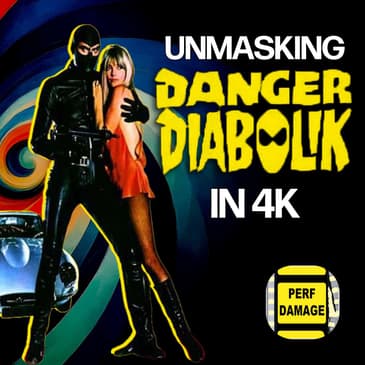
This week on Perf Damage, we're going behind the mask of the new 4K HDR release of Danger: Diabolik (1968) — coming soon from Kino Lorber!
Charlotte walks us through the work behind the new transfer from the original 35mm camera negative—what was done, what wasn’t, and why it looks better than ever. She shares behind-the-scenes stories of how some of the original opticals were updated, how a long-missing outro was rediscovered, and why this version is the most faithful to the original Italian release we've ever seen on U.S. home video.
Meanwhile, Adam dives into the wild world of production drama—from casting clashes to Dino De Laurentiis being... well, Dino. Expect pulp, politics, and plenty of behind-the-scenes chaos.
If you're a fan of Mario Bava, deep cuts in film restoration, or just want to know how Diabolik got his groove back in 4K, this episode is for you.
Subscribe for more deep dives, restorations, and film nerdery.
The new 4K HDR disc is coming soon from Kino Lorber!
Note: This episode is not affiliated with or sponsored by Kino Lorber. We're just excited to talk about the work that went into this release and share what went on behind the scenes and we recommend that you pre-order a copy of the disc!
Contact Us At:
www.perfdamage.com
Email : perfdamagepodcast@gmail.com
Twitter (X) : @perfdamage
Instagram : @perf_damage
Letterboxd : Perf Damage
Check Out our Youtube Channel:
https://www.youtube.com/@PerfDamagePodcast
[00:00:00] Welcome to the audio only version of the Perf Damage podcast. We highly recommend checking out our YouTube channel for the full experience where you'll see visuals and details that we might not fully explain here. Otherwise, sit back and enjoy the episode. Welcome to Perf Damage! Welcome! This is the show where we dive into the secret histories of Hollywood. And talk about film restoration which is what we're talking about today!
[00:00:27] Yes, and I'm very excited because this is one of my favorite movies. And I've wanted to work on this one for a very long time. And finally had the opportunity thanks to Kino Lorber! Well, and what is the film? Danger Diabolik. We're gonna talk about the whole restoration because there was some cool stuff that went into this one including some cool opticals that were fixed. I almost said obstacles. There were some obstacles. There was lots of obstacles in fixing those opticals.
[00:00:57] There were some of those. There was a lot of research, a lot of prints were looked at. Yeah, yeah, a lot of reference, a lot of reference. What else? Lots of stuff. Yeah, I mean, well, you know, you gotta watch it to find out all the stuff. We're not gonna list it all off here. So, if you want to hear about the restoration of Danger Diabolik and a few little tidbits that Adam looked up so he could contribute something. Oh, come on now. Just kidding. Yeah. That's the history part. All right. If you want to hear more about that, stay tuned.
[00:02:05] Hey, movie lovers. I'm Adam. Part of the double feature. This is Perf Damage. Popcorn popped. Wine at the ready. Let's press play. John Philip Law had a big year, 1968. He did. Because Danger Diabolik, Barbarella.
[00:02:35] And Skidoo. And Skidoo! Yeah. That's right. For a while I had Danger Diabolik, Skidoo, both of those posters on my wall. I did not have Barbarella. Can't afford that poster. But we do have Danger Diabolik right here. You can't see it. It's right off. Maybe we'll do an insert. Cut to the insert. Right there. Yeah. You know, what's funny is that when this movie came out, Diabolik was the better reviewed movie of the two. Of what? Barbarella and Diabolik. Yeah. And of Skidoo. And of Skidoo, yes. They were both reviewed.
[00:03:03] Everything was reviewed better than Skidoo. Yeah. Barbarella was scathing reviews and they were still better than the Skidoo reviews. Yeah. So the version of Diabolik that we know and love today almost never happened. In 1965, Dino De Laurentiis got the rights to Diabolik, which was a very famous and actually the longest running Fumetti, which is a comic book in Italy. And written by two females too, right? Two females, yes.
[00:03:30] Got the rights to the film and in September he went into production on it with a completely different director and a completely different cast. Seth Holt was the director and De Laurentiis claims that he, after two months of shooting, he shut down the production because he looked at the dailies and said they were so terrible that he couldn't go on. Now, Seth Holt, the director. I've seen some De Laurentiis films so terrible you couldn't go on. I know.
[00:03:57] And that's why I give a little bit of credence to what Seth Holt, the director said. He said that the money was mismanaged and that they ran out of money and that's why he stopped the film. Because of that, the investment companies came in, they seized the film and that's why we don't have it today. No one's ever seen any images from this film because, you know, they came in and they took it as collateral to get paid. Right. And they never got paid. Here's some money for your film. Yep.
[00:04:25] That's what Seth Holt said was happening. Yep. And the other reason that I think that this has credence is because you don't shoot for two months and then look at dailies. You look at dailies daily. That's why they're called dailies. That's why they're called dailies. And so, you know, you would stop this after a couple weeks so that you don't bleed money.
[00:04:46] Instead, they let him shoot from September 20th, 1965 to November 13th, 1965 and then decided to shut the film down. So, little controversy. It's probably a good thing that we didn't get this version because now we have our version of the film that we all know and love. Mm-hmm. We began shooting our version in 1967.
[00:05:11] Mario Bava described the production as nightmarish because he and De Laurentiis were making two different films. They butted heads the entire time. De Laurentiis wanted to make a family friendly film, you know, something that would play kind of to a wider audience. Did he read the comic book? Well, that's the thing. He kept telling Mario Bava to tone the violence down because Mario Bava was trying to stay true to the comic book. Right. And the comic book, the character is a complete psycho. Yeah.
[00:05:39] He wanted to make him a different character basically. His name is Diabolic. Right. I mean, come on. And he's not a hero. He's a villain. Like, that's the point of Diabolic, you know? He sleeps on a bed of money. Me Diabolic, a bank robbing hood who baffles the cops.
[00:06:08] He robs from the rich to give to the girls. Ask Eva. Oh, you shouldn't have done it. She can't get a good night's sleep unless she's covered with money.
[00:06:42] Master lover. Master. Ask Eva. Well, since you mentioned that iconic scene, the bed of money. The bed of money. The bed of money. It's in the trailer. Yes. This brings up the fact that Catherine Deneuve was the original person hired to play Eva in the film. No way.
[00:07:11] She didn't get along with Bava at all. The two of them like clashed constantly. She didn't have any chemistry with John Philip Law. And. How are you not going to have chemistry with him? This is bringing it all back. She refused to do the nude scene in the bed of money. She didn't want to do the love scene. She was worried about the nudity. Didn't want to do it. So after they fired Catherine Deneuve, they hired Melissa Mel, which was actually Mario Bava's second choice. She's great. And the two of them have mad chemistry on screen. Yeah.
[00:07:40] In fact, they had a relationship that went beyond the screen. They lived together for several years afterwards and they even adopted a black cat. And they named it Diabolic. No. Yeah. No. Isn't that awesome? That's true. That is true. So Mario Bava had $3 million to make this film, which was more money than he'd ever had to make a movie in his career.
[00:08:05] And even though he and De Laurentiis didn't get along, De Laurentiis loved him when he turned the film in for $400,000. That's how much this film cost? How much this movie cost? $400,000. How? With that underground layer? It was all trick photography. There's actually some, you pointed out some really cool trick photography that I never noticed before. The airplane. Yeah. So you pointed it out. That's a model and they're just walking up a ladder. Yeah. Yeah. I never noticed that. Yeah.
[00:08:35] Mario Bava was like $3 million. I don't need to spend this money. I make movies for, for nothing, you know? And, and so he, yeah, he turned the movie in for $400,000 and then De Laurentiis loved him and said, Hey, do you want to direct the sequel to this? And he turned him down cause he didn't want to work with him again. He said he was too overbearing. So, which I mean, pretty much anybody that worked with Dino De Laurentiis said he was pretty overbearing as a producer. He would insert himself quite often movies.
[00:09:04] So Charlotte, let's talk about this 4k HDR from Kino Lorber. Yeah, let's do it. So I got to ask the obvious question. What, what was the source? I thought it was going to be the grain question. No, not the green. No, that, that one's coming, but no, let's big finale. No, the source. I'm going to get you on grain this time. I'm going to get you. The source was the 35 millimeter original camera negative, which is the which we are lucky enough to have. Wow. That's awesome. Yes.
[00:09:33] And fun fact, the original negative, the titles are in Italian. Makes sense. Your mind just blown. Italian production. That makes sense. The original negative. So the Italian credits, we took those out and luckily we have an IP that's got the original English title. So we put that in on the Italian credits. Dino De La Rentia's name is the last one you see the producers credit is last. Oh yeah. American credits. The director's credit is last.
[00:10:04] Yeah. That's a Mario Baba. That's interesting. Cause they, the interesting to us anyway. Yeah. I don't know if it has something to do with guilds or things. I think it does. I think producers always listed last there. Yeah. So that's what we use. Scan that at 4k. Did some cleanup work. This film, man, is it dirty. Such a dirty film. Needed a lot of cleanup. Needed a lot of cleanup. And fortunately we were able to pitch in a little bit of extra cleanup.
[00:10:31] So this was a joint cleanup between Paramount and Kino. Yeah. We were able to do a little collaboration on this. It's still not perfect. No, no, no. This was not what you would call like a full restoration. No. Right? Not at all. No. It wasn't on that level. No. Not at all. We did not have the budget for that. With cleanup, one of the hardest things to clean up when you're doing dirt removal, scratches, stuff like that is smoke. Right around the credit sequence, right towards the beginning of the film, there's that huge
[00:11:01] sequence where there's all that smoke. And that's probably the worst looking scene of the whole film. And it's like right at the beginning. And unfortunately, and that's, that's where you want it to look the best. Right. When people pop the disc and you want them to go, wow, this looks amazing. You want that to look the best. And that probably looks the worst. Well, on top of that, it was an optical as well. So you have probably baked in dirt there. You absolutely do. Which is difficult to remove. Yes. You have layers of that because it's layers of effects on top of each other's.
[00:11:27] Well, so once they get, once they get past that credit sequence, everything looks phenomenal. Yeah. Better than it ever has. Better than it ever has. So Charlotte, let's talk about color on this. I know that you had some big hurdles to get over on certain scenes, right? Well, this film has an enormous amount of day for night shots. Yeah.
[00:11:53] And I think we've gone over that before, but day for night, just like it sounds, the production shoots at day with the intent of printing it down to make it look like night. And a lot of times they'll add a little blue or they'll just make it a little darker. And, you know, they look terrible. Yeah. You do the best you can. I think. With what you got. The sequence, that big day for night sequence with the siege. So long at the end. Oh my.
[00:12:22] In the sand dunes and that scene. Yes. That was one of the only sequences in the last master that people complained about because it was too bright. Yeah. Yes. And that's one thing whenever you're doing another transfer, you always look at those notes. You try. You take those into consideration. You know, you also look for prints, which we had quite a few, which we looked at. I was there during the final HDR grade. And yeah, those scenes are actually look like night now. Finally. Yeah.
[00:12:50] So if people don't like them, they can just complain to you. Sure. You're saying. I mean, I, I, I'll take the blame. Yeah. I mean, that's one of the challenges with HDR too, right? Is that it's going to look brighter or it's going to look darker. You've got the bigger range that you then have to take into account too. So one of the fun things was, you know, now you've got a light and house and now you can kind of. Bring it up. That looks a little better. Yeah.
[00:13:16] And I'm very sensitive to the blue in HDR because HDR can go way too blue. Yeah. So any other scenes that were particularly problematic, like the underwater scenes, were those hard or? No, no, those actually look pretty good. I mean, other than the fact that it's clearly a man, not Eva underwater, clearly two guys in the underwater vehicle, not a woman other than that. But there's nothing I can do about that in color, but, uh, but other than that, no, that
[00:13:45] scene, that scene was fine. So one of my favorite stories about this one is the dreaded. Oh, opticals. Yes. Opticals. Long time listeners know that that's one of the things if I can fix an optical, I will. And for this one, this title, I dove in deep and I pulled so many elements and had my film inspector look at these and my film inspector, Paul. Awesome job.
[00:14:14] He looked at so many elements. He's getting a big thank you. Poor Paul. No, Paul loved it. He was super excited. So we looked at so many elements for this, just looking for different things. We'll get into the music part of that later. But one of the things that we found were just these odds and ends of just background driving kind of plates or, hey, there's some guys in a car with a blue screen behind them, or,
[00:14:43] hey, it looks like somebody in a pool swimming. So we found all this random stuff that to someone who's not familiar with the film, it may not really look like much. But to someone obsessed with the film, I knew those were pieces of the optical. So we had them scanned and fingers crossed, we were just hoping that these are the right pieces for the exact shots or the exact takes in the film. And luckily some of them were.
[00:15:12] So we were able to replace, I think, five optical shots. I'll check that number. And what I mean by this is that we had the front plate of the actor driving in front of the blue screen. And then we had the back plate of the action that goes behind him. And we're able to comp together a new image that doesn't have those awful lines around. Cause that was the problem with these optical. So unlike... Charlotte hates fringing. Yeah.
[00:15:40] Unlike some of the other obstacles where just the quality is degraded, which it was in these two. The problem with these opticals was the lines. These are the kind of things we wanted to recomp because we can do it better now and we don't have those harsh lines. Well, yeah, you're not doing it photochemically and you have original negative. So the two comps aren't going to go down a generation now. Right. Which, you know, is just going to make it look better. Right.
[00:16:06] So we had two shots of Diabolic at the beginning, two shots of Jinko and another guy driving around the city, a shot of Eva swimming. Which was probably the worst comp in the entire film. That was the worst one. We also had a shot of Eva, have a rear view mirror. Yep. So little shots that we were able to replace, you know, the second, third, whatever generation elements were in the negative.
[00:16:34] We were able to replace them with original negative pieces that I was really, really proud of. Yeah. And that's not something you get to do for every film because the, you know, those elements don't exist, but you guys kind of dove in really deep into the archive and found it. Found them. Yeah. And that was something that was done on the Paramount lot, the, all the work for this, the color work, the cleanup, the, uh, this optical, the comping work that was all done at Paramount. Yeah. DPS. That's a. Paramount.
[00:17:03] Digital post services. Yep. That is. And they did a great job. Yeah. It looks fantastic. Yeah. Oh, I got a weird fact for this one that Terry Thomas in the film was actually only on the set for one day and he couldn't come in and do his post dubbing. So they actually recorded sound on set for Terry Thomas, which must've been like everybody on set in Italy must've been like, what's happening?
[00:17:32] What's going on here? You know, like what are the, I don't know where they were from. Well, I mean, I'm not doing. They're from some country. Hey, I don't want to offend Italians with my bad Italian accent. Some unknown country. I mean, I could do a bad Italian accent. Don't do it. Yeah. You'll be denied entry. If you ever go. Denied. No. So do you want to get into the dubbing? Yeah. Well, since you brought up the audio, I have so many good stories about the audio.
[00:18:03] So the whole idea with the audio on this one, I knew going in that something didn't feel right about the end of this movie. Been a fan of this for a long time. We've had this discussion before the way that this film ends. It ends with diabolic spoiler alert. If you don't want to know how it ends, just turn, you know, just stop watching right now. It's from 1968 though. So we're not really going to be talking about the end of the movie. We are spoiling it. We're going to be talking about the end.
[00:18:33] I'm warning you right now. Okay. Okay. You've had your warning. Okay. So diabolic is in gold, right? Encased in gold. He's in golden, right? In golden. In golden. You heard it here first. I love that. Okay. In golden. That's how we're going to refer to him from now on. Yes. It ends with him laughing and then this cool guitar riff comes up. Yeah. Yeah. Right.
[00:19:01] So, but when you hear that guitar riff, there's a sound of a car that you can hear. It just sounds like earlier in the film, like around those parts where we fixed the obstacles. It sounds like it was just lifted from somewhere around there. I don't think I'd ever heard that until you pointed it out to me, but now I can't unhear that. Yeah. That always just jumped out at me.
[00:19:31] So in the historical research, I found mention of the run out music, which run out music, end music. That's, that's what that means. And they keep, they kept talking about deep, deep down. Deep, deep, deep down. The exit music for this film.
[00:19:58] So I knew that originally that's what was planned. So, you know, kept that in mind. So I decided, let me start pulling. We have some old prints. Let me start pulling them and see what's on these old prints because we happen to have a German print. You guys, you know, if you've been around here a while, you know, you know, those German prints. Yeah. We happen to have a German print from 1960s, 1967 film stock. This film was from 1968.
[00:20:27] So that's an oldie. That's an original. And we had a French print. Same deal. 1967 print stock. So I pulled both of them and both of them ended with deep, deep down at the end. Although they were both slightly different from each other. They weren't the same.
[00:21:13] So then I start looking at other elements thinking, well, let me see. Let me see if maybe those two were just different, but maybe there's other ones that are the same. So I pulled a 16 millimeter print that was also from France and that was identical to the other French one. Okay. So then I pulled another French print kind of similar. It had a laugh. It had the song, but then it faded out really quick. So it didn't have the whole song. It didn't play out like it does. Yeah. Okay.
[00:21:43] But it had the song, but it was there. Okay. That's a little different too. That's like a third variation. Those were all the European prints. We had the rest of the prints were all English American prints and they were newer. So then the next one was a 1986 English American print. And that one had a guitar riff.
[00:22:16] That was the first one, 86, that had that da-na-na-na-na that came up. And there was no deep, deep down. Hmm. Completely gone. Okay. That's weird. So that's kind of like what we're used to hearing. Uh-huh. Right here. So I'm thinking, oh, well, maybe it was never in the American version. So there's a 1991 print. So I pulled that. This is going to mess everything up. I can tell already. Yes, yes, yes.
[00:22:53] And then deep, deep down comes back and it plays the whole way through till the end. So that's kind of like that French one. That French print. The first French one from 67. Exactly. Huh. All right. Well, there's a 98 print. Let me pull that. Guys, this is. This is a lot of prints later. Poor Paul, right?
[00:23:23] 2004 print. What the hell? So we had so many prints with so many different things and we were left thinking, what the heck do we do? So again, we go back to the paperwork and we see, you know, what, what are we supposed to do?
[00:23:51] And what we find out is that basically in Europe, it was a free for all in post. So our, our goal is always to go back to the most original thing. What was the original intention for the film anchors? What were they trying to do in the paperwork? It was clear that they wanted to have that exit music.
[00:24:13] Another thing on the negative, there was a ton of black at the end of the, the movie after the, the end card. There was room there for the song. So we felt really justified that the song deep, deep down was supposed to be there. And the laugh was always there.
[00:24:37] So even in the German print, the laugh was there, even though it was very faint and the French one, it was there, you know, the laugh was supposed to be there. So then it was just a kind of, how do we get the laugh? You know, what music follows it. Yeah. So that, so that's how we got to where we were getting it back to the original version, fitting all the pieces, but it was, you know, a lot of prints later, a lot of scanning.
[00:25:03] Thank you to ProTech for scanning and getting me the audio for all of these. Wowza. That was a lot. And possibly people have never heard it quite like this before. All right. So I want to talk about the two dub versions for this, the two English dubs. There were two versions and they were done around the same time.
[00:25:27] And the reason being, they weren't happy with one of them was paramount and the executives were not happy with the way that the performances were done in one of the dubs. If you have the VHS or Laserdisc, you have what's considered the remixed version. Yeah. The subpar one. Yeah. The lesser. There's one that's the better version. There's the others, the lesser version. I think that's the diabolique version. The remixed version is the lesser version. Right. That's going to be so confusing. Thanks.
[00:25:57] The whole underworld worries me less than a single man. Diabolic? Excuse me. They're waiting for you, Inspector. The whole underworld worries me less than a single man. Diabolic? Excuse me. They're waiting for you, Inspector. Good luck. I'll get you diabolic alive and you can arrest him. You'll interest me, Val.
[00:26:26] I'm on new business after all. There's an old saying. You should know about it. By getting you diabolic alive and then you can arrest him. There is an old saying that you should know about. It takes a thief to catch a thief.
[00:26:53] So, Adam, do you have any favorite moments in the film? Oh, gosh. There's so many. Cool. That's very interesting. Just kidding. I love the scene where diabolic strips down and shoots his uniform out of the catapult. Oh, yes. To make it look like he escaped, but he's just naked standing there. They are all looking over the side and he sneaks out all naked. That part cracks me up. I love that scene. Yeah. I love working on the scene.
[00:27:22] I found that there's a leg that's in a shot that I always thought was just a police officer, but in seeing the raw scans, I noticed it was actually just someone from the crew. What? Really? Yeah. Yeah. Because I never noticed that. Yeah. You wouldn't notice it because it just looks like a police officer. Yeah. But this leg here is actually, it's someone from the crew. It's awesome. So that's fun. Yeah. I love those little things like that. Yeah.
[00:27:52] I mean, this movie, he shot it so quick and so cheaply that, you know. Yeah. And there's scenes like this where he doesn't have the mask on. Oh, now he's got the mask on. Oh, now he doesn't have the mask on. Danger Diabolic. Yeah. Danger Diabolic. Cult favorite. Cult classic. In 4K for the first time. HDR. I know. Super colorful movie. Hopefully. Hopefully translated. I mean, it's going to look good. I hope so. Yeah. And I feel like this is one of those movies that kind of screamed for the 4K treatment
[00:28:21] because, you know, it is so colorful and comic booky. It did. But it's one of those movies that the, at the studio, everybody kind of, what is this movie? Danger Diabolic? Huh? Yeah. Well, I mean, it's not one of the top 100. It never has been. So. No. But it's one that I dearly love. Massive failure when it came out. And thank you to Kino for picking it up and putting some money into it. And I'm just glad that we could collaborate on it. And I'm glad I could work on it.
[00:28:51] And I'm sorry it took so long. But hopefully it was worth it. Well, I hope you guys enjoyed this little peek behind the scenes in the restoration of Danger Diabolic. Yeah. It's one of our favorites. Yeah. And hopefully it will become one of your favorites. If you've never seen it before, please go check it out. It's fun. It's a little long, but it's fun. It does get a little long by the end. It does. It does. But it comes around. It is. Yeah. But it's like a comic. It's like a comic book.
[00:29:19] It's like three comic books in one. In one. Yeah. Three movies in one. Yeah. Who could ask for more? Well, until next time, thanks for joining us here on Perf Damage.
[00:29:29] I'll explain it here so you can drop it in. Hold on.
[00:30:02] That is not your outtake. Nah. That might be our outtake. Shit. Ha ha ha. I'll see you soon. Bye. Bye.