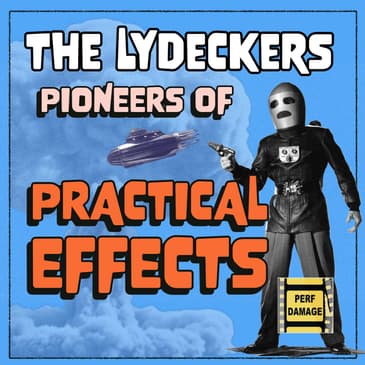
In this episode, we’re diving into the world of Republic Pictures and the two brothers who turned a B-studio into an A-list innovator: Howard and Theodore Lydecker. Known as the masters of miniature effects, the Lydecker brothers created jaw-dropping special effects that set Republic Pictures apart in the 1930s through the 1950s. Their groundbreaking work inspired generations of filmmakers, including Steven Spielberg and George Lucas.
Join us as we tell the story of these unsung heroes of Hollywood, explore their creative process, and showcase some of Republic’s best miniature work—from rocket-fueled serials to daring action sequences. Discover how the Lydecker brothers brought big ideas to life on small scales and cemented their legacy in film history.
Contact Us At:
www.perfdamage.com
Email : perfdamagepodcast@gmail.com
Twitter (X) : @perfdamage
Instagram : @perf_damage
Letterboxd : Perf Damage
Check Out our Youtube Channel:
https://www.youtube.com/@PerfDamagePodcast
[00:00:00] Welcome to the audio-only version of the Perf Damage podcast.
[00:00:04] We highly recommend checking out our YouTube channel for the full experience, where you'll see visuals and details that we might not fully explain here.
[00:00:13] Otherwise, sit back and enjoy the episode.
[00:00:17] Welcome to Perf Damage.
[00:00:19] Welcome.
[00:00:20] This is the show where we talk about the secret histories of Hollywood.
[00:00:23] And the secret histories of film restoration.
[00:00:27] Okay, not really.
[00:00:28] Not all the time.
[00:00:30] We do tell you stories of film restoration, but not today.
[00:00:33] No, today we're going to do something a little different.
[00:00:34] In fact, I think I'm going to start it out with a little quiz.
[00:00:37] A quiz?
[00:00:38] Yes.
[00:00:39] I'm going to ask you guys a question.
[00:00:41] What do Jurassic Park, Superman, Lord of the Rings, Inception, Jason and the Argonauts, and Rocketmen from the Moon all have in common?
[00:00:57] Anybody? Anybody?
[00:00:58] I don't hear anything.
[00:01:00] They all have amazing miniature practical effects.
[00:01:07] Yes, miniature practical effects.
[00:01:09] And that's what we're going to talk about today.
[00:01:14] Miniatures have been the cornerstone of filmmaking since the silent era.
[00:01:18] And while you've probably heard of some of the big name in special effects, we're here today to spotlight two brothers who shaped the industry across nearly a century of innovation.
[00:01:29] So, to hear about the Lidecker brothers, the godfathers of special effects, stay tuned.
[00:01:46] Hey movie lovers, I'm Adam.
[00:01:48] And I'm Charlotte.
[00:01:49] And welcome to Perf Damage.
[00:01:51] We're a movie-obsessed husband and wife team who work in the film industry.
[00:01:55] I oversee film restoration at the oldest studio in Hollywood.
[00:01:59] And I bring the inside track from film development and production.
[00:02:03] And we love to explore the hidden tales of movies past and present.
[00:02:08] So, join us for a cinematic journey like no other.
[00:02:11] From classic gems to examining the art of the double feature.
[00:02:15] This is Perf Damage.
[00:02:20] Popcorn popped.
[00:02:21] Wine at the ready.
[00:02:23] Let's press play.
[00:02:34] Alright, so, we had a lot of things that we're going to talk about today.
[00:02:38] But, there is one thing I have to tell you about that's going to come a little bit later in the video that Adam really wanted me to put at the start of the video.
[00:02:47] But I said, no.
[00:02:48] I did, because it was a lot of fun.
[00:02:50] It is.
[00:02:50] It is.
[00:02:51] But I said, no.
[00:02:51] We're going to reward the people that stick around for the whole thing.
[00:02:56] Or the people that want to just fast forward to the end.
[00:02:59] Fine.
[00:03:00] Here is the time code you're going to want to check out.
[00:03:03] There is a very fun video.
[00:03:05] It's over here, Adam.
[00:03:06] I pointed that way.
[00:03:07] Did you not see that?
[00:03:08] He understands that.
[00:03:09] I was actually, no.
[00:03:10] I was just a little faster on the uptake this time.
[00:03:12] Yeah, he understands.
[00:03:13] There's a video.
[00:03:14] It's a little comp.
[00:03:15] It's a, it's a little hilarious video about lessons I've learned while working on the Republic Pictures.
[00:03:21] There's serials.
[00:03:23] It's humorous.
[00:03:24] You might want to check it out.
[00:03:26] That's all we'll say.
[00:03:27] Anyhow, next.
[00:03:29] Now back to our regular programming.
[00:03:34] So Charlotte, when we're talking about the origins of special effects, practical special effects,
[00:03:41] we think about it in periods like eras, right?
[00:03:45] Right.
[00:03:45] And each era influences the era after it.
[00:03:50] The first era really all started with Willis O'Brien and his stop motion work on King Kong.
[00:03:55] Right.
[00:03:56] Like that movie was groundbreaking.
[00:03:57] Willis O'Brien is credited as being the guy who invented the 3D stop motion technique.
[00:04:03] And so all of the people that came in the generation after them had seen King Kong and that was what they were influenced by.
[00:04:10] Right.
[00:04:15] The people that came after him.
[00:04:24] And these are the names that pretty much everybody that's into film immediately recognizes.
[00:04:29] Like Ray Harryhausen.
[00:04:31] Ray Harryhausen became the top of the line stop motion guy after Willis O'Brien's work.
[00:04:36] Right.
[00:04:36] And if you don't recognize the name, you recognize the style.
[00:04:39] You've seen people fighting them.
[00:04:40] Yeah.
[00:04:41] The skeletons.
[00:04:41] The skeletons from Jason and the Argonaut.
[00:04:43] You've seen the dinosaur.
[00:04:45] You know, like, and the movie that made me recognize Ray Harryhausen, his last film, 1981's Clash of the Titans.
[00:04:51] Right.
[00:04:51] You know, so he was an influence on film over decades.
[00:04:57] Right.
[00:04:58] You know.
[00:04:58] And another contemporary of that era was the Jerry Anderson stuff, which was done by Derek Metting, who did all the marionette stuff for like Thunderbirds are go.
[00:05:09] Right.
[00:05:10] Stingray.
[00:05:11] UFO.
[00:05:11] Yeah.
[00:05:12] All of those big.
[00:05:13] He did so many series with the marionette.
[00:05:15] Right.
[00:05:16] He also did some of the James Bond stuff.
[00:05:18] Oh, and Superman.
[00:05:19] Superman.
[00:05:19] Yeah.
[00:05:19] And then so the generation after that, the people that saw Harryhausen's work and Derek Metting's work, that's the ILM period.
[00:05:28] Right.
[00:05:28] Like the people that did Star Wars.
[00:05:31] Right.
[00:05:31] I mean, you had people like Richard Edlund, Douglas Trumbull, Joe Johnston, who became a director in his own right.
[00:05:37] You have Phil Tippett.
[00:05:38] He's now the stop motion guy.
[00:05:40] Right.
[00:05:40] If you need stop motion, you go to Phil Tippett.
[00:05:42] Now we've got the modern era, the people that were influenced by them.
[00:05:46] People like the Weta Workshop.
[00:05:48] Yes, absolutely.
[00:05:49] Peter Jackson doing Lord of the Rings.
[00:05:52] They did all of those bigatures on the original Lord of the Rings series where they made all the miniatures, but they call them the bigatures because they were very big models.
[00:06:01] Right.
[00:06:01] And that's working on concepts created by the Lideckers.
[00:06:04] Yeah.
[00:06:04] Because they wouldn't call their miniatures.
[00:06:07] Miniatures.
[00:06:08] They call them scale models because they were very large.
[00:06:12] Yes.
[00:06:12] They always.
[00:06:13] Which we'll get into.
[00:06:13] Yes, we'll get into that.
[00:06:15] It was part of their fundamentals.
[00:06:16] They have like a list of fundamentals.
[00:06:17] Yeah.
[00:06:18] The point that we're making here is that practical effects are still something that is being used today.
[00:06:25] And it's something that's been around for as long as filmmaking has been around.
[00:06:32] Since the silent era.
[00:06:33] Yeah.
[00:06:33] And then there are these two brothers, the Lidecker brothers, who revolutionized a lot of techniques that are still being used today and yet are relatively unknown.
[00:06:43] Unknown still.
[00:06:44] Yeah.
[00:06:44] Like a very few people actually will put them in that kind of line of, you know, lineal line to today.
[00:06:52] And they were very, very influential.
[00:06:54] Like a lot of the stuff that they did influenced big filmmakers like Steven Spielberg and George Lucas.
[00:06:59] We would not have Indiana Jones at all if it weren't for the Lideckers.
[00:07:04] That's right.
[00:07:04] And Republic Picture Studios.
[00:07:06] For example, we have a quick example for you here before you tune out and say, yeah, whatever.
[00:07:11] Yeah.
[00:07:11] Like who are all these people?
[00:07:13] For example, there's a Republic serial called Zorro's Fighting Legion.
[00:07:17] There is a stunt which we are going to show you here, which if you've seen Indiana Jones and the Raiders of the Lost Ark, this may look very familiar to you.
[00:07:28] The same stunt was used in Stagecoach by John Ford.
[00:08:04] Yeah.
[00:08:04] Later that year.
[00:08:05] And it was performed by the same stunt actor, right?
[00:08:08] Yakima Kanut.
[00:08:08] Yeah.
[00:08:09] I did the same stunt, which is, this is a crazy freaking stunt.
[00:08:28] Yeah.
[00:08:29] It's amazing that anybody would pull this off.
[00:08:32] The stunt department at Republic Picture Studios.
[00:08:35] The Lideckers miniature work.
[00:08:37] So many departments that elevated Republic Pictures.
[00:08:40] From a scrappy little bee.
[00:08:42] Scrappy little bee studio.
[00:08:44] And they made their production value A-level.
[00:08:48] So today we're talking about Howard and Theodore Lidecker.
[00:08:52] They were pioneers in the field of special effects.
[00:08:55] If you've ever been amazed by the seamless blend of reality and illusion on screen, stick around because it all goes back to the Lidecker brothers and their unparalleled eye for detail.
[00:09:05] Let's explore how two men in the 1930s turned a small independent studio into a visual effects powerhouse.
[00:09:25] Before we talk about the Lideckers, we kind of have to talk a little bit about the history of Republic Pictures.
[00:09:31] Yeah, let's set up Republic Pictures because it's important to know what Republic Pictures was before we get into who the Lideckers were.
[00:09:39] So Republic Pictures was a Poverty Row studio.
[00:09:44] And if you're not familiar with what a Poverty Row studio was, it's as it sounds.
[00:09:49] It's a studio that didn't have a lot of money.
[00:09:52] Right.
[00:09:52] You know, they were small independent studios.
[00:09:55] Very small.
[00:09:55] That were able to have big stars.
[00:09:58] And they were able to get their features on as B features in front of A pictures.
[00:10:02] Herbert J. Yates's idea was to create a super B studio.
[00:10:06] Right.
[00:10:07] And so what he did was he took several Poverty Row studios and he merged them all together.
[00:10:14] Yeah.
[00:10:14] Six of them.
[00:10:15] The two main ones that he was after, though, were Mascot and Monogram.
[00:10:19] And he had a game plan.
[00:10:21] The reason that he wanted to combine with these two was because Mascot was known for making cereals.
[00:10:28] Mm hmm.
[00:10:28] They were the first to do a sound cereal.
[00:10:33] King of the Congo, 1929.
[00:10:35] Right.
[00:10:36] And they had figured out how to maximize profits with cereal shooting.
[00:10:43] And I guess we should really start and tell what a cereal is.
[00:10:46] Oh yeah.
[00:10:46] Yeah.
[00:10:46] Let's do that.
[00:10:47] So cereals were also called chapter plays.
[00:10:50] And this was to become the bread and butter for Republic Pictures.
[00:10:55] And these were weekly episodic cliffhangers that appealed mostly to younger boys.
[00:11:00] And they featured heroic characters in action packed pulp storylines.
[00:11:06] And the thing that Mascot had figured out with the cereal business was how to save money by shooting scenes by location.
[00:11:14] So instead of shooting by script order and shooting each chapter one at a time.
[00:11:21] The location appeared in episode one.
[00:11:23] One, six, eight.
[00:11:24] And then again in episode four.
[00:11:26] Yeah, yeah.
[00:11:26] So they would shoot all of those at the same time.
[00:11:28] And while this would cause major confusion for the actors.
[00:11:32] Right.
[00:11:33] Yeah.
[00:11:34] Most of the actors said they didn't know what was going on from day to day.
[00:11:37] What was happening.
[00:11:37] Yeah.
[00:11:37] They just kind of showed up and did what the director told them to do.
[00:11:40] Yeah.
[00:11:40] This saved a lot of money for the studios.
[00:11:43] Herbert Yates was really interested in this production style.
[00:11:47] So this is one of the reasons why he was interested in acquiring.
[00:11:50] The process.
[00:11:50] And then Monogram, they had a series of film exchanges all across the country.
[00:11:56] So...
[00:11:56] What does that mean?
[00:11:57] That was his distribution network.
[00:11:59] They had set up, you know, in major cities and they would send their serials to the major cities and they would distribute to local theaters.
[00:12:07] And so by acquiring both mascot and Monogram, he had both the means of production and distribution.
[00:12:14] What I love about Republic was that Herbert Yates wasn't after the majors.
[00:12:19] By combining all of the Poverty Row studios, he wasn't trying to become a major.
[00:12:25] What was his saying? Quality at a budget.
[00:12:27] Yeah.
[00:12:28] He wasn't trying to be a major.
[00:12:30] And even though they got the nickname repulsive pictures, he didn't care.
[00:12:34] Yeah.
[00:12:35] No, that didn't bother him.
[00:12:37] It didn't matter as long as he was financially, you know, making money on it.
[00:12:41] And I really respect that.
[00:12:42] And I love that.
[00:12:43] And I love the stuff that Republic pictures did.
[00:12:46] They did what they did well.
[00:12:48] Yeah, they did.
[00:12:49] Absolutely.
[00:12:50] And I love, I love that we own the catalog at Paramount.
[00:12:53] I, it's such a joy to work on.
[00:12:55] I have to say.
[00:12:56] So.
[00:12:57] Well, I mean, there's some gems in there.
[00:12:59] There really is.
[00:12:59] There are tons of gems.
[00:13:00] And a lot of that is due to the Lideckers.
[00:13:03] What a segue is that?
[00:13:06] Usually at this point, I would tell you, let's not spend too much time on their origin story.
[00:13:12] I know you love a good origin story, Mr. Comic Book over here.
[00:13:16] But.
[00:13:16] They had a very unconventional upbringing.
[00:13:18] Yeah.
[00:13:18] And I think that that kind of led to their prowess in their fields.
[00:13:23] Yeah.
[00:13:23] Theodore Lidecker was born in Inglewood, New Jersey in 1908.
[00:13:27] But shortly after his birth, his father, John Howard Lidecker, moved the family to Havana, Cuba,
[00:13:33] for a job that he got as head engineer overseeing the raising and restoration of the battleship Maine.
[00:13:39] Nice.
[00:13:40] His father was a restorationist.
[00:13:42] I like that.
[00:13:42] Yeah.
[00:13:43] An engineer restorationist.
[00:13:45] Hey, hey, restorationist is a restorationist.
[00:13:48] So while in Cuba in 1911, his younger brother, Howard Babe Lidecker, was born.
[00:13:53] Shortly after Babe's birth, John Howard moved the family to Balboa, California,
[00:13:57] where he applied his engineering skills to the construction of tuna boats and the design of mini golf courses.
[00:14:04] So random.
[00:14:04] Well, like most people in California, he eventually found himself in the movies.
[00:14:10] John Howard found his way into the movies serving as an assistant art director to William Cameron Menzies on films like Douglas Fairbanks' Thief of Baghdad.
[00:14:19] He's also purported to have worked on the 1925 version of Phantom of the Opera for Universal.
[00:14:24] And this is where the brothers got their bug for movie making.
[00:14:28] Upon completing high school, Babe went to work immediately for Max Sinnott Studios.
[00:14:33] The two brothers ended up working for United and Tiffany Stahl.
[00:14:37] And then when sound came in, they recorded sound effects for all the majors like Paramount, MGM, Columbia, and Fox.
[00:14:45] And they only made a dollar a day doing that.
[00:14:48] They would go all around recording sounds for their sound libraries because everybody had to build up sound libraries.
[00:14:53] Well, Ted got fed up with this and Ted was always kind of an outdoorsman.
[00:14:57] And he said, well, if I'm only going to make a dollar a day, then I'm going to go off to Idaho and become a cowboy because at least I'll be making a dollar a day there.
[00:15:05] But I also get room and board and food for free.
[00:15:08] Well, I got to tell you, I've read a lot of interesting stories about sound men during the early sound era days recording sounds to build these sound effects libraries.
[00:15:19] And I can understand how it could have been stressful because there were a couple stories where sound men were trying to find sounds for buffalo or hyena sounds.
[00:15:32] Exotic animals at the time, right?
[00:15:34] And they would get so frustrated at the writers because they would say all these writers have to do is say that there's a sound of a buffalo.
[00:15:42] But we in Los Angeles, we have to go find a buffalo sound.
[00:15:46] Do you know how hard it is to find a buffalo in Los Angeles?
[00:15:50] I can't just go down to Hollywood and Vine and find a buffalo.
[00:15:54] I got to go up to, you know, wherever.
[00:15:57] And then I have to find a buffalo.
[00:15:59] And then I have to wait for it to make a sound.
[00:16:04] But I digress.
[00:16:06] I can imagine how it could be very frustrating trying to get some sounds for a dollar a day, which was probably what, like 20 bucks?
[00:16:12] Yeah, that's, I think we did the math on that one.
[00:16:15] And it's like 20 bucks.
[00:16:16] We did the math.
[00:16:17] Yeah.
[00:16:17] But Babe decided to grind it out here in town.
[00:16:20] And eventually he found himself at Mascot.
[00:16:23] And he got to work with this very famous guy, Larry Wickland.
[00:16:27] And Larry Wickland had done miniatures and miniature effects for major studios.
[00:16:31] Then he came over to Mascot to become the department head of, you know, their special effects department.
[00:16:37] So Babe saw an opportunity here.
[00:16:39] And he decided to call his brother Ted back.
[00:16:42] And he said, look, we can learn under this guy.
[00:16:44] And we're doing some really, really cool stuff.
[00:16:46] So when Republic was formed, they were already part of Mascot.
[00:16:50] And they kind of came with the deal.
[00:16:51] John Coyle was another guy that they worked under.
[00:16:53] So they learned from these two old masters who taught them everything they knew.
[00:16:59] And they just, you know, they sucked it up like sponges.
[00:17:02] Shortly after the formation of Republican 35, John Coyle steps down as the head of the special effects department at Republic.
[00:17:09] And then Babe takes over.
[00:17:11] Howard does.
[00:17:11] That's how they became the heads of the special effects department.
[00:17:14] So the Lidecker brothers' responsibilities as the special effects department were really large.
[00:17:21] They encompassed a lot of stuff.
[00:17:23] And here I'm just going to read this.
[00:17:25] They were responsible for nine optical areas, you know, inserts.
[00:17:29] So like if someone pushes a button, like this is photographic stuff.
[00:17:32] They were responsible for the main titles.
[00:17:34] They were responsible for added shots.
[00:17:36] So they would do an edit and then see that they needed something.
[00:17:40] Oh, that something was missing.
[00:17:40] Yep.
[00:17:41] So then they would just call on the brothers to go out and shoot it.
[00:17:44] They were responsible for the construction of all props for process shots.
[00:17:49] They were responsible for the gun room.
[00:17:51] Mats and glass shots.
[00:17:54] Special effects shots, which included all fire, water, rain, snow, smoke, and underwater setups.
[00:18:03] And of course, miniatures.
[00:18:05] So basically pretty much everything that wasn't main unit.
[00:18:08] So the way the guys worked together, they would conceptualize what they needed.
[00:18:13] And then Ted would go off and draft the plans.
[00:18:16] He would oversee the construction or any rigging that needed to be done.
[00:18:20] And then Howard would be the guy that goes out and actually shoots it.
[00:18:24] He was the guy that was really into cinematography.
[00:18:26] And they lived by several rules.
[00:18:29] The first one was build large.
[00:18:31] Miniatures was kind of a misnomer for what they were doing.
[00:18:34] What they did was scale models.
[00:18:36] The larger you built it, the more realistic the light would be on it.
[00:18:40] So the closer you could come to the actual size of the object that you're shooting,
[00:18:45] the more natural it would seem on screen.
[00:18:47] Two, photograph from every possible angle.
[00:18:50] You and I were discussing this yesterday.
[00:18:53] And you were like, well, Republic is building a stock library at the time, right?
[00:19:00] Yeah.
[00:19:00] They reuse a lot of this stuff.
[00:19:02] So my theory was, well, they're shooting it so that they can reuse it in other features
[00:19:08] and other serials and stuff like that.
[00:19:11] Right.
[00:19:11] I could definitely see Herbert J. Yates going, well, if I gave you the money to build it,
[00:19:15] then you shoot the heck out of this thing before you blow it up.
[00:19:18] Yeah.
[00:19:19] We need a plane.
[00:19:20] We needed flying west, east, north, south.
[00:19:23] Yeah.
[00:19:24] You know.
[00:19:24] Up, down.
[00:19:25] Up, down.
[00:19:26] Every way.
[00:19:27] Crashing, launching, anything you can get.
[00:19:29] Everything.
[00:19:30] Yeah.
[00:19:31] Before you blow it up.
[00:19:32] That was my theory on, because when I asked you, I said, do you know why they said that?
[00:19:36] And that was my theory.
[00:19:39] Right.
[00:19:39] Number three, always use natural light.
[00:19:42] This one kind of goes with their next rule.
[00:19:44] Number four, photograph against real location backdrops.
[00:19:47] When you're trying to make something seem real, you put it against a real environment and then
[00:19:51] the viewer's brain kind of fills it in.
[00:19:53] They take it as real, you know.
[00:19:55] But it's also got the natural light showing natural shadows.
[00:19:59] And the more of that naturalness that you have, the more realistic it seems to the viewer.
[00:20:05] And then the last one they did was photograph at high speed.
[00:20:10] So, Babe had a chart that he made.
[00:20:12] He would vary the speed relative to the size of the object so that when it played back at 24 frames,
[00:20:19] it would seem, it would have mass and size.
[00:20:22] And I think this is illustrative of their very scientific approach to this, you know.
[00:20:26] They were like, well, you know, this is our profession.
[00:20:29] We want to do this the best we can.
[00:20:31] So, let's come up with the methods that work the best.
[00:20:34] Right.
[00:20:44] So, we've talked about the way the brothers worked and how they did some of the stuff that they did.
[00:20:51] And kind of their rules of thumb while shooting.
[00:20:54] Let's talk about some specifics.
[00:20:55] Some like actual things that they shot.
[00:20:58] Yeah.
[00:21:00] Like serials.
[00:21:01] Yeah.
[00:21:01] You know.
[00:21:01] I mean, serials I think are some of the best showcases of what they did.
[00:21:05] Because in one serial you get so many awesome things.
[00:21:10] Right.
[00:21:11] Because you've got 12 to 15 chapters depending on the serial.
[00:21:14] And each one of them has a cliffhanger.
[00:21:17] Except for the last one.
[00:21:19] Yeah.
[00:21:19] They were basically just show reels for these guys.
[00:21:21] Right?
[00:21:22] Yeah.
[00:21:22] That's why everybody really associates the Lideckers with serials.
[00:21:26] Even though they did a lot more than that.
[00:21:28] But.
[00:21:28] They did.
[00:21:28] Yeah.
[00:21:29] So, serials.
[00:21:31] One of my favorites is Daredevils of the Red Circle.
[00:21:34] Yes.
[00:21:35] I think it's a great showcase for the work.
[00:21:38] That first episode has not one but two massive set pieces in it.
[00:21:43] It starts and ends with a big set piece.
[00:21:45] Yeah.
[00:21:45] Not only do you have incredible effects that are in that.
[00:21:49] You also have incredible actors who are in that.
[00:21:53] You have a stuntman and an incredible athlete.
[00:21:56] Right.
[00:21:56] Right.
[00:21:56] To work around all the stunt work that you're seeing in this one.
[00:21:59] It's about three brothers that are in the circus.
[00:22:28] Mm-hmm.
[00:22:30] Very, very prolific director.
[00:22:32] And you know it's a William Whitney serial when you see it.
[00:22:36] Right?
[00:22:37] Yeah.
[00:22:37] Um, so I, you know what?
[00:22:38] I actually have a quote about Daredevils of the Red Circle from William Whitney out of his book
[00:22:44] that I'd like to read real quick. We talked for two hours and set down on paper what we would shoot
[00:22:49] and what Babe would shoot. We had to find a tunnel with a curve in it so you couldn't see the other
[00:22:55] end. Babe would match that tunnel in miniature for the tunnel collapsing and the water flooding it.
[00:23:00] He would shoot a moving process plate of the water chasing the camera down the tunnel
[00:23:04] so we could put our lead on the motorcycle in front of the process screen.
[00:23:08] We'd also shoot the run-throughs of the motorcycle in the real tunnel.
[00:23:12] Babe would shoot the watertight doors closing to stop the water so we could put our set in front of it
[00:23:18] with the lead spinning a big wheel to close the doors. Now all we had to do was find a tunnel
[00:23:23] with enough curve in it so we couldn't see the other end.
[00:23:26] This scene holds up really well. It's hard to tell the miniatures from the real tunnel.
[00:23:32] Yeah I mean the Lighthackers did such a great job building that tunnel. It's exact. It's an exact
[00:23:37] replica. Yeah. And even the traveling mat. Yeah the process shot is really well done. Yeah.
[00:23:42] Especially for the time period. Yeah. And your guy David Sharp does some really awesome moves like
[00:23:47] even when he's just fighting somebody he does all these crazy flips. Yeah. There's one where he like
[00:23:51] flips over and knock them down. Yeah. Oh yeah he's really good at that. So cool. Yeah. There's another
[00:23:56] stunt he does like does a backflip and kicks two guys out at the same time. So cool. So cool.
[00:24:02] Who does that? So Charlotte are you working on any serials right now at Paramount? Yeah we're
[00:24:07] actually working on two different ones. We're working on the the two oldest ones Darkest Africa
[00:24:12] and Undersea Kingdom. I did want to talk about an interesting thing with some of the serials that
[00:24:18] happened in the 50s though. In the 1950s demand for serials declined because of television. Right.
[00:24:25] Because they were episodic and these were kind of like what you were seeing on TV so the demand for
[00:24:30] them went down but production costs were rising but Republic still wanted to produce serials. So
[00:24:37] they came up with a an idea to still produce serials but to keep the cost down and that was
[00:24:44] they asked the writers to look at serials that had already been produced and look for set pieces
[00:24:52] action sequences things like that that had already happened that they could then work into storylines
[00:24:59] and reuse them. So they reused all of these things that had happened in previous serials and then put
[00:25:07] them with new heroes and new stars. So there's a few examples I can give you. There's a serial called
[00:25:14] G-Men versus the Black Dragon and there's a couple sequences where you see the bad guys chasing the good
[00:25:22] guys and these sequences are reused in the serial flying disc men from Mars and all they did was switch out
[00:25:33] the good guys and the bad guys. You know if you'd only seen it once in a theater 10 years ago you
[00:26:27] weren't going to really remember that. Yeah that maybe that huh maybe that looks a little familiar but
[00:26:32] it's got new stars and new stuff and look it was basically stock footage right so I don't I don't
[00:26:40] knock them for doing that. No not at all. I think that was actually really smart of them to do that. Well they
[00:26:43] were always looking for ways to turn an extra buck like that so they would do the serial the serial
[00:26:49] would come out and then they would edit that serial into a feature and then release it under a
[00:26:54] different name. Yep. Like Darkest Africa is called Darkest Africa but it's also called King of Jungleland
[00:27:00] and then later that was called Batman of Africa. Just imagine from an archival standpoint you got
[00:27:05] stuff under all kinds of different titles sometimes so. Also I want to talk about some of
[00:27:10] Howard's accolades. Howard was nominated for. Babe. Babe. Yep. Babe's accolades. Babe. Babe was nominated
[00:27:15] for two Academy Awards. The first one was for Women in War 1940. In that one they tilted the miniatures
[00:27:23] sideways and placed a camera above them and so that when an explosion went off it rose like an explosion
[00:27:29] actually does but it looked like it was spreading laterally instead of going up. The other film that
[00:27:35] Howard got nominated for while he was at Republic was Flying Tigers 1942. In this one they got nominated
[00:27:43] because of all of the special effects that they did with the planes. They built these models of
[00:27:50] Tomahawk P-40 Tomahawk planes and this is this is interesting. They got invited by the government.
[00:27:56] These were prototype planes at the time. They got invited by the government to come look at the
[00:28:01] planes so that they could replicate them but one of the rules was that they couldn't replicate the
[00:28:06] inside. They had to fabricate their own insides so that they didn't give away any war secrets.
[00:28:11] They did not only models that they strung up on these elaborate lines. They also built full-size
[00:28:16] replicas on the ground that didn't fly. Really impressive work for this film.
[00:28:28] So in late 1950 Herbert J. Yates couldn't afford full-time staff anymore at Republic so he let the
[00:28:35] Lideckers go but this wasn't a bad thing for the Lideckers because they'd made such a big name you know
[00:28:41] two-time Academy Award nominees all their work in the serials that everybody had seen was very very popular
[00:28:46] so they became the hottest freelancers on the market at the time and the only problem was that
[00:28:53] they had to split up. They could no longer be a team. So Theodore ended up going straight to Disney
[00:28:59] but he didn't like it there. He didn't like the culture of Disney so he ended up at Universal
[00:29:05] where he ended up doing the miniature birds for Hitchcock's The Birds. That's really cool.
[00:29:10] And of course you know Theodore saw this as a job and so the moment that he could actually retire he
[00:29:18] ended up retiring. The real drive was you know being working with his brother as a duo but his son ended
[00:29:25] up making films when he was a kid and so he came home one day from work you know before he retired
[00:29:32] and he saw them like attempting to blow models up for their their mini epics that they were shooting
[00:29:39] on Super 8 at the time and he's like whoa whoa you guys you need to calm down let a professional do
[00:29:45] this because he didn't want to blow any fingers off or anything like that. So it's a safety thing
[00:29:51] and you know when your dad is like one of the best guys in town you let your dad do it. So he got
[00:29:58] really involved in making their home movies. He would build models with them show them all the
[00:30:04] techniques for scale and then you know he would do of course all the pyro stuff for it and they would
[00:30:10] just blow up it. So their mini epics were like big hits in the neighborhood. All the kids loved
[00:30:15] watching their films and they all came involved and they all love Theodore because he was you know
[00:30:20] the cool dad that came and helped him with their big features on weekends. Howard went to work for 20th
[00:30:26] Century Fox. One of the biggest producers he worked for was Erwin Nowlin who would go on to do
[00:30:30] Earthquake and Poseidon Adventure. You know a lot of very towering yeah towering Inferno right. Yeah.
[00:30:38] But he started on TV shows like Lost in Space and Voyage to the Bottom Sea and both of those are
[00:30:44] shows that Howard ended up working on. A lot of miniature work on those. So in fact it was TV
[00:30:50] that gave Howard his first win. He won an Emmy in 1966 for individual achievement in cinematography
[00:30:58] for Voyage to the Bottom of the Sea. Finally got that win. Very cool. You know Howard tried to get
[00:31:04] Theodore out of retirement several times but you know Theodore was way having way too much fun
[00:31:11] entertaining entertaining the neighborhood and you know going off on fishing expeditions
[00:31:15] yeah to to go back to work. He said it would just be too much work to go back to work.
[00:31:20] Howard on the other hand was like he you know had the drive. In 1968 Howard suffered an
[00:31:26] aneurysm but he bounced back and he went to work on Tora Tora Tora Tora. Tora Tora didn't come out
[00:31:32] until 1970 but he worked on that up until the day he suffered a fatal heart attack in 1969. That's how
[00:31:39] dedicated he was to his work. He was 58. In 1974 Universal tried to get Theodore out of retirement again
[00:31:46] for Earthquake. Another Erwin Allen film of course. Yeah but if Abe couldn't get him out of retirement.
[00:31:53] Universal's certainly not going to do it right. Yeah if his brother couldn't do it Universal's not
[00:31:58] going to do it. Yeah Theodore continued to enjoy hunting and fishing until 1990 when he passed away.
[00:32:04] This is a quote from Theodore during his retirement but he was looking back on his career. Theodore says
[00:32:10] my business was the most fantastic there was. Everything was new every day. You were in your
[00:32:16] own little world of explosions and miniature cars and planes. People don't understand or realize what
[00:32:22] we did Howard and I. It was kind of like Walt Disney when he first started. Everything you did was
[00:32:27] your own way. I wish we could do that kind of stuff today. It was wonderful and nerve-wracking. We worked
[00:32:33] on a weekly schedule for serials. The miniatures and climaxes were all done at the last minute.
[00:32:38] We never got a complete script in advance. We would make up a budget but there were always changes.
[00:32:44] On features the effects were always done after the picture was completed.
[00:32:48] Daredevils of the Red Circle is one serial that stands out in my mind. I'll never forget it. Dave
[00:32:54] Sharp was fantastic. I mean these guys were guys of few words. They were great technicians
[00:33:00] but it was a job. So Charlotte let me ask you a question. While you've worked on a lot of these
[00:33:06] Lidecker films what are some of the takeaways that you have? What are the things that you know
[00:33:13] you've learned handling these films? Well as we've teased at the beginning there are things that I've
[00:33:22] learned but they're not they're not really restorationy things. They're more life lessons.
[00:33:30] Oh these are things that we should all listen to because you know we need to take these to heart.
[00:33:35] There are and I felt so strongly about them that I cut a reel together that I would like to share with
[00:33:43] all of you. The guy driving the car that's actor Walter Reed and I'm serious when I say you cannot let
[00:37:22] him drive and it's not just a car that you can't let him drive. You can't let him drive an airplane.
[00:37:30] I mean if if he's in an air if he's in a cockpit like get out of the get out of the plane immediately.
[00:37:37] If you see pretty much if you see him in any position where you don't have control and he does.
[00:37:42] Yeah like if you see him on a railway car I mean get off of the railway. He can't even be trusted
[00:37:48] with that. I mean it's just there's fire there's explosives. I mean danger just gets in his way
[00:37:55] at all times. He can't shoot a gun. It always jams on him. The gun is out of bullets every time. I don't
[00:38:03] understand what is wrong with him. I mean there is there's a guy is just cursed. He's cursed. He's
[00:38:08] cursed. There's a there's this one movie that I was watching once called Angel on the Amazon and I was
[00:38:17] pretty excited to see his name pop up in the credits. It was then followed by Howard and Theodore
[00:38:22] Lidecker. So of course I was extra excited because hey man I got the Lideckers coming up.
[00:38:28] So the movie starts and Walter Reed is standing with a group of people and they're all leaning
[00:38:34] against this plane and thinking to myself man I sure hope Walter Reed's not the pilot of that plane.
[00:38:43] And then you know they everybody gets on the plane and then you know shows the plane flying and it's
[00:38:48] this cool little miniature by the Lideckers and then it starts showing all the people on the plane
[00:38:53] and then there's two people playing cards and neither one of them is Walter Reed and then it
[00:38:58] shows a guy you know nerdy guy with a magnifying glass is also passenger also not Walter Reed and then
[00:39:05] who pops out of the cockpit it's freaking Walter Reed is the co-pilot of the plane. This plane is doomed.
[00:39:15] And of course the plane is freaking doomed it is but luckily he's only the co-pilot of the plane so
[00:39:24] there's actually a pilot so the plane the plane actually does land thankfully but it's actually
[00:39:29] a pretty cool crash because yes it does crash because he is in he is in the he is in the cockpit
[00:39:36] so it crashed. Had he been the solo pilot the thing would have exploded. Oh it would have crashed. For no reason.
[00:39:40] It would oh yeah it probably would have exploded. It was just blown up. Oh because that does happen.
[00:39:45] There there is a there is a serial where he is in the cockpit and he he's crashing towards a bridge
[00:39:52] and you think wait is he going to crash into a bridge but then somehow he ends up crashing into
[00:39:56] another plane midair? I mean who does that? But no they uh they end up landing the plane thanks to the
[00:40:04] other pilot of course but it's a pretty cool pretty cool crash. Yeah good crash good crash. Yeah thanks to the
[00:40:12] Lideckers. Yeah another thing that's not in that reel that you just watched is um that if you see
[00:40:19] William Whitney's name as the director of whatever you're watching you are guaranteed to see an entire set
[00:40:28] be destroyed in the film or the serial whatever you're watching. Yeah if there is an object in the room
[00:40:35] it will get crushed. Yeah. Yeah. Or thrown or falling on. I don't know what it is. William Whitney loves to
[00:40:43] destroy everything in a room. I mean. Can you imagine the set dressers? They're just like oh oh no.
[00:40:52] I don't know what it is. He just destroys everything. It is Pat. I can only imagine
[00:41:00] Herbert J. Yates coming on this set going what the hell have you done? So anyways I don't know if that
[00:41:09] really answered your question. What have I learned? I feel like we've all had a learning moment here.
[00:41:15] I mean many many takeaways from this right? Yeah I mean look sometimes what you learn isn't what you
[00:41:22] set out to learn but you learn something on the way and these are just some of the things I've learned.
[00:41:28] So Charlotte why do you think that the Lideckers aren't remembered along with like Harryhausen and
[00:41:34] those those type of people? I don't know because they're just not they're not a big name. I mean
[00:41:38] they're like they're they're like I mean day players is the wrong word but they're behind the
[00:41:44] scenes guys. I mean yeah but so was Ray Harryhausen. He was behind the scenes guy. I think
[00:41:48] I think it's because of the accessibility of their material. That's probably a big thing. Yeah I think
[00:41:54] because it was Republic Pictures and they were B movies they're not uh they're not as curated or
[00:42:00] taken care of. Hey don't say taken care of we take care of them. Until you guys got them. Until you guys
[00:42:07] got them. Hey. We take really good care of them. Just because the people aren't seeing them doesn't
[00:42:12] mean they're not taken care of. You know that better than most. Yes yes but I up until this point
[00:42:18] right they they just weren't uh. Watching backpedal here.
[00:42:25] No it's probably true. I mean yeah I mean people will know because they don't see them. I mean
[00:42:30] they're just they're just credits in an A you know in a credit crawl. Yes cereals are hard to find.
[00:42:35] They they really are. They're all over YouTube. But yes you can watch really crappy versions of them
[00:42:39] on YouTube for sure. Um uh why do we not see more of them? Why why uh I'm gonna ask you this question
[00:42:47] I'm gonna put you on the spot. Um why do you think that we don't have access to the cereals?
[00:42:54] You do they're on YouTube.
[00:42:59] That's all you're saying? Okay.
[00:43:02] Look as I've said before commenters we just restore them we don't release them.
[00:43:09] That's that's another department. Yeah. So. Well I mean there's a lot of Republic pictures
[00:43:13] out there and Lidecker's were all over those so. Um. Yep yep. Yeah so they're you know it's out there.
[00:43:22] Check out their name. They're in the credits. They're on almost every Republic pictures film
[00:43:26] that you can see. So just another name in the credits and that's that's kind of the thing that
[00:43:32] we like to point out here. We like to point out names that you see in the credits that maybe you
[00:43:36] never really looked at or thought much about before. I mean for people that watch this podcast
[00:43:42] how many times now have you seen Natalie Kalmas's name in the credits and thought hey I know all about
[00:43:47] her now. Or the Westmore's. Or the Westmore's. You've seen Wally Westmore's name and you thought
[00:43:51] hey I bet he's not even on set this time. And you'd be right. And you're probably right. I mean
[00:43:56] these are the kind of people we'd like to highlight here and you'll probably see the Lidecker's name
[00:44:00] Howard and Theodore all the time now if you're going to watch a Republic pictures movie. Yeah.
[00:44:04] Because their name is almost always there. And these are the kind of people we like to highlight.
[00:44:10] Yeah. And you'll notice them now. Yeah. And I think you know their legacy is important.
[00:44:14] You know George Lucas, Steven Spielberg, big filmmakers like that were influenced by the
[00:44:19] serials. So the Lidecker should be there on your Mount Rushmore of practical effects.
[00:44:26] Absolutely. Yeah. With Willis O'Brien and right between Willis O'Brien and Ray Harryhausen.
[00:44:32] Sure. Right. Sure. Why not? Yeah. Absolutely should.
[00:44:34] Babe and Theodore. Babe and Theodore right there. Yep.
[00:44:41] Hope you've enjoyed learning about the Lideckers and a lot about Republic. We ended up talking a lot
[00:44:46] about Republic but it's hard to talk about Lideckers and not talk Republic pictures.
[00:44:51] Yeah. I mean. Because they're so. They were so linked together. So linked together. For so long.
[00:44:55] Yeah. Because I mean the Lideckers elevated Republic and Republic wouldn't be Republic without
[00:45:00] the Lideckers. Without their work. Absolutely. Yeah. So. So until next time. Thanks for joining us.
[00:45:06] Here. On Perth Damage.
[00:45:39] So here's another little interesting fact. The Lideckers created an octopus for the 1948 film
[00:45:45] Wake of the Red Witch that John Wayne ends up battling in that movie. That was in the Republic
[00:45:51] props department and was stolen in 1954 by Ed Wood for Bride of the Monster.
[00:45:59] Did they give it back? Seven years later. No. Never. It never got back to them.
[00:46:04] Isn't that funny? No. Yeah. It's kind of funny. It is kind of funny.