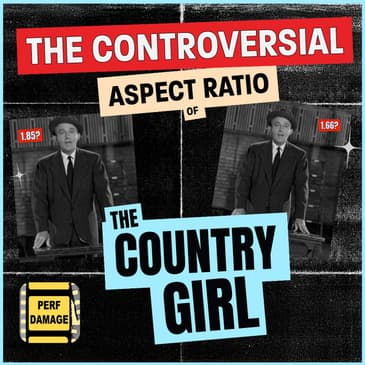
Building on our last episode about widescreen formats in the 1950s, we’re taking you inside a virtual restoration room for a hands-on look at how we determined the correct aspect ratio for The Country Girl (1954). You'll see clips of the film in multiple aspect ratios so you can decide for yourself—was it meant to be seen in 1.66:1 or 1.85:1? If you’ve ever wanted to be a film restorationist for a day, this is your chance to experience what the job is really like. Join us as we compare the film side by side, break down the visual and historical evidence, and reveal how the final decision was made—no lab coat required!
Contact Us At:
www.perfdamage.com
Email : perfdamagepodcast@gmail.com
Twitter (X) : @perfdamage
Instagram : @perf_damage
Letterboxd : Perf Damage
Check Out our Youtube Channel:
https://www.youtube.com/@PerfDamagePodcast
[00:00:00] Welcome to the audio-only version of the Perf Damage podcast. We highly recommend checking out our YouTube channel for the full experience, where you'll see visuals and details that we might not fully explain here. Otherwise, sit back and enjoy the episode. Welcome back to Perf Damage! Welcome! This is the show where we examine the secret histories of Hollywood. And talk about film restoration, which is... The topic of the day! What we're doing today!
[00:00:27] Today, that's right. Today, what are we going to talk about, Adam? Well, we had a wonderful discussion with Bob Furmanek and Jack Theakston from the 3D Archive recently... That's right, that's right. ...about aspect ratios. I know! Such a thrilling topic! Shockingly, people actually enjoyed that. I know, I was kind of shocked too. I mean, we enjoyed that. I mean, we definitely enjoyed that. That's like one of our favorite things to talk about. But you guys seem to enjoy it too.
[00:00:54] So, we thought maybe let's do a piggyback on that and we'll talk about a specific case study. Right. That we touched on a little bit in that episode, but we didn't really expand on because we had guests on. We wanted to talk with them more about their experience. Right, and we wanted to let them talk and... Yeah. So, we're going to talk today about The Country Girl. And this is a film that I worked on with a colleague of mine
[00:01:22] last year, a little while ago. And we ran into this issue where we had trouble trying to figure out what the aspect ratio was. And... And of course, this is from 1954. 1954. The year that Paramount actually switched over into widescreen. Very troubling year if you're trying to figure out widescreen. So, anyways, we figured we are going to
[00:01:44] take you guys into a virtual restoration room with us and show you what it's like trying to figure out an aspect ratio when you're working on a movie like this. Yeah. So, we're going to show clips. We're going to have those conversations like you have in the room. A restoration room. And you guys are going to be along for the ride. Yeah. Yeah. Whether you like it or not. And hopefully, you'll find it interesting.
[00:02:12] Yeah. So, you'll get to see exactly why we make some decisions. And you'll get to see what this film looked like in different aspect ratios and understand why we went with 166. So... If any of that sounds interesting to you... Sounds interesting to me. Stay tuned. Stay tuned. Hey, movie lovers. I'm Adam. And I'm Charlotte.
[00:02:41] And welcome to Perf Damage. We're a movie-obsessed husband and wife team who work in the film industry. I oversee film restoration at the oldest studio in Hollywood. And I bring the inside track from film development and production. And we love to explore the hidden tales of movies past and present. So, join us for a cinematic journey like no other. From classic gyms to examining the art of the double feature, this is Perf Damage.
[00:03:12] Popcorn pop. Wine at the ready. Let's press play. Let's press play. The country girl. Well, do we want to give a little background? Do you want to... Nah. Just kidding. Yeah. I mean, let's talk about...
[00:03:43] Let's talk about why you picked the country girl. Well, what is the country girl? And what the country girl is. Yeah, exactly. Why don't you tell the folks what the country girl is? Or, hey, wait. Actually... Let's just roll the trailer. Let's do that.
[00:04:13] I know you've read and heard about our picture, the country girl. And about the wonderful performances given by my co-stars, Grace Kelly and Bing Crosby. You've never seen either of them do anything like this before. And that's a tribute not only to their own talents, but to the size and power of this story. One of the great successes of the Broadway stage. Now, when I say size, I'm not talking about spectacular settings or a cast of thousands.
[00:04:44] This is the story of three people at the crucial moment in their lives. How they face it and what they become to each other. That's our story. Bing Crosby as Frank Elgin. A surprising and striking portrayal. Far different than anything else he has ever done. Grace Kelly, Academy Award winner for this, her greatest performance, as Georgie Elgin, the country girl.
[00:05:12] And I might forgive even you, Mr. Dodd, if you can keep him up long enough for me to get out from under. All I want is my own name and a modest job to buy sugar for my coffee. William, now... You can't believe that, can you? You can't believe that a woman is crazy out of her mind to live alone in one room by herself! William Holden as Bernie Dodd. Another powerful characterization from the screen's top dramatic star.
[00:05:40] When you took this job, I promised you no pity. And no pity it's going to be... I don't expect any! I'm only warning you, get rid of me. Let me go back to New York. So you can tell the boys at the Lambs Club that you quit because the part wasn't big enough? Oh no. If you leave this show, it'll only be for one reason. Because I fire you. Because I fire you for being an unreliable, slobbering drunk!
[00:06:30] Won multiple Academy Awards. Yeah, it was nominated for seven Academy Awards. It won two. It was the only Academy Award that Grace Kelly ever won. In fact, a year later, she actually quit the business altogether. Yep, retired. After winning. Retired. Yeah, and all the awards that it lost that year, it lost to On the Waterfront.
[00:06:54] Right. And the big runoff between Grace Kelly and Judy Garland that year. Everybody thought Judy Garland was like a shoe-in to win for A Star Is Born. Yeah, she was nominated. And she was actually not present at the Academy Awards that year because she was in the hospital. She had just given birth to a son. Right, right. And I guess they sent people over there to cover it. The film crew. Yeah, the crew was over there in case she won the award so that they could hand it to her. Ready to go with a camera.
[00:07:23] Yeah, and it didn't happen. And then so they're like, Okay, so we got to pack up here. You mind? Congrats on the babe. Yep. Awkward. Yeah, so that's what a lot of people will remember from this year. Not really, yay Grace Kelly, but Judy was robbed. Yeah, well, besides Grace Kelly, we have Bing Crosby in the film and William Holden. Yeah, stellar cast.
[00:07:53] Yeah, packed film. So here's an interesting little fact about this film. This was actually the first film that Bing Crosby allowed himself to be dubbed into a foreign language when he's singing. Yeah, he was really protective of the Bing Crosby sound. Yeah, so usually if he's singing in a film, the language was going to be dubbed. It could be dubbed in the other language until his voice came on and then the picture would have to be subtitled.
[00:08:22] So you would hear, you know, if it was in French, the French actor would be speaking. And then as soon as he would start singing, it would be Bing Crosby's voice singing and it would be subtitled. So this was the first film that he allowed that on. And I think part of that was because in reel one, there's a scene where Bing Crosby is auditioning and he's doing a mix of talking and singing. Oh, you got a desk sergeant down there's a little on the prod, a little on the muscle, a little on the cantankerous side, huh?
[00:08:52] Here's how we'll handle his case. Oh, with a cheerful song and a valentine and a sense of humor that scores, you're no longer in spin. It's a great world you're in and it's mine. It's yours. And it's hers. And it's hers. Share it among your friends. If you got some of it on you, tell them where you got it, huh?
[00:09:21] One of the things that all the foreign offices were saying is that you're really going to break the magic here of the character if he keeps talking in this foreign language. And then it's Bing Crosby singing a line in English and subtitled. And then our actor is dubbed again, saying the line. Talking in the language. And then he goes to singing again because there's a lot of talking, singing, talking, singing that's happening in this performance in the beginning.
[00:09:49] So I think that's what really convinced him to be able to, you know, to allow them to do it. Plus, this film is really more about a down and out actor. It's more of a dramatic thing than about a singer kind of musical. Right. Film. There are musical passages in it, but it's not a musical per se. Right. Yeah. So the studio was very, very worried about getting the dubbing right on this because it was the first time that Bing had allowed his voice to be dubbed.
[00:10:18] I don't know what he ultimately thought of the dubbing. I never found that information. No, all the memos were just back and forth between the offices. Yeah, just about we better get this right. We better spend the money to make sure that this is right because we don't want Bing to be upset with us and say we can never do this again. So. Do you like me? Doc, I think you're one of the most likable guys I ever seen. Come on.
[00:10:46] This was one that you looked at and you were like, man, I'm not familiar with this movie. So we watched it. Yeah, a couple of years ago, you know, because we always discover gaps in our film knowledge. Right. We've seen a ton of movies, but you can never see them all. And this is something, the more movies you watch, the more you realize that. Yeah. Yeah. It's funny. You meet people that aren't as into movies and they always apologize. Oh, I haven't seen this. Like, dude, I haven't seen everything. Hey, I'm comfortable with the fact that I have gaps, you know? Yeah. We have gaps. Yep.
[00:11:16] Everybody does. So this was a gap. And we thought, wow, look at the stars in this, the awards that it won. Yeah. And why isn't this better known? Why haven't we seen this? Yeah. So we watched it. And the transfer that we saw was just older. It wasn't from original Neg. It was really dirty. It was just, it was an old transfer. And when we watched it, the first thing we thought was. Man, this, this movie deserves a little love. This deserves love. Yeah.
[00:11:45] And it's, hey, it was a Paramount movie and just so happened to still be owned by Paramount. So, hey, why don't I try to figure out how to get this onto our backlog? Well, that's part of your job, right? That is part of my job. What you do, you schedule the films. It is part of my job. You decide which films each year go onto the list to be restored. There's a lot of things that go into that. It's not just like, that sounds good. Yeah, no, it's not all like, oh, I like this movie. Let's put it on there. I mean, let's be honest, there's a couple of those.
[00:12:13] But there's a bit more to it than that. And because of this one, because of who was in it and just how important it was, I thought, you know, if this gets a proper transfer from the original negative, which we had, somebody's going to release this, whether it's Paramount or a third party, somebody's going to want this. Right. And it deserved it. Spoiler alert, they did. Kino Lorber came to the rescue, I guess, to put it out there. They did. Yeah. They did. But that release, yes, that release was a little controversial.
[00:12:43] It caused a little controversy. Yeah. Because when we did the new transfer from the original negative, we decided to go with a 1-6-6 aspect ratio. That was after doing a lot of tests, looking at things both ways, and we decided 1-6-6 was the way to go. This was not an easy decision for us. Well, and what we're going to do is take you behind the scenes. Can you hold that thought? Yep.
[00:13:13] And, you know, and people on the internet were a little upset about it. I don't even remember what I was saying. That cracked me up. And I'm cracking up. I can't even remember what I was saying. But, no, seriously, I can't even remember what I was talking about now. Oh, I'm sorry. But it's all good. So, anyways, we did 1-6-6. People on the internet saw that and they thought, this is wrong. Well, they saw documentation.
[00:13:39] There was a box office magazine thing, which we talked about with Bob and Jack last time in the aspect ratio episode. And that was a, you know, that's, again, that's a good resource for trying to figure out what the aspect ratio was. 54 is the year that Paramount switched to an all-wide screen house when most of the stuff that they did was 185 that year. So, a lot of things point to this being 185. But there's, it gets a lot more complicated than that.
[00:14:05] Because you see with The Country Girl, this film was in production a month before Paramount actually switched to that all-wide screen thing. Before the Dick Tim came down, they're like, all things on wide screen now. Yeah. It was exactly like that. Just like that. They said it in that, you know, with that German accent. They called everyone into a meeting. They said, and you will make all the films. No. No, they didn't do that. They didn't do that? Okay.
[00:14:35] Anyways. So, yeah. So, it's just, it's complicated because there's no official documentation in the studio notes. I look at the correspondence between the, you know, that are in the studio notes. And there's nothing that officially says this is the aspect ratio. The only thing that it says is, hey, let's shoot this so we can show it in all these aspect ratios. Right.
[00:15:05] Right. But they're, you know, through research, you discovered that Shane, they were playing with different aspect ratios on Shane, which is another like really great. Well, that came out the year before. Right. But you. Well, they shot, and Shane is a different case because they shot that for 137 and then the studio decided, eh, let's release this in 166. So, they zoomed in on it. Right. But they had come down to like their widescreen format being 166 at that point. Right. Right. So, they were shooting in 166 and then they switched to 185.
[00:15:35] So, that was the thing. So, yes. That's, I see that's why you're running. Yeah, that's why. Yeah, yeah. Yeah. Yeah. So, that became the question. Is it 166? Is it 185? Because we knew at 1954, it wasn't 137. Right. Yeah. That wasn't even the question. That was long gone at that point. So, it had to either be 166 or 185. So, that was the question. So, that's where we are. So, with that little bit of background. That's a lot of bit of background. Well, not really. Not too bad.
[00:16:05] Yeah. Yeah. Let's take people behind the scenes. All right. Take them into the virtual studio. Into. Let's go. All right. So, first, this is a SMPTE chart. So, this tells you how to frame something. And this is incredibly busy and crazy looking. Yeah, it looks like a circuit board. I know.
[00:16:34] It's insane. So, we're going to simplify this. It's horizontal lines here that show you the aspect ratios. And if you look here, we've circled where it's showing you that aspect ratios are for 166 and 185. So, it's kind of pointing there. But it's still a little complicated. So, we're going to remove everything and show you where those lines are. So, the green line on the top and bottom, that represents where a 166 image would live. So, you know, the green on the top, that's the top of the image. On the bottom, that's where the bottom of the image would live.
[00:17:03] So, the rest of that would be cut out. This will make a lot more sense in a minute. So, just stick with us here. And then the pink is a 185 image. So, that's more of a widescreen image. If you're wondering why the heck do we need to see this? This is crazy. We're showing you this because this is how we're going to apply it to the film frame of the country girl to give you an idea of what this film would have looked like framed for 185 versus 166. So, this is actually a raw scan.
[00:17:32] This is a raw scan of the negative. There's no matting applied to it. You can actually see the sprocket holes on the side, the perfs. Yep. This is a... No perf damage, by the way. There is no perf damage. Not in this frame. Yeah. This is a raw scan and this is what it looks like. And so, then the green there, you see the green box would be what a 166 image would look like. And then the pink box there would be about what a 185 image. And these are all approximate, okay? Don't come at me with your ruler, all right?
[00:18:01] This is just for educational... Illustrative purposes. Illustrative purposes, okay? Don't come at me with your aspect ratio ruler, all right? We're just showing you this just to give you an idea, okay? I mean, our approximations are close, though. We're not saying that they're like way off or anything like that. Yeah, they're pretty damn close, okay? They're pretty damn close. But don't come at me with your ruler. All right. So, here's what we're going to do. We're going to watch the film. So, we framed the film. What we've done is we've applied that 185 aspect ratio.
[00:18:29] So, we're showing you that image from the film. We're showing you what would be within that box if this movie was framed for 185. Yeah, the matting is on there already. The matting's on there. And right away, we see right at the beginning, the Paramount... The stars were kind of... The stars were very, very close to the top of the frame. They were. They were. Which is not normal. So, we're looking at the credits.
[00:18:50] So, one thing that we talked about with Bob and Jack was that you can't really judge what the correct aspect ratio is from the credits. Right, right. Credits are usually not even shot by the original DP. Correct. They're not. They were sent to the credits department and sometimes shot... The credits department. Yeah, like they were shot by other people. So, you know, that if you're trying to go for... You can't judge by the credits. ...filmmaker's intent, that is, you know, that's...
[00:19:18] Credits are not what you judge that by. They're not the only thing you're going to go by. So, but we're showing you the credits because we want to show you. In 185, they look pretty good. They're, you know, these are framed a little... They're a little high. Yeah, I mean, the title there is a little close to the top. You know, we could make a slight adjustment. We could bring that down or whatever. Okay, fine. So, let's jump ahead and then let's actually get into the film. So, this is the beginning, the first scene.
[00:19:47] 185, the guy's head's getting a little cut off, you know, when he walks in. Bends down, stands up, his head's still getting... You know, Bill Holden's chin gets to the bottom of the screen there. But we do see the cameraman adjusting the camera to the guy's action. Yeah. So, that's an indicator that, you know, he's trying to frame. He's trying to keep things in frame. Correct. Yeah. All right, so, jump forward a little bit further. Bill Holden gets up. So, let's see. He's following the action here.
[00:20:15] But notice his head's sort of getting cut off. Yeah. Why is he cutting his hair off like that? Yeah. Again, they adjusted the camera up to accommodate him in the frame when he stood up. But even here, with all the people in the shot, it still feels a little tight to me. Well, yeah, look at this guy. I mean, the guy in the front. His shoulder disappears off the frame. Yeah, yeah. Edge. And just... And here, Bill Holden stands up and his head's out of frame. And clearly, this is a planned camera move.
[00:20:43] I mean, this is a planned action because he had to walk away. That's in the script for him to storm off. And that just felt wrong. Okay. Okay, fine. But, you know, that's just one scene. That's just... Yeah, that's indicators. These are the things that are showing you that maybe 185 isn't right. Yeah, so, they're just learning to shoot in 185. Maybe they don't quite have it done yet. Yeah, they don't quite have it done yet. So, Bing Crosby comes out.
[00:21:09] But, again, here, Bill Holden's head gets cut off. I mean, they're in the frame, but they're very, very close to the edges. I know, look how close their heads are to the top and their feet are to the bottom. Yeah, when the camera moves down a little bit to accommodate this third subject... It's so close. Bill Holden's head is touching the top of frame. It's just so close. It makes me uncomfortable. But if you think that's bad, here we go. This is like a clear indicator. And, again, we are not adjusting up or down here per shot.
[00:21:39] This is staying exactly where that box was. Right, and as a cameraman, one of the things I want to bring up here, where Bing Crosby is being cut off is at the navel. And one of the things you never shoot, as a rule of thumb, is to cut someone off at the navel. It's very, very unflattering. So, you always go either a little below the waistline or above the waistline. It's just not a good look. It's not a good look for anybody. Right. Just not aesthetically pleasing. So, I know what you're thinking.
[00:22:07] You're thinking, well, the problem is we haven't given them enough headroom. Right. You've center cut it. It's in the center of the frame. Adjust up if you need to, right? Right. So, let's adjust up. Let's actually bring the frame up and match it to where it would be for like a 166 frame. Where the top of the 166 frame would be, right? Yeah, which sometimes, you know, that's, if you're projecting it, that would be sort of closer to what you would do projecting-wise, you know. Again, approximate, guys.
[00:22:36] So, let's do that. Let's give them a bit more headroom and then see how that plays. Okay. So, we've given them more headroom. Now, we've cut up. We're cutting them off at the ankles. Yeah. Not only that, but the subject, the third guy here is basically just shoulder and head now. It's strange. So, that definitely didn't work. That was too much. But here, now we've got the right amount of headroom. Right? Well, and this is where familiarity with the film and performance comes in.
[00:23:04] But, look, now we're cutting off Bing's hands. We can't see his hands. And I think his hands are important in this scene because he's nervous. He's sort of playing with his hat a bit. He's fidgeting. And he also looks four feet tall now because of where he's cutting him. He does, where it's cutting him. Again, that's like the worst case scenario right at the waistline. So, clearly that didn't work. So, the 185 where we were cutting it, that didn't work. The adjusted headroom, that didn't work.
[00:23:34] So, just for kicks, let's see what it looks like in 166. All right. Well, let's do it. Suddenly. Look at that. Things just kind of snap. That third subject is actually established well in the foreground. They snap into place. Look. Their conversation. No one's cut. He's got the adequate amount of headroom. You can see Bing's hands. Look at him. And he's clearly, he's kind of fidgeting and nervous. He's fidgeting. Performance is really important in this scene.
[00:24:02] He doesn't look four feet tall. What did Bob Furman XA say? He said, suddenly things snap into place. They snap into place. This snapped into place. Look at that. Okay. But this is just one shot. Right. And we know one shot doesn't tell the story. So, let's go a little bit further. Okay. So, let's go. Now, we've got Bing in his audition. So, now we're back to the 185. The original 185 from the SMPTE chart. We're back at that. Look at that. We're cutting his head off there. The hat is lost.
[00:24:33] Look, the camera is moving here to accommodate him bending down and then standing up straight. Again, so, when we were in that original color session, and this is originally how we had it framed, we're thinking at this point, there is no way. Look, look how uncomfortable Bill Holden looks. He looks like he's crammed in there. He's like, give me more room. I need one six. Oh, my head is getting cut off. Look, he looks uncomfortable. They all look so uncomfortable in that 185. 185. It just, ugh.
[00:25:01] Bill just wants his hair to be in frame. He just wants his hair in frame. And, you know, Bing wants it in there. And Bing does not want his forehead cut off. All right. Let's see what it looks like in 166. All of a sudden, again. It snaps into place. You can see. Look how happy he looks. Oh, he's so happy. It also establishes this table, which was weirdly floating just above the bottom of the frame before. He also brings that out as a prop.
[00:25:30] It's part of sort of the, I don't know, it's a prop that he brings out to interact with it again. And there's that frame you stopped on at the beginning. You pop it back to 185. See how tight it feels again. He's pointing. Hey, where'd my 166 go? Look at him dancing. Look at 166. It just looks better. I'm biased. Yes. Yes.
[00:25:59] But it just looks better. And Bing is so happy. Look how happy he looks. Not just better. It looks right. It's almost as if he knows. I mean, look. Look at how. Oh, see, that's just pure joy. That is a I love 166 face right there if I've ever seen one. He has the freedom. He has the head space. He's got it all. All right. So let's go back to the beginning then. And let's just really compare.
[00:26:25] Let's see those opening credits, what they look like at 185 and our 166 that got released. And you can see. And again, this is a approximate 185 that we've got here based on that SMPTE chart. It's pretty damn close. It works. It's fine. I do think that that building being cut off at the top is a little weird. Look, again, we could have adjusted this down a little bit. Look, again, this is copying from that SMPTE thing. This is where we'd end up.
[00:26:55] Anyhow. Again. We remember this guy. Yeah. You remember this guy when he walks in and his head got a little cut off. But look at it in 166. Just. Do you see the camera movements to keep him in frame? Look at Bill Holden. He doesn't. The camera movements now make sense. Well. Look, see there. He stands up. He's got that normal headroom. Yeah. And then again, the Bill Holden scene when he gets up. Camera's following him.
[00:27:25] Yeah. Keeping him in frame in 166. Mm-hmm. Look, his hair doesn't get cut off when he stands up straight. While he's acting, you never saw Lonesome Town. Elgin played a part exactly like this and he was just magnificent in it. All right, don't take my word for it. Ask Henry. He played the piano in the pit for that show. When was that? Seven or eight years ago. He wasn't falling off bar stools then. I hear he hasn't had a drink in a long time. To a drunk? Ten minutes is a long time. I'm not asking you to live with him. I just want you to listen to him.
[00:27:55] All right, go ahead, go ahead, go ahead. So there you have it. Little peek inside the studio. Those are the conversations you guys have. Yeah, sort of. They do go like that sometimes. Yeah. You know, you look for camera movement. Mm-hmm. You look for composition. You look for headspace. What's another thing you look for? Something else. All kinds of stuff. Yeah.
[00:28:24] All kinds of stuff. You heard it here. All kinds. All kinds. That's very scientific. All kinds of stuff. We're not a science department. Isn't it? Anyway, so yeah. That's how you decide between 185 and 166. I mean, that's not the only way. But yeah, so that, I mean, that, that's what we did. We checked all the reels. We only focused on one reel here today. We didn't want to get too complicated. But again, we checked throughout the whole film.
[00:28:54] This isn't, we didn't just look at five minutes and say, oh, nope. Yep, that's it. This isn't working. Right. No, you have to apply it to the entire film. No, we go through the whole thing. And I actually did a LinkedIn post on this on November 12th, which there is a reason why I chose that day. That is the day that Grace Kelly was born. It was Grace Kelly's birthday. And oddly enough, that is also the day that William Holden died on. Wow. So they intersected. Very weird. Yeah.
[00:29:23] That's a very weird coincidence. Yeah, it's a very weird coincidence. Weird coincidence. It's a weird coincidence. It's a weird coincidence. Yeah. Very weird. I don't know how I happened to find that. I was just looking up stuff and I saw the date and it's just, hey, wait a minute. So I posted on that day about this journey, about the aspect ratio journey on LinkedIn, about how we compared the different aspect ratios and how we looked at studio notes and we did our research
[00:29:51] and how we spent our time coming to the conclusion that 166 was the right way to go. And I still feel that way. And... Well, I think, you know, using this as a case study, I think... Case study. ...that you, the viewer, can now decide for yourself whether you think... You want to go with the tightly cramped frame? Now you got a few clips to enjoy. Well, you used some different examples too, some stills. I did on LinkedIn.
[00:30:21] To illustrate on LinkedIn. Yeah, for some different... For other reels. But anyhow. Well, we hope you enjoyed that peek behind the scenes of The Country Girl. Yeah. And, you know, controversy is always a good thing, really. Yeah. I mean, that's what brought this episode on really was the controversy of the aspect ratio. Right. I mean, anytime someone's talking about an old movie, that's good. Yeah. I mean, that's the thing, right? Right.
[00:30:48] Even though people were saying online, oh, they did the wrong aspect ratio. And, you know, that brought up a lot of talk about it. And, you know, again, I feel confident that we did the right aspect ratio. We as in me and the project manager, Charles Stepsick, who worked on this. Oh, yeah. We definitely have to give a shout out to him. Incredible preservation manager, senior preservation manager at Paramount. And, you know, we're very confident that we did the right thing here.
[00:31:16] Um, but we're just also happy that people are feel passionate enough to feel something and feel, you know, not feel upset, but feel passionate enough to speak out about it and want to make sure that things are done right. And film debate is healthy. It is. It is. We love that. Because we do the same thing. Yeah. And sometimes I'll just take in the devil's advocate role, even if I feel the same way as the person across from me just to argue about this. Yeah, you will. So.
[00:31:46] Really annoying. But, uh, yeah. No. Uh, film debate discussions, always good. And always questioning things is good, too. Just making sure. Because, like we said, we really thought it was 185. All the documentation was pointing us in this 185 direction. But then we get into the room and 185 just didn't work. And this was not just me and Charles. This was the colorists.
[00:32:13] This was other people we were calling in saying, hey, can you look at this? What do you think? Everybody just felt this is way too, this doesn't look right. This just doesn't look right. And again, we go through all the reels like this. This isn't just, we check a spot or two and just make a call and, you know, call it a day. Right. So, we take our jobs very seriously because we always say every movie is somebody's favorite movie. And you want to try to do it justice no matter what it is.
[00:32:39] Even if it's that stupid dummy that's in those Republic pictures. You know the thing I'm talking about. Yes, I know you've done a bunch of movies with that guy. But you know what? Stupid dummy. That guy's somebody's grandpa. Oh, shut up. I want to thank you. Okay, daddy. I'm not your daddy. Don't tell me you're my granddaddy. No. No. Your granddaddy was a maple tree. Well, if I did come out of a tree, I'm no sap like you. Well, I'll tell you, Elmer, I don't like this business.
[00:33:08] I heard in a ghost. What? Ghost? Let me out of here. So, you're doing the good work helping that family legacy live. Yeah. Live on. Yeah. Republic films. Doing that for grandpa. Okay. That stupid dummy though. Oh my God. All right. Well, I guess until next time, thanks for joining us here on Perf Damage.
[00:34:14] Well, we hope you enjoyed that peek behind the scenes with the country girl. Yeah. I said, oh my God.