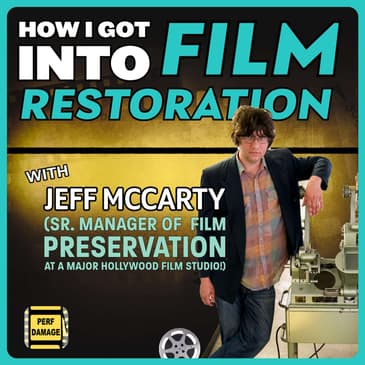
In this episode of Perf Damage, we sit down with Jeff McCarty, a Senior Preservation Manager on Charlotte’s team at Paramount, to talk about his incredible journey to get into film preservation. Jeff shares the story of how he got his start from attending the USC film school, to working at Technicolor and he walks us through the many twists and turns that led him to Paramount. Along the way, he’s worked on some major restorations, including The Godfather (1972), the silent classic It (1927), The Day of the Locust (1975), and King Kong (1976).
Jeff gives us an inside look at what it really takes to preserve and restore films—from the technical challenges to the unexpected surprises in the archive, and reflects on what it means to care for cinematic history. It’s a conversation packed with behind-the-scenes stories, deep knowledge, and a whole lot of film love.
Plus, Charlotte and Adam geek out about nitrate, color timing, and what it’s like to work with someone who knows his way around a vault reel like nobody else.
Contact Us At:
www.perfdamage.com
Email : perfdamagepodcast@gmail.com
Twitter (X) : @perfdamage
Instagram : @perf_damage
Letterboxd : Perf Damage
Check Out our Youtube Channel:
https://www.youtube.com/@PerfDamagePodcast
[00:00:00] Welcome to the audio-only version of the Perf Damage Podcast. We highly recommend checking out our YouTube channel for the full experience, where you'll see visuals and details that we might not fully explain here. Otherwise, sit back and enjoy the episode. Welcome back to Perf Damage. Welcome. This is the show where we explore the secret histories of Hollywood. And talk about film restoration, which is what we're going to talk about today. That is our topic.
[00:00:31] With a guest. A special guest. Yes, a special guest. That's right. We have a guest. Our first guest in this setup. I know. What's going on? It's not virtual. Longtime listeners of the podcast may recognize this voice. This is Jeff McCarty. You're hearing the applause, right? Oh, yeah. Oh, no. He's applauding. Yeah. All right. So we're going to talk about some of the restorations that Jeff's worked on. We're also going to talk about how we got into restoration. Right.
[00:00:59] So if you want to hear more about that. Stay tuned. Stay tuned. Hey, movie lovers. I'm Adam. And I'm Charlotte. And welcome to Perf Damage. We're a movie obsessed husband and wife team who work in the film industry. I oversee film restoration at the oldest studio in Hollywood.
[00:01:29] And I bring the inside track from film development and production. And we love to explore the hidden tales of movies past and present. So join us for a cinematic journey like no other. From classic gems to examining the art of the double feature. This is Perf Damage. Popcorn pop. Wine at the ready. Let's press play.
[00:01:54] So anyhow. Here we are. Here we are. We are. We are on Perf Damage. Jeff is live on camera now instead of just being a voice. True. Jeff's got a really interesting career. Yeah. So let's, let's, why don't you tell us about your career to get to film restoration where you are today?
[00:02:24] It's funny because growing up I didn't even know film restoration was a thing. I don't think most people do. No, no. Pretty common. Yeah. I love movies. I watch Cisco Niebert like, you know, religiously. They taught me a lot about movies actually. Their books. Well, you grew up in Chicago also. I grew up in Chicago. Yeah. And also Hollywood just seemed so, I know we talked about Charlotte, just so far away. Like it did not seem like something for someone like me to do. Right. And anytime I would even broach the subject with my parents, they'd kind of be like, yeah, you might want to get into engineering or something. Yeah.
[00:02:53] Why don't you be a doctor? Yeah. Doctor, engineering, law, whatever. None of those things appeal to me. So, but yeah. So I, you know, I love movies. I kept lists of movies all the time. Maybe my earliest form of collecting metadata. You know, lists of the directors, the genres. Yes. You are a big list. Jeff loves lists by the way. Yes. I do. I do love lists. I do. I do. My, my first inkling of film restoration was actually an episode of Cisco and Ebert where
[00:03:22] they had a full, it was like the future of the movies or problems with them. I forget what the theme was, but they had a whole section on film restoration. And I, and they had Martin Scorsese come on who brought a can of Lawrence of Arabia from the vaults to show the condition the can was in. And it was really degraded, really rusty, really corroded, just looked terrible. And I had never even thought about storing film prior to that. And, you know, film seemed to come from the heavens. It's, I didn't think of it.
[00:03:52] Yeah. It wasn't a physical, tangible thing. No, no, no. I'd seen it projected. There was a, some friends of my parents who had a small theater that would play movies sometimes. So I got to go into a projection room. So I was aware that it was on film. Right. But I didn't really think about, you know, much like the rest of Hollywood didn't think much about it for like decades. Right. About properly storing it and, you know, taking care of it and making sure it's going to be able to be seen for future generations and how it decomposes. And so that was my first knowledge of that at all.
[00:04:22] Um, so then, uh, I went to USC for film school to be a filmmaker, took a lot of critical studies courses. Never formally trained to be a film preservationist. I've never, that wasn't ever, I didn't know it was a career, you know, so it's, uh, I want to be a filmmaker, maybe a film critic. I wasn't sure. But, uh, well, I think that's one of the most interesting things is that everybody's journey to become a film restorationist is completely different.
[00:04:48] So at USC, we were the last generation, last year probably of undergraduate kids who actually worked with film. We shot everything in 16 millimeter. We cut in movieolas, shot a few things in 35. Uh, we, we learned how to, um, do negative conform, learned what an inner positive was, all of that in school. Uh, and shortly after that they switched to avid and nonlinear editing and shooting all on video. So, so I had, you know, all of that experience from school.
[00:05:17] But yeah, my first actual film industry job was a post house called vid film. And it was a duplication house for video. Basically they would make, they had giant rooms of almost like airplane haters of endless VHS machines recording airline, you know, all the videos for the airlines or so forth, making copies of D2s and D1s and digi beta cams. And, um, so that's what I was there, but they also did telecine and telecine was transferring film to video.
[00:05:45] So I would prep the film that would come in, I cleaned it and inspect it. Um, and you know, that was pretty much it. Then give it to them and they tell us any of it. So that was my first job handling film, which led to working at Technicolor, which is a, you know, the, the famous film lab. And that's where I learned all the photochemical arts of film restoration, except for developing. I didn't, didn't develop film there.
[00:06:08] Now having worked both photochemically and then now working digitally, how has restoration changed? Because you said you, yeah. Yeah. I mean, well, for one thing, just, I mean, I, it was very physical when I worked there. I mean, the first job I ever had there, the first film we ever restored was a house sweet it is. It's a Debbie Reynolds comedy for 1967. And I remember we made a print from the negative and we put the print up on a movie
[00:06:37] Ola and in front of me, I'd have the negative on a bench and we would play the film on a movie. All the stop at every frame where there was dirt and turn around, swivel around to the desk, find, isolate the piece of dirt on the negative and using chemicals, soften the emotion a little bit and actually pick out the piece of dirt. Oh, wow. And then go to the next frame and find the dirt and just, I did that all day long. That was my first, you know, restoration work I did there. It was all, I was a, I was a dirt picker basically.
[00:07:08] And then I started printing film. I did that for years, optical printing, contact printing. Can you explain what those are? Oh, optical printing is where you are shooting a print through a lens. So you have the negative over here and there's a lens and you're shooting over there. So you, so you can like reduce, you know, the size of the film. You can, there's a lot more creativity you can do with an optical printer.
[00:07:33] You can contact printer is the negative and, and print stock are in lock with each other. They're writing over the aperture and being exposed together the whole time, as opposed to being shot through a lens where the lens, you can manipulate things and control things and contacts is more like one-to-one kind of stuff. So I did that for years and that was fun. I got to work with a technoscope, Thunderbirds are go. I think was the first, was the first thing I printed there. Jerry Anderson. Yeah. Yeah. Wow. It's really cool.
[00:08:01] It's like a two perfs. This frame is widescreen, but it's flat. And then we blew it up anamorphically for the four, you know, perf print that would go out. We did a sequential exposure. I printed on the original optical printer that prints snow white. Oh, wow. Really cool. A bunch of experimental stuff. I was talking earlier about the gaucho. So Douglas Fairbanks movie where every red and green frame was inverted. So you print what you print it one way, you know,
[00:08:29] this way and then flip it around and do every other frame and see, you know, superimpose them that way. We did stuff. There's a film called the big circus, which the blue layer, the original negative was faded much like our Vista vision titles. And so that was the first time I ever printed a blue record on top of the original negative, just to bring back that, that blue, much like we do now with the scanning and for Vista vision since the blue layer is the top layer and often starts fading the fastest in Vista
[00:08:59] vision. So, yeah, I did all that work there. Probably the biggest film I worked on there was the big parade. 1925 King of the Door, World War One classic. I spent an entire summer patching up that film because after film printing, I went into film inspection and I became very, very good at making film repairs. Like if there was a hundred feet of film missing perforations on one side, I, that was shrunken.
[00:09:23] I'd slowly piece by piece build an entire perf line going all the way down. So that's perfect. That's perfect. Yeah. Yeah. The person even there, I totally rebuild them. Right. And shrunken. So like you can't even use normal film stock to do it. You have to do it kind of incrementally. Yeah. It'll get to, you know, it starts getting too, too close together. The perfs. So I did all that and just made crazy repairs to it, printed it.
[00:09:52] We had a big screening. Tom Hanks was there actually said we had that. We did a great service for mankind. He loved the film so much. Um, worked with, uh, old, uh, French prints from 1903 that were hand painted the cells. Uh, that was really interesting. We did that dry optically. And so, you know, we wouldn't damage any of the dyes that were in there. So, uh, the battle of Midway. We did that, that, that title. That was a John Ford when he was over there in one war two, shot a bunch of stuff. And it continued my film history too.
[00:10:22] Like I learned all about the pre-code era, which I knew about, but because I worked at Technicolor, we worked on all the Barbara Stanwyck, all the James Cagney, you know, all the Warner Brothers pre-code films. And I just grew a deep appreciation for that, which is one of my favorite things about doing this too. I learned about movies I didn't know about. So then you moved from Technicolor over to. I was at Technicolor for 12 years.
[00:10:45] Um, and yeah, then they, for about two years I was doing freelance film editing and I got a job at Paramount. So that's where I met Charlotte shortly. You actually got the job that I applied for. Oh yeah. Yeah. You were mad at me. I wasn't mad. She was disappointed. So yeah. She was just disappointed. It all came around. Um, no, you were way more qualified for that position. Yeah.
[00:11:13] But I had not done a lot of digital restoration. Um, do you want to talk about the Godfather? Oh yeah. Yeah. Yeah. Yeah. The Godfather. The Godfather was originally restored before my time, uh, by Robert Harris and Gordon Willis was still alive and they did a great. Gordon Willis is the, the, the cinematographer. Right. Yeah. And Jan Harborough who works over at Warner Brothers MPI. That's where we did all of our digital imaging at, and they did a great job. I mean, that was a, you know, I mean, they know what they're doing.
[00:11:41] And so we weren't trying to remake, you know, the restoration of the Godfather. We just wanted to honor that restoration, but make it, um, work in new digital mediums like HDR and so forth. And it had never been scanned 4k and stuff like that. So, but one thing that had not had that did not happen in 2007 is that 30% of the Godfather is dupe negative because they're in the original, the original negative because the original negative for whatever reason was run to make a lot of the release prints early on.
[00:12:10] Well, cause it was heavily damaged. They didn't expect it to be the big success that it was. Right. And at the time they used to run prints off of the negative. I think the data locusts actually had the same problem because it was so beat to hell. Yeah. And normally the process would be for anybody that doesn't know. You'd make an interpositive from your, from your negative and you make, which is known as an IP, which is known as an IP. And you'd make an intermediate from that. And that is what you would make all your, your release prints. But yeah, by the time you get to the print. Yeah.
[00:12:39] It's, it's three generations away from, you know, from the original negative. So it's going to be a little bit compromised. Uh oh, uh oh. Um, hey Ripley. Come on up. Ripley, Ripley worked on the Godfather with me. Come on. You know how Vito Corleone had to, had his cat. She actually did. Well, uh. She actually did. Yeah. No, I believe it. I believe it. She went to a review session of the Godfather to the audio session. Oh, nice. So she did work on the Godfather. Nice. Um, so the Godfather, a really cool, cool thing about that.
[00:13:08] So we started working on it right before the COVID lockdown. Uh, we did the, we got the original negative inspected where we saw how much of it was dupe negative still like 30% of the film is duped. It's crazy. Yeah. That's, that's a lot. Yeah. So, uh, during the pandemic, all of a sudden we all had to go home. Um, and one of my colleagues, Jeffrey Osmer works in the, in the, um, archive. He built his own inspection bench at his house, took all the old trim boxes home, an original
[00:13:38] line script of the Godfather and matched up a bunch of the footage from the trims that were thought lost. That had been removed from the film. Dupes had been cut in. And we still had a bunch of it, not all of it, unfortunately, but about half of it. So this is insanity. This is some insanity. Yeah. Yeah. They really dig the, yeah, they really into the Godfather story. They really want to hear the stories. Coming in. Um, but yeah, so we were able to restore half of those dupe sections with original negative,
[00:14:08] which is really incredible. Yeah. So like you were saying that you would replace these, right. Right. They had replaced these sections, but they had kept them. Right. And you were able to go in and find them. Thanks to Jeffrey Osmer. Thanks to a code book and a little key. You were able to find them. So. Yeah. Cause even 2007, they replaced most of the stuff with CRI. Um, and they weren't able to just, um, recombine the separation masters very well in 2007, but we were able to do that much better with, with newer technology now. Right.
[00:14:37] So what's CRI? So a CRI is a color reversal intermediate. So it's, it's. Jeff hates CRIs by the way. Charlotte always says that. It's true. It's true. I don't really hate them. I mean, they breathe really badly and they're, yeah, there's. They're not all bad. Yeah. They're not all bad. I mean, it's an interesting technology. The idea of making a negative from a negative, it's, it's reversal stock. Right. So you don't have to, so you skip that negative to positive stage. Right. Which is not ideal. Yeah.
[00:15:06] They thought that it was actually going to preserve like, you know, or, uh, yeah, you would be saving a generation. Exactly. Exactly. But it had, but it had its own problems with the stock itself. So occasionally stuff looks good. Like, uh, there's a film. Scalawag. Yeah. Scalawag that we did. It's a CRI. It looks beautiful. Yeah. I mean, I did it right. I don't always hate them. It's not true. It's a CRI. Jeff hates them. Yeah. It's a CRI.
[00:15:36] It's a CRI. So I think that's a CRI is a CRI. It's a CRI. It's a CRI.
[00:16:06] It's a CRI. It's a CRI. It prevents the crosstalk and yeah, you can recombine them faithfully. And so we were able to do that with the Godfather and replaced anything that we could not do with OCN trims with those and it looks great. So what was your final tally then at the end of, uh, you were able to restore how
[00:16:35] We have those numbers and we will put them up on the screen. We do have them. I'm just going to guesstimate them. Uh, we'll see if they're right. It was like 30% of the film was dupe stock. I believe we replaced, I don't know, maybe 17% and the other 13 was from. So I mean, of course, Charlotte can. I have no, I don't remember, but we're going to chat. GBT will not know that. No, they will not. Yeah. No, no. But my PowerPoint presentation that I put together. Yeah.
[00:17:05] Yeah. I know the numbers were, but regardless, it looks great. It does never look better. I think it's in the 90 percentile. And the whole, like Jeff was saying, the whole restoration was done during the COVID lockdown, which doesn't sound that impressive, but just trying to move film elements between vendors, trying to get stuff scanned, trying to get in to look at stuff. It was a very hard time. We'd have to watch. Yeah. And we'd have to watch these things in different rooms. Like there's only two people allowed in a room. So it'd be like me and Laura Thornberg in one room and, you know, Jan and whoever else in the other one.
[00:17:35] And it was just, it was nutty. Yeah. Um, but, and they were the only people I saw during the pandemic, other than my, you know, fiance and my daughter, you know, the people I worked on The Godfather with. Yeah. And it won the HPA award, which it was the inaugural restoration award. Yeah. And it won the award for best restoration. It was that. And with the film like The Godfather too, it's like, so we're, you know, we're restoring it into new color spaces that did not exist back then.
[00:18:02] So working with James Makowski from Zoetrope, who is, you know, the voice of Francis Ford Coppola, who also watched the film and gave his blessing to it. We had to reign a lot of stuff in as well. We had to leave highlights blown out in spots where they're supposed to be blown out. We had to crush the back of Vito Corleone's office in the very opening shot. You're not supposed to see all that detail, even though it's fun to see it all like, oh, look at all that cabinetry. But, uh, it's, it's supposed to be like hell. Yeah. You don't, you don't want to see all that little stuff. So, but certain things it was great for you.
[00:18:32] You could see all the details and tell you show your wedding dress, which is really nice. And, you know, I should have been seen. So it's kind of that, you know, keeping the spirit of the film, right. And making an experience that works very well in new mediums. It's faithful, but you know, respects both. Well, and that's, you know, that's honestly what you guys are working against all the time. All the time. Yeah. With new technology, just because you can do it doesn't mean you should do it. Right, right. And, and you're always like trying to work for the benefit of the film.
[00:19:01] Like always, it's always about the film. Um, and, and of course we always try to bring the talent in if they're alive, you know, to make sure that they're happy with everything we're doing. And we always consult like the best archival print we can if it, if it exists. And especially if something's been approved by talent. Especially if it's been approved by talent. Yeah. If a cinematographer swore off, you know, signed off on it, then yeah, to us, that's the Bible of how it should look. Right. I'm not gonna, you know, reinvent the wheel to, you know.
[00:19:30] Well, it's not your place. Your place is not, it's not my place. No, no. You can complain about it in the color bay and say, I would have done this differently. Right, right, right, right, yeah. But. Right, definitely not. No, no. Yeah. And people can buy it on 4K, see the restorations. Yeah, which is one of the best things about some of the restorations we'll talk about today. Cause we do work on a lot of stuff that. Isn't available. You can't see. Right. Lots of films that can't be seen. At least not yet. Not yet. Yeah. You guys are working on it. Oh yeah. Always, always. So let's talk about another one. Sure, sure.
[00:20:00] Something that's like really close to my heart. Alright, which one? Was King Kong. Oh yeah. I love King Kong. Yes. My favorite King Kong movie. I'm just gonna say it. I know it's controversial. I get some hate for that. I mean, I love, I, of course I love the original film. I mean that, that's the original. It's set the whole tone and everything. All the special effects are incredible. But the one I loved as a kid was that 70s one. Yeah. Since I've known Jeff, he wanted to restore. Yes. I really did. Very, very much so. Yeah. It has some bad.
[00:20:30] Well, people would say there's a lot of bad. There's a lot of bad stuff. But, but, but some really bad matte lines. With some of the. What's a matte line? The special effects. Well, that's just when you're compositing different elements of a shot. Let's say you have a. Like a special effects shot. Yeah. Like you have King Kong in the foreground. He shot him in front of a green screen. You have like the mountains behind him. That's a back plate. Then you have another piece, maybe Jessica Lane in Kong's hand. And they ought to be optically an optical printer again, which I worked at a tactic color
[00:20:59] composited together into one seamless frame. And the problem is it's an imprecise science. And you can see the matte lines of where things didn't quite line up when you're, you know, maybe King Kong, you can see some fringing around his, his hair and stuff. The compositing matte. Yeah. You see like a green outline around a person. Yeah. And it takes you, it takes you totally out of the film. You're supposed to be wowed by the majesty of this big giant ape. Yeah. And in a print. Yeah. You wouldn't have seen that in a print. Not as much. It's totally obscured.
[00:21:28] Both HDR with really sharp. Yeah. I mean, it's sharp imaging, high resolution, high contrast, dynamic ranges that never existed before. You're seeing all this shit. Like, you know, just, just really prominent. So yeah, we blurred those edges to look, how would it look on film? And that's something I guess people could say is kind of controversial. Like, Oh, you're changing the film. We're not really changing the film. We're changing how it looks in HDR and make it look how it looked when it was actually projected in the theater. Right. And that's very common in 4k that people do that.
[00:21:58] Like they did it for Indiana Jones. Right. Yeah. The war of the worlds with, you know, with the, the lines holding like the ships, The wires. The puppet wires. It's like, you couldn't, you couldn't see it in the film print. You could see it once you scanned it. Right. So yeah, you should do that. And I guarantee if the filmmaker was sitting next to me in a bay. Right. And gave me the choice of leaving the shitty mat lines in or, you know, obfuscating them. He's, I mean, he's going to ask me to blur them. I mean, there's a couple of things that they leave in.
[00:22:28] Like in the Godfather, there's a scene when, when Michael Corleone does his first double assassination of the police chief, McCluskey and, um, Slauso. And he walks when he, when he drops the gun, he walks past the camera and he bumps the camera. And we could have like, you know, straightened, stabilized, stabilized and all that. But, uh, but, uh, but Coppola asked us to keep it in. And I think that's cool. Um, same thing with the, when, when veto is gunned down outside that overhead Eagles eye
[00:22:56] shot, there's one gun that you don't hear a sound effect for. And he wanted that to stay off too. Oh, nice. But you know, there's also the famous, uh, Jimmy Conn beating up, uh, tell you shire's husband and he clearly misses them in that one punch. It's everyone laughs every time we see it, but so, yeah, I mean, those are little mistakes. They're meant to be left in, but, and King Conn. One thing I could not fix is that giant 40 foot mechanical ape. That's always going to look shitty. It just, it just is. And that I would not fix cause it looked shitty.
[00:23:25] Then it's supposed to look shitty. It's gonna look shitty now. Yeah. But it was, you know, state of the art at the time, but, but you know, it was what they could do at the time. And it's a historical artifact and this big giant 40 foot. I mean, it's, it's amazing. This piece of engineering they did. It didn't work very well in the movie, but it's pretty cool. They did it. I'm not going to remove it and make some sort of, you know, digital recreation just to make it more fluid. Cause that's part of the film. Yeah. See, that's different. Cause that looked bad in three, five millimeter as well. And that's the whole thing.
[00:23:55] Just trying to make it look like it did opening day when people watched it. Right. So you also got to work on the audio. You just. Yeah. Yeah. So we went back to the original dialogue music effects stems remix that also went back to the original music masters, which are, you want, let me explain the music master, which is basically just, I mean the music it's on a bridge. It's on it. It's on fucked with it's just, it's just the original music.
[00:24:22] That's not been compressed or put through anything or remixed into anything or, or. Yeah. I mean, it's like the raw. Yeah. Yeah. Exactly. Exactly. Yeah. It's what they recorded in the room. Yeah. It hasn't been mixed down or anything. Right. Nothing's been added to it. So yeah. So we went back and use that. So we have this nice, beautiful full score. It just. Booms and swims and all around you. And you said DME's just. Yeah. Do you need to explain dialogue music and effects? So that means that all those tracks are separate. So.
[00:24:52] Which that gives you greater ability to make a five ones. Yeah. Yeah. I mean the bane of our existence often is not even just for making five ones is having a composite track without that separation because. Yeah. So a composite track means that they're all on one. So everything's together. So you can't. It's all been flattened down to. It's flattened down. So, you know, you don't have that separation. You can't put the dialogue over here. And the music over there. You. They're all together. It's tied together. Yeah. Yeah. Right. Yeah. Like you could have like a really bad line of dialogue, but you can't. The music's playing underneath it. Yeah.
[00:25:21] Or maybe the music's way too loud and you don't have the option to. Although. Although I hear they are using some new tools to extract dialogue and music and effects. We are. In Sunset Boulevard. We are. Do you want to talk about that? We'll be talking about that soon. Yeah. We will. We'll talk at length about that one. Yeah. Very soon. Yeah. We're always trying to find new restoration tools to do things we couldn't do before. Yeah. Sometimes AI is not bad. No. So very controversial what you just said. Oh, I know. Very controversial. I know.
[00:25:50] I mean, well. No, it's an AI tool that's actually for good. Well, I mean, I'll say, I mean, if there's something you could not do prior to AI and you can do it now and it's, you know, fixing an image in some fashion or extracting a sound you can extract. I think it's a good thing. I mean, how could it not be? I mean, AI is archive intelligence. Oh, there you go. Yeah. I mean, honestly. Yeah. It's all about new technology. Like what everything you guys do, you couldn't do 20 years ago. No.
[00:26:17] So, you know, all the whole digital workflow is completely different than what you grew up on. Like what you started. Absolutely. Completely different. Again, like AI tools to, you know, there's a something we're trying to do with a, oh, if there's a film that had incomplete color records and you had like half the film that had like color records and you extract. So that's like a three strip. Yeah. Like a Technicolor. Like a true color, a two strip, a true color film, whatever, where like you had like the
[00:26:44] red and blue records for maybe half the reels and maybe only the red records for the other half. Somehow using AI intelligence to extrapolate a color palette from the existing records and how they relate to one another and filling in the missing color and the reels that are not, you know, they have missing color records. That's something you're, you're experimenting with right now. Yeah. Yeah. He's been doing a lot of work with that. That's great. Yeah.
[00:27:13] Because sometimes you'll have missing reels, like a reel that you don't have. Right. Yeah. A lot of, a lot of times. So that's a way to get the, the full film the way it's supposed to be experienced. Yeah. There's another thing we're trying to do with a Mary Pickford film where there's some decomposition in the image and we have a really low resolution reference video that we could potentially upscale for some of that stuff that's decomposed, but somehow like doing some sort of image mapping
[00:27:42] where we can marry the upscale to what's left of the, of the decomposed image. Right. And marry, marry. And marry, marry together. So it's taking the information that's missing and then kind of filling that in. Right. Yeah. Yeah. Yeah. Because you have the motion, you have the movement, you can see it in the low res thing. Right. But mapping some of the detail from the stuff that survives in the high resolution and filling it in. So, I mean, that's stuff that you can't do without like computer intelligence. Right.
[00:28:11] Jeff's always looking for new stuff like that to play around with. Yeah. I think that's fascinating. Yeah. And you should be using technology to your benefit, you know? Yeah. I mean, another thing. Yeah. And never for a whole film. Right. It's just like, hey, we have this one problem. What exists that maybe can help us with this one problem here? Yeah. Let's talk about Reds. Yeah. Yeah. Yeah. Reds, like one of my favorite films. I still cannot believe it's not on the Library of Congress list. It's ridiculous. I cannot. Every year it gets looked over.
[00:28:41] Yeah. All right. So this year we'll try to get it on the National Film Registry. The National Film Registry. I vote for it every single year. All right. This year, everybody. Everybody can vote for it. Yeah. Call to action. I mean, it's such a great, one of the greatest historical epics Hollywood ever produced. It's ballsy as hell. It's about communists. It's about, you know, it takes place during the 1917 Bolshevik Revolution. Warren Beatty, Diane Keaton, they go over there to start a revolution, get, you know, disenfranchised from it.
[00:29:10] It's a love story. It's just, it's just fantastic. So that film was kind of similar to, we talked about Day of the Locust, right? We haven't talked about that. Oh, okay, okay, okay, okay. So that had a print as well that was signed off by Vittorio Storaro, was the cinematographer, and Warren Beatty from 20 years ago, which had a very particular look to it. So we scanned the film. I screened that print many times for the colorist. Well, because the last transfer looks completely different, right?
[00:29:40] The last transfer, yeah, for whatever reason, again, that last, yeah, it was all washed out. It didn't have the, there's a certain process that Storaro used called the ENR process, kind of an early form of bleach bypass, but not quite as aggressive. It's like silver retention to just give it deeper shadows, deeper contrast, but this, you know, but you had to be, Storaro controlled it very carefully. It wasn't all washed out like, like traffic or, or Saving Private Ryan or something. Right.
[00:30:06] There actually was color there, but just, you know, it has a very dramatic kind of look to it. And the, like a lot of the masters since, I mean, all the digital masters prior to this one just did not have that look whatsoever. It's a very warm looking film, lots of golden kind of colors and reds and stuff like that. Reds for reds, you know? So, yeah, so the whole, so basically I screened it many, many times for the colorist. I took photographs.
[00:30:35] And then another big thing with that one was, is there was a lot of bad optical blow ups in the film. So there was maybe 16, 17 sections, the most egregious being the last scene of the film. My favorite makes me cry every time when Diane Keaton's traveled across the tundra to get to Jack Reed played by Warren Beatty. He's been. Spoiler alert, by the way. Okay. Yeah, I can't. I don't want to give it away. You can say it. It's a four hour movie. It's true. Like I don't want to give it all away.
[00:31:05] And it's 40 years old. So yeah. But so, so anyway, there's a shot where he first sees her coming off the train and it was so ugly looking and doopy and just full of terrible grain. And because I went back into DDL and the editor's code books, I could see that she had optically blown up these shots because she didn't like the original composition. Which means that they zoomed in on it. Yeah. Yeah. So, which is exactly ugly and swimmy. And it's a dupe. So it has more flicker and everything else.
[00:31:31] So I went back to using the code book to find all the original trims when Warren Beatty shot a lot of footage. I mean, we're talking sometimes a hundred takes of something. I mean, it. Wow. Yeah. It was in. Yeah. Yeah. I mean, yeah, probably worse. Yeah. But what's crazy is that Paramount still had all of them. That's really cool. And that I know. Because that's around the time when a lot of that stuff didn't survive. I mean, a lot of they got rid of a lot of that. So I don't know how. I know. We'll talk about that with the Ten Commandments.
[00:32:01] But, but yeah, no, it's amazing. All of it still is there. All of it like all these boxes. So we spent a few months just tracking down these shots and finding them and re-scanning them and putting them back in there. Of course, making sure they were composed the same way. Zoomed in a little bit, but doesn't have the grain, the kind of grain it did before. And now it's fluid. It looks great. You don't get taken out of the movie. So you guys worked with, with Warren Beatty on this too. Very closely, right? Yeah.
[00:32:28] We worked with him on that one and Heaven Can Wait, which he also directed. He was a lot of fun to work with. Great storyteller, right? Oh yeah. Yeah. You guys heard a lot about everything, right? He's a great talker. He's very charming. He's, he's, he's definitely that guy. But no, but he, uh, he was very flattering towards our work. Some would say he has it. He does have it. Right? Oh yeah. Definitely does.
[00:32:57] Yeah, definitely. Speaking of it. That's a good segue. Right. Which I just watched for the first time. Yeah. And what'd you think? Last night. Been trying to get you to watch it. I loved it. I love that. For so long. Yeah. Yeah. Yeah. 1927. Silent film. Was that your first Claire Bow? Uh, yeah, I think so. Uh, no way. She and wings. Yes. Okay. So no, that was my second. Okay. Cool. Yeah.
[00:33:25] So actually, no, we watched that, um, that short that they just found, uh, at Sinecon also. So yeah. Oh, it was a Claire Bow short. Yeah. Okay. So you're obviously a Claire Bow aficion. Yeah. Not really. He's a huge fan. Huge fan. Um, but, uh, no, I absolutely loved it. I thought it was very contemporary feeling. Um, I thought it looked amazing. You guys did a great job on it. Yeah. That was the one we restored a couple of years ago. Yeah. That was from a, uh, second generation fine green.
[00:33:54] The original negative no longer exists on that. Like a lot of silent. A lot of like a loss on films. Correct. Um, and that one had a lot of problems, a lot of damage. One real had a terrible scratch down the entire thing. Real five. Yeah. There's a funny story about that. Oh, the real five scratch. Yeah. What was it? Well, it didn't start out as a restoration. This title. Oh yeah. We were just going to do a little bit more cleanup and that was it.
[00:34:20] And then real five, we sent over to another vendor to get cleaned up. And we said, just clean up the scratch. Oh yeah. So we sent it over. That's right. We get it back. We drop it in the timeline and they had cleaned up the scratch, but they also cleaned up all of the dirt. Yeah. All of like the flicker. They stabilized it. It was incredible. It stabilized. It was beautiful, but the reels around it were still like, so we're watching it and we're like, what are we going to do?
[00:34:48] We can't tell them to like take the dirt out and put stuff in. So we really had no choice. So then we had to send the other reels over to get those also cleaned up. Hey, I think it worked out better for the film. It kind of did, but it looks beautiful. Yeah. It was all, it was a 2k thing by then. It was, it was. I wish we had done at the 4k level, but yeah. But we had already started and it was just sort of a thing that happened. So yeah, it was kind of a funny thing like that. We didn't want it to look this good, but it looks this good.
[00:35:17] Well, what you guys do is not everything is a actual full on restoration, right? There are certain things that are preservations and it's, it's usually based on financials, unfortunately, but yeah, it's the amount of cleanup that we do. Yeah. That we can do. Yeah. Most of our titles are not full, full restorations, right? You guys work on hundreds of movies a year. Well, that's just our terminology though, because if you look at a lot of stuff that people put out and they say, this is a 4k restoration, it's at the same level that what we're calling a preservation. Preservation sometimes.
[00:35:44] It's just when we say restoration, we mean there's, you know, no dirt, no anything left right in there. We do try to make every title we work on though, like instantly markable. Like if it had to be, we wanted to, you know, every film I work on and Charlotte works on it. Unless Jeff really hates it and he says, no, that's not true. There's been a couple. No, no, not many. But there's a couple where he, Leather Saint, maybe? Leather Saint, maybe? No, no, no. He still made that look really good. Did he? Yeah, no, I do. I give them all the respect. But there's been a handful. What?
[00:36:14] Name one. I don't think so. I swear there's been some where you're like, this is terrible film. Well, yeah, I've said that. This is just, well, we say, you know, every movie is somebody's favorite movie. True. Even the Republic dummy. Except for the Leather Saint. Ugh. Leather Saint is no one's favorite movie. That really has to be one of the worst movies. Yeah, it's about a boxer who doesn't box. And it's a VistaVision title, guys. And a lover who doesn't love. And a lover that doesn't love. It's probably the worst VistaVision movie made. Well, here, that you've seen so far.
[00:36:43] Well, Here Me Good's pretty bad too. That one is also pretty bad. Yeah, yeah. And we were calling it Hear Me Bad. Hear Me Bad. Yeah, that film was not good. I don't understand why he was in VistaVision, but hey. Because everything was in VistaVision. Everything was in VistaVision at that point. Yeah, yeah, yeah. True. Good movies and bad movies didn't matter. True. A couple things on It. On It. Oh, sorry. Yeah, we're still in It. Yeah, yeah, yeah. So the other titles were pretty much missing. There's only like flashcards, flash frames. So this is where the digital technology comes in again.
[00:37:12] We had to find a way to bring them to proper length. So which involves kind of looping them, but looping them into, you know, something that way it doesn't feel jumpy. Like you're just repeating the whole thing, adding kind of a flicker, everything else to it. That's all digital manipulation. But otherwise it would look just like a static image. Yeah, so that means we had one frame basically of the title card. You know, the intertitles. Mm-hmm. That's what he's saying. So, you know, we had to duplicate that long enough. Yeah.
[00:37:42] And then also trying to figure out the timing. The timing, yeah. How long do you need to actually read it? Need to actually read it. Yeah, yeah. Right. Yeah, there is some sort of like cheat. Someone came up with like a word count or a character count for that. I don't think we used it for this one, but it has been used in the past. Well, we had a template of sorts for the first few reels which were complete, but the next few reels were incomplete. So I think we kind of based, we timed it based on how many words was used in the first few reels. Oh, okay. Yeah, for any of the ones that were only flash frames. Well, you guys did math.
[00:38:11] That's crazy. Oh, yeah, yeah. Well, we also did frame blending because we had a very speed because it was projected originally more around 21 frames per second, not 24. And the only way we know how to do that is this process called frame blending, which it's like if you watch it, if you step, you know, frame by frame through a film, you look at it, it's basically at times marrying two frames together and inventing like a frame in between that wasn't there. But it's the only way to give that 21 frames per second illusion.
[00:38:42] But we carefully go through it and remove anything that where it's too obvious, where you actually see like a double image or something. That usually happens in fast motion. If Clarabelle's like running up the stairs, sometimes I'll go back to the 24 frame second just for that and then make it up afterwards, like in the title card or something. Because I think this technology needs improvement. It does need improvement. Absolutely. Absolutely. And it will. I'm sure eventually improve. Yeah. It's totally imperfect.
[00:39:10] But at least, but also I'd rather watch the film at a normal frame rate than I would watching. All sped up. Yeah, all sped up. Yeah, absolutely. It throws the whole rhythm of the film. Well, yeah. And it's comedic for no reason. Yeah, yeah, yeah. Even though it is very funny. And you'd only see the stuff if you step frame through it. Right. And no one's watching these films. Well, hold on a second. Yeah. The internet is. Yeah, they are. Okay, that's fine with the internet. That's fine. That's not how you're meant to watch the films.
[00:39:40] Yeah. The films were projected into a theater. Correct. Audiences could not step frame through shit. That's their prerogative. Yeah. You know, like they want to sit there and bitch about how a step frame looks. That's fine. They call it frame fucking. Okay. Frame fuck. Wow. She's like out on that one. Too dirty for Asta. Sorry. Yeah, yeah, yeah. Frame fucking is where she. She draws the line. She draws the line. Bye Asta. Sorry. She did frame fuck off. But we talked about it and I think you even mentioned Day of the Locust. Yeah.
[00:40:10] Yeah, let's talk about that earlier. Let's let's talk about that one. Yeah. Day of the Locust, the John Schlesinger film. It was not a big hit when it came out, but I think it's a great film. It was shot by Cam Camry at Hall. Talked about John Schlesinger. Great film. You kind of sounded like Chicagoan right there. Yeah, you had your accent came. Yeah, it really did, right? Yeah. I'm a Chicagoan. I also have stuffed up sinuses. I don't know what to say about that one. That was all done from the original negative. Much like The Godfather, it was beat to hell.
[00:40:40] Lots of damage in that film. Lots of dirt. And not a popular film, so it's not the same. Not a popular film. Yeah, they weren't printing off of that one. They must have because it looked, I mean, it was really beat to hell. Yeah. Really badly. It's a gorgeous film though. Absolutely. The text list for the opening, and the opening looks so much better. Yeah. The text list you were talking about. Yeah, we had found the original text list. Which means we found the original negative for the opening title sequence. Yeah, yeah. That's a long title sequence. It has a lot of beautiful imagery in it.
[00:41:09] Yeah, so when you're watching the title sequence of a film that has the text on it, that's actually usually a second generation or so. Yeah, that's an optical. So that's why, yeah, so if you're ever looking at it and you're thinking, man, this looks like crap. Yeah, just wait till the movie starts usually. Yeah, just wait till the movie starts. Yeah, just wait till the movie starts. So we found the text list and we were able to recreate the title so it looks better. The best example of that was from Saturday Night Fever where we found- You had to replace those CRIs. Which Jeff actually worked on as well. That's true, right.
[00:41:37] But we had some text lists that we found which was better imaging than the composite stuff. We also found the original Saturday Night Fever neon sign. Yeah. It was photographed footage with slated footage. Yeah, we've got that video. I've got that video of you talking about it. Yeah, yeah. You should just put that in here. I know, yeah, you could. I will, cut to the video. Yeah, yeah. When it comes to the film Saturday Night Fever, there's two iconic sequences that most people think about in their minds.
[00:42:05] The first being the famous dance sequence. The second iconic scene is the opening title sequence. Which shows Travolta walking down the streets of Brooklyn with his cool shoes and chasing after all the ladies. Eating pizza and of course the Bee Gees Staying Alive is playing the soundtrack. Very famous opening title sequence.
[00:42:28] So, when it came time to restore the film, like a lot of original negatives from the 1970s, there was a fair amount of CRI sections cut in. CRIs are basically color reversal intermediates that were cut in and they would, you know, usually trash the OCN trims. So, and CRIs are bad elements over time because they have color fluctuation and density flicker. They're damaged, scratches, dirt.
[00:42:58] They're very grainy. They don't make for very good restoration elements and there's only so much digital cleanup that can really, you know, make them look nice. So, I started to look through every box I could find of Saturday Night Fever. Anything that says Saturday Night Fever on it in film, I went through trying to find the original OCN trims of the background plates of Travolta walking down the streets of Brooklyn. I didn't find any OCN trims. I did find a copy, a dupe negative 35mm, which was much better quality than the CRI.
[00:43:27] But I still didn't, I still had the problem not having the title overlays. So, I was trying to find those as well. I couldn't find them. So, I came to one final box and it was poorly labeled, just said 35mm blah blah blah. I was like okay. So, I, you know, opened it up, put it over the bench, started winding through it and all of a sudden I saw, huh, this is really interesting.
[00:43:48] It was like a 1970s looking hippie first assistant director guy who was slating what looked like the actual main title design of the film. They had actually hand made a neon, a blinking neon sign that said Saturday Night Fever. And they shot it against a black background. And that's what they overlaid over the film. That was really cool.
[00:44:10] So, we scanned it and inserted it and voila, with that new dupe negative and that sign and the rest of the titles which we did recreate. Probably the best looking, the main title sequences look ever. So, but Day of the Locust, all, there were some missing sections. They were just, like I said, it was beat to hell. It was slugged out stuff. That was all from YCM separations. Recombine them.
[00:44:40] They look great. Just like with Reds, we had a approved print by Comrade Hall that we used as our base and I used the same process with Reds. We just screened that print repeatedly, taking photographs of it, trying to make sure we captured all those golden magical hues of all their Hollywood dreaming. Yeah, because that was also shot very uniquely with a lot of like gauze in part of the lens. Very, yeah, yeah. And the last transfer. It was not dreamy. No, it was not. No, not dreamy. It was not dreamy.
[00:45:09] And if anyone can recreate dreamy, it's you. I was there at one of your color sessions too with that. And I remember you like going to your notes that you had from the print. Yeah. And you're like, oh, well, I wrote down that this was a specific color of yellow. No, I did. Yeah.
[00:45:26] So when I watch the print, I do make like extensive notes, copious amounts of notes about, I'll write down like what the wall looks like, what the, all the skin tones, obviously, what, you know, I go through every single sequence and write that down. I always reference it. Did you scan that print too? Yeah, yeah. We scan those prints too. Yeah. So not only you project it, so you can see how it really looks, but then you also scan it just, just another, let me go back and double check.
[00:45:52] And the scans of the prints, they're, they're questionable looking in some ways, but it helps you. It does help. It's a reference. It does help. So you can say, let me go back and check, even though this isn't a full representation of it projected. Yeah. It's a good, it's a reminder. It is. It helps. You can toggle back and forth too. Yeah. I know it's helped for framing. I know we've talked a lot about framing. Yeah. Jeff will usually keep the prints around too, so he can throw it up on a bench. I throw it up on a bench constantly. Yeah. And I'm always going back to it and looking at it and taking pictures.
[00:46:20] And yeah, I'll, he'll take pictures of the frames a lot too. Thank you. So Jeff. Yes. We've talked, we've talked about a lot of the things that you've worked on. Yeah. What are you working on currently? Uh, the thing I'm most excited about working on, I really need to get to it. And the reason it's, it's been a, so far kind of a little bit of a heartbreak is the Ten Commandments. It was a film I've loved since I was a kid. The 1956 version says will be to me. Two of them. One was the silent one was from the fifties. Right. Um, it's been, it's been restored already.
[00:46:49] The film, everything that does not have an optical effect looks great. It's, it's beautiful. It's been beautifully restored, beautifully colored, would not change any of it. But there are about 130 optical effect shots, which look really terrible. And it's only because of much like King Kong, the bad matting. Right. It's a, you'll have like, you know, Moses partying the waters and unlike King Kong, which had maybe two or three layers, these shots are like six or seven layers.
[00:47:15] You got like the water, you got the clouds, you got the crowds, you got the, you got Moses. Every element is a, is what they call a print down. Yes. And so you're generations and generations away from. At least it was shot on this division. So that's true. So, so, so we found a lot of the plates, um, like the, the ocean and the crowds and stuff like that. But we, what we don't have is the green, the blue screen of the principles. Yeah. So like Charlton Heston going like that.
[00:47:43] We have all the other things, but not the main guy. Yeah. So I'm really trying to find that stuff. And that would be, I, I'd feel like almost some of my work here on earth was done. If I, so this is like a passion project. This is a passion project. Yeah. You're doing in between other projects. Like whenever we get time, I kind of dig into it. Yeah. We went to the Margaret Herrick library. I found some production notes, which actually listed all the shots that were used for all the optical effects, which was great to actually give me, okay, these are the actual takes that
[00:48:12] were used and everything else. But it's just trying. And fortunately, unlike reds, it seems like a lot of stuff, at least the, the, the shots of the principles that I was looking for might've been trashed. I'm hoping. We don't want to say that yet. We don't know. No, no, I don't know. Yeah. That's what I've been told. I hope that's not the case. I'm going to try to prove otherwise. What's your, what's your saying, Charlotte? Um, it's not lost or we just haven't found it yet. Yeah. There you go. It's not lost. That's true. We just haven't found it yet. It's not gone or whatever. Yeah. That'd be great.
[00:48:41] You know, you're supposed to like seeing, you know, you could be experiencing the wrath of God, you know, coming down and smiting Pharaoh and parting the seas. And then you see like Charlton Heston, like half of them is kind of cut off with like bad lines and it's just, it doesn't look good. Yeah. Well, I'm hopeful because all of this was sent to the optical department, special effects department, and we're finding a lot of trims and stuff like that that was used in other films and we're finding stuff like that that was tucked away elsewhere.
[00:49:09] So I'm hopeful that maybe we'll find this kind of stuff somewhere someday. We have found 650 minutes of 10 commandments stuff. Yeah. Random stuff. Yeah. This could be costume tests. Very cool stuff. Some of it used as like basically like, like, like slugs, like filler, right? Yeah. Yeah. For A and B reels. Yeah. And some of it is the, the documentary that they were shooting for 10 commandments that never got completed.
[00:49:38] I think it was called land of the Nile or something like that. So we found some of that stuff, but we found so much stuff. So I feel like there's a chance. Oh yeah. Maybe we should complete the documentary. Yeah. You're still discovering things every day. And the frogs. Yeah. Yeah. Yeah. Yeah. There was one sequence, you know, of the seven plagues of Egypt. Was it seven? Seven plagues? Yeah. I think so. And one of the plagues they wanted to have was, was frogs and the frogs falling from the sky.
[00:50:07] They actually built mechanical frogs that, but they didn't work very well. So there are still production. Yeah. Yeah. What's her name? Nefreti or a man Baxter plays Nefertiti. Yeah. Yeah. Yeah. They're, they're shots of the Mac mechanical frogs, like crawling up her bed and stuff like that. And we haven't found that footage. No, no, no. You did find test footage of just actual live frogs. Oh, cool. Yeah. They're just hopping. Yeah.
[00:50:35] It was very exciting when you found it was because it said frogs. Yeah. It was frogs. Yeah. And we have some friends at the archive that are very excited about the frog. Yeah. Yeah. Yeah. That's kind of like the unicorn footage from that film. If you could find that. I know we sent the picture of the, you know, the little trim that said frogs to them. That'll be your legacy at that point. Like when you're, when you're done and retired, people will still remember who found the frogs. Yeah. That'd be cool.
[00:51:03] Well, Jeff, thanks for coming out. Yeah. Yeah. And that was always fun. Tons of fascinating stories about restoration. So many good ones. And be sure you can check out reds. Reds is available. Oh, definitely reds and definitely vote for it for the national film registry. Yeah. This year, national film registry reds this year. Yeah. We got to get it on there. Yeah. You can check out reds. You can check out, um, Godfather that's out on 4k. Yeah. King Kong is out. Yes.
[00:51:32] There's a 4k steel book from Paramount. That's yours. Yeah. Unfortunately, not day of the locust yet. Or it has not been put out yet. It has not been put out yet. We'll list everything here that's available. Cause we're probably forgetting something cause you know, wine. We did talk. Well, we did talk about a lot of movies. Yeah. Honestly, lots of movies. We did. So, all right. Well, thank you again, Jeff. Thank you for coming on. Yes. This was fun. It's always fun talking to you. Yeah. Yeah. You've been on a couple of times before on the audio only ones.
[00:52:01] It's good to see your face for the first time. You braved the video. Yes, you did. I apologize everybody. Yeah. Maybe some of the other preservationists will come on now too. Let's hope. Let's hope. Yeah. You, you did it first. All right. Well, I guess, uh, until next time, thanks for joining us here on Perf Damage.