
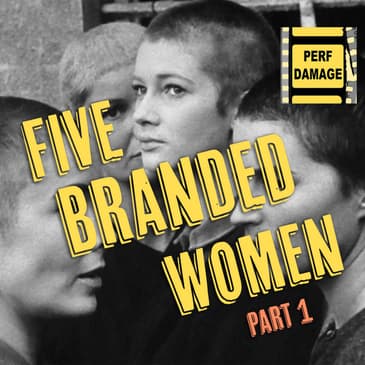
Charlotte is back! In this episode Charlotte and Adam look into the film Five Branded Women and discuss blacklisted writers Paul Jarrico and Michael Wilson along with the film's blacklisted director Martin Ritt. They give some background on the HUAC hearings, the significance of the Hollywood Ten and even explore the only blacklisted film Salt of the Earth.
Contact Us At:
www.perfdamage.com
Email : perfdamagepodcast@gmail.com
Twitter (X) : @perfdamage
Instagram : @perf_damage
Letterboxd : Perf Damage
Check Out our Youtube Channel:
https://www.youtube.com/@PerfDamagePodcast
Blacklist Five Branded Women
===
Adam: Welcome back everybody to another episode of Perf Damage and guess who's back this week? I'm back. Heh heh. Everybody's going, thank God. The quality hath returned.
Adam: Heh,
Charlotte: No, I'm really glad that you got a couple of guys to be on the show while I was out.
Adam: Yeah, they were very excited to be special guest hosts. I think they came out well. So Charlotte, now that you're back what are we going to talk about this week?
Charlotte: We've been doing a lot of research into Hollywood in the 1950s. This is definitely my favorite era of Hollywood. So much was going on we've talked about 3D before, the big craze for it started in the 50s. The widescreen era. The studio system was ending in the 50s. Yeah, we haven't
Adam: talked about the widescreen wars yet. We haven't
Charlotte: and we, that is on the list of things to talk about. It definitely is. Yeah, there was a lot of stuff going on and one of those things was, The McCarthy era HUAC and the Red Scare, and I recently worked on a film that tied this story in and I made you watch the film recently because it's really good. And we decided it was worth doing a podcast episode on. Yeah,
Adam: so we're going to center on the film Five Branded Women. From 1960. From 1960. Directed by Martin Ritt. But we are going to give you a lot of background on what was going on and how this was significant to the Hugh Ack McCarthy hearings. Yeah,
Charlotte: and one thing we've talked about is films that had people in them that were blacklisted. Specifically writers. For a film that had blacklisted writers, what sort of obligations do you have as a preservationist or a restorationist to preserve history versus writing a wrong? In other words, do you go in and add credits? That should have been added that maybe have now been acknowledged by the WGA the Writers Guild or do you leave them out?
Charlotte: Because that's not how it was
Adam: Originally released Yeah, I could see that being a conundrum for you guys It is you guys are probably constantly discussing
Charlotte: that? And anything that we change we're only doing digitally We're not touching original
Adam: preserving the original.
Adam: So the original is still preserved as it was released. Yeah But now you're adding these WGA acknowledged credits in for subsequent digital releases.
Charlotte: Correct. And this has been going on since the 90s, this sort of thing. And I've always had mixed feelings about it until recently. When I did a lot more research into this film in particular, this made me realize when we update credit on a film.
Charlotte: is the right thing to do. And what we're doing is we're going in and recreating that card in the opening credits that says screenplay by or written by with the WGA recognized credits for the film the WGA actually has a list on their website of all the films that had blacklisted writers that they've now acknowledged and approved worked on a film.
Charlotte: Sometimes with that acknowledgement comes Academy Awards because some of them are Academy Award winning films that the writer couldn't accept an award for because they either had a front Who was the face of their script that they wrote. Or they wrote under a pseudonym.
Adam: Or they were just left off altogether.
Adam: They were just left off altogether. That's insane to think that Academy Award winning films had writers on them that were unacknowledged.
Charlotte: I know. Watching a film you think, these are the people that made this. But that might not actually be accurate. How crazy is that?
Adam: Yeah. It's crazy to think that Academy Award winning films that are major films, not forgotten films have some people left off of them and have for decades.
Adam: Yeah.
Charlotte: One of the films that was affected by the blacklist and had writers whose names weren't originally credited to the film is Five Branded Women.
Adam: Yeah, Five Branded Window had two blacklisted writers.
Charlotte: I don't think this is a very well known film, so I thought it would be one that would be good to
Adam: talk about.
Charlotte: So if you want to hear a little bit about the blacklist. We're not going to go too deep into that. About a couple writers that were blacklisted and a really great film you should check out if you can.
Charlotte: Stay tuned.
Charlotte: Before we get into the movie, let's set the stage for what was going on in America and Hollywood and the world at the time. We're going to do a quick refresher because a lot of you probably already know this stuff, but just stick with us because we want to set the stage to make sure we're coming into this all on the same page if it were. Since it's about writers. It's about writing. Yeah, I think they get that's a pun. You get it, right? You
Adam: get it. Oh, I'm doing the over explaining comedy.
Charlotte: The blacklist, it started because of the rivalry between the U. S. and the Soviets during the Cold War because the Soviets were communists and Americans were afraid that communism was going to spread across the mainland.
Adam: Not our mainland necessarily, but in Europe it did, Soviet Union became a superpower and they were spreading their ideology across Europe and across Asia.
Charlotte: Those fears were exacerbated by the Korean War and the Chinese Revolution, which was evidence of the spread of communism for many people.
Adam: Yeah. And for a lot of people back then, communism basically represented anti Americanism, right? It went against all of our capitalist ideas. Immoral. Yeah, it was immoral.
Charlotte: The poster child for this whole thing is Senator Joseph McCarthy though.
Adam: It came out of the concept of the Red Scare. That communists secretly lived among us. And were working against our American ideals to undermine them.
Adam: And get us all involved in, secretly covert Communist missions against the United States.
Charlotte: And he would deliver speeches on this, McCarthy would, and he would name people when he had no proof. This is really what fueled that. And what started HUAC,
Adam: House on Un American Activities Committee. Correct. HUAC. We'll just call it HUAC, it's easy. We're gonna call it HUAC. And nobody wants to say it. That's a mouthful. It is. No one wants to say it over and over again.
Adam: Yeah, I don't got time for that. Yeah, no one wants to listen to that. They can't fast forward it for one second.
Charlotte: So McCarthy wasn't the only person naming names, though. There was actually a column in the Hollywood Reporter in 1946 called A Vote for Joe Stalin. And in it, William R. Wilkerson, who was the publisher and founder of the Hollywood Reporter, named several names of communist sympathizers, including Dalton Trumbo.
Charlotte: And he was one of the first persons identified on what was known as the Billy's blacklist. So one of the first blacklists that
Adam: came out. Which was shortened to the blacklist eventually. Yep. That was where that concept, the idea of the blacklist. A list of people's names that were suspected communists or communist sympathizers.
Charlotte: And in 1947 HUAC interviewed. Forty one people who were working in Hollywood, and these individuals became known as friendly witnesses because they named several people whom they accused of holding views sympathetic to communism.
Charlotte: Out of that came the Hollywood Ten. ,
Adam: which the HUAC board considered Unfriendlies.
Charlotte: Very unfriendly.
Adam: They pleaded the Fifth Amendment. , but they didn't. refused to answer questions that would incriminate them, they decided to use their television time to grandstand and espouse a bunch of political views.
Adam: Yes, they did. Some more than others. And that was their downfall. tried to embarrass the committee of just, Remaining silent and so they were punished for it, right? Let's list
Charlotte: the Hollywood 10.
Charlotte: There's Alva Bessie screenwriter.
Adam: Herbert Biberman,
Charlotte: albert Maltz, the screenwriter who served in the US Army Air Forces during World War II but that did not get him any sympathy from HUAC.
Adam: The next guy, Edward Dmitrich, the director. He was part of the Hollywood 10 and he was sentenced to six months in jail, but only served four months and 17 days. And there's a story that goes along with that.
Adam: He shared a cell with Albert Maltz, the guy you just mentioned. And the two of them had constant conversations about, capitalism versus communism. So when North Korea invaded South Korea, they had differing views. And this happened while they were in jail. They were in jail.
Adam: Yeah, Edward Dmitri said this is proof that communism isn't this kind of peaceful concept where people live and everyone helps each other which is what he believed communism was supposed to be. But Albert Maltz looked at it completely differently. He said, The Americans and the South Koreans had invaded the North and that the Democratic North Korea was only striking back.
Adam: So he put his own spin on it. He would never see that anybody that believed in communism could be wrong. Ultimately, he just talked incessantly and it drove Dimitri nuts. And so he decided to recant his statement.
Adam: I'll do anything to get out of here. I just want to get out of here. This guy's crazy. So he ended up going back in 1951 and naming some names of people that were in the party with him, including seven film directors, Arnold Manoff. Frank Tuttle, Herbert Jack Berry, Bernard Vorhaus, Jules Dessin, and Michael Gordon, amongst 15 other people.
Adam: Wow.
Charlotte: And didn't he ultimately blame Albert Maltz and others for pressuring him to include communist elements in his films?
Adam: He did, yes. Yeah.
Charlotte: Some of the other members of the Hollywood Ten, John Howard Lawson also a screenwriter.
Adam: Samuel Ornitz a screenwriter.
Charlotte: Adrian Scott, a producer and screenwriter, he also served in the U. S. Navy, but got no sympathy from HUAC for that.
Adam: Lester Cole, a screenwriter, and Lardner Jr., also a screenwriter. And there's a funny story about this, too. You got
Charlotte: all kinds of stories.
Charlotte: All kinds of funny stories. Where are you getting those stories
Adam: from? I read a book called Red Star Over Hollywood by Ronald Radosh and Alice Radosh. It was published in 2005. And it talks about the things that led up to the HUAC and the blacklist and the post blacklist period.
Charlotte: So what's the story on Ring and Lester?
Adam: Jay Parnell Thomas, the HUAC chairman. Was accused of padding his own payroll by billing the U.
Adam: S. Treasury for individuals who are not actually working in his office. So basically, it was just absorbing their pay and putting it in his own pocket. This was just two days before he won election to the House for a seventh term. A grand jury was convened to investigate the charges. And Thomas invoked the Fifth Amendment.
Adam: This is the exact thing that the Hollywood Ten went, served jail time for. Yep. He did not want to testify, because he was afraid that he would, perjure himself in some way. So he was indicted for conspiracy to defraud the government. He pleaded no contest and received... Conspiracy? I He did.
Adam: He did. Okay. He pleaded no contest and received a sentence of 6 to 18 months in federal penitentiary in Danbury, Connecticut, which is where Lester Cole and Ring Lardner Jr, who he sent to jail, were serving their time. Hello, friend. So one day in the prison yard, lester Cole and Ring Lardner Jr. saw Thomas, who was their tormentor, working in a prison chicken coops. This is Cole recounting the event. He says, Atop one of the coops was Thomas, a hoe in hand, scraping chicken droppings from the roof. He saw me, and called down, Hey, bullshie, I see you got your sickle.
Adam: Where's your hammer? To which I yelled back, and I see you're still picking up chicken shit.
Adam: Isn't that awesome? I love it.
Charlotte: Whether or not that's true, I
Adam: don't care. It's a great story. That's so good. That's a wonderful Hollywood story. It's true. That guy did go to jail and he'd served in the same poetic justice in a way. So we just have one Hollywood 10 member to mention the big one.
Charlotte: One that everyone knows, Dalton Trumbo. And Trumbo, had one of my favorite moments when he was on trial, where he's asking HUAC to show him the evidence that he's a communist.
Adam: That's just amazing. He's so smart and funny and condescending to these guys.
Charlotte: Yeah, and while he was blacklisted, he wrote The Brave One in 1956 and Roman Holiday in 1953, both received Academy Awards for Best Story that he could not claim.
Adam: Well, Dalton Trumbo was the most prolific of all of the blacklisted writers after he got out. And he ran a front farm.
Adam: He had so much work after he got blacklisted that a lot of the B movie producers in Hollywood would hire him. Because they knew they would get him on pennies on the dollar. He wrote 12 movies in the first year after he was blacklisted under different names.
Charlotte: Wow, that's like a Republic Pictures kind of
Adam: deal.
Adam: Just pumping them out. And he was so popular that he had so much work that he couldn't do it all himself, so he farmed it out to other blacklisted writers. So he created the concept of a front farm. Ultimately, he wrote over 30 scripts under pseudonyms during that time period
Charlotte: those were the Hollywood ten but there were other people that were put on trial and testified.
Adam: Lot of famous Hollywood actors and actresses. Ronald Reagan
Charlotte: being one of them.
Adam: Lucille Ball. Lucille Ball actually, they had a signed card that she was a member of the Communist Party.
Charlotte: That was because her
Adam: uncle, right? Her uncle was very active in the party and made the kids, she was just a child at the time, sign a card and join the Communist Party.
Adam: What about Elia Kazan? Yeah. Yeah, he provided names.
Adam: Elia Kazan was one of the most famous film directors of the time, and he named names, but he only named names for people that he contacted beforehand to ask if it was okay that he use their names. And they said, fine, because they said, save your career, because mine is already over. That was the general consensus. And he only named names for people that were in the the theater that he was in when he first started. That was the Lee Strasberg Theater.
Adam: And
Charlotte: Walt Disney is another one who testified. And he became the poster child for Hollywood's conservative party.
Adam: Along with Howard Hughes. Which
Charlotte: is
Adam: hilarious.
Charlotte: Disney said that he had been approached by those in the Communist Party but had refused their advances. But he did not supply specific names of those people. And he went on to be one of the leaders of the Motion Picture Alliance for the Preservation of American Ideals. He was on the board.
Charlotte: And that was a group that promoted conservative values and work to combat what they saw as the leftist influences in Hollywood.
Adam: They famously created a document called the Waldorf Statement. Representatives from many of the major studios Met together at the Waldorf Astoria in New York.
Adam: Yeah, that's why I got the name. That's why it's called the Waldorf Statement. They came up with the idea that if you were associated with the Communist Party in any way, if you got called to the hearings or if you were named in the hearings, then you would no longer be able to work for the studios, right?
Adam: Oh, you
Charlotte: have that quote from Jack Warner. Jack Warner. That sort of sums up what that really means.
Adam: Richard Collins, who was an actor at the time he got called to HUAC and was looking for work and he was called into Jack Warner's office
Adam: to defend himself. He comes in and he says, this is a mistake the plain fact is that I am an anti communist and Jack Warner fired back. I don't give a shit what kind of communist you are. Get outta here!
Adam: He's telling him he's not a communist. And he says, I don't care what kind of communist. He hears what he wants to hear.
Adam: That's what the Waldorf statement,
Adam: basically the spouse, no matter which way you went, you didn't work. If they felt it was safer not to hire somebody that was involved in it, even if it was just tacitly involved. You were just seen as tainted. If you knew people or associated with people that were named, then you weren't working because it was just safer for them.
Charlotte: And the Motion Picture Alliance, That Disney was a part of created what became known as the blacklist. And that list was used by some studios to deny employment for people that they suspected had communist ties.
Charlotte: So it was hard for these people to get work.
Adam: Except for Dalton Trumbo. Yeah. But he wasn't enjoying the success he was before because he was making probably 25% of what he was making before. So what happened? What did these guys do? I know what I would do. I've moved to France.
Adam: So what did they do? They moved to France. All right. Yeah. Wee, wee, Wee. Yeah.
Charlotte: But why did they move
Adam: to France? Because France looked at Communism and communist sympathizers in a different light.
Charlotte: Their relationship with communists was
Adam: complicated. But the communist party was an actual party in their country.
Adam: Whereas here, it was not. It was a recognized political party.
Charlotte: And a lot of intellectuals and a lot of elite. We're in this group. So I think that might be one of the things that drew some of the writers to France that or it's just it's France
Adam: Yeah, it's France. The food's good.
Adam: Yeah great cheese and wonderful meats And bread and
Charlotte: pastries. Lavender fields.
Adam: Beautiful architecture. And they love the arts ultimately. Yes, they do. Yes, they celebrate the arts in France.
Charlotte: But they weren't all pro communists in France. In fact, they were a key member of NATO and part of the Western Bloc during the Cold War. , so they were also fighting communism too.
Adam: Yes, in the late 40s and 50s, the French government conducted a series of high profile trials, much like we were doing here, like HUAC that targeted communist leaders and sympathizers, which also resulted in prison sentences, deportations, and other punishments.
Adam: What was happening in our country was also happening in France at the time.
Charlotte: So France's attitude towards communism was complex. It was nuanced
Adam: I mean they were a legitimate political party in their country where in America they were not right So you could be a communist in France and be accepted, like you said, into the intellectual elite and the art community. But they were also very wary of them like we were here in our country.
Charlotte: And I'm not saying the entire French film industry was communist. No. That's not what I'm saying. No. Nevertheless, the French film industry welcomed all of the Hollywood blacklisted writers, some actors, directors, producers. They welcomed them with open arms because they love the arts over there.
Adam: Yeah. And who wasn't happy to get Dalton Trumbo? Yeah. And
Charlotte: Jules Descens. So yeah, Dalton Trumbo is one of the ones he ended up moving to France after he was in Mexico for a while. He moved to France in the fifties. Jules Descennes.
Adam: Yep. He directed probably more famous films in France than he did in America including Rafifi.
Adam: I love Rafifi. Which is one of the greatest crime stories
Charlotte: ever made. When you met me, you were impressed that I had that on DVD.
Adam: I was. You had the Criterion DVD. I know. I was like, ooh, dang,
Charlotte: I remember you being impressed about that film specifically. Specifically.
Adam: Yes. Because it's one of my absolute favorites.
Charlotte: And he became part of the French New Wave.
Adam: Who else, Charlotte?
Charlotte: Carl Foreman. He was a screenwriter and producer. And he co wrote the screenplay for The Bridge on the River Kwai with Michael Wilson who also relocated to France and Michael Wilson is one of the writers of Five Branded Women.
Adam: We're gonna bring it back to that. We're bringing it back very shortly. We're getting close. We're tying it in, guys. Getting close, guys.
Charlotte: And who else?
Adam: Herbert Biberman. He was a director and one of the Hollywood Ten. He moved to Mexico after being blacklisted, but I think we need to talk about a little film that he, Paul Jericho, and Michael Wilson did in New Mexico in 1954.
Adam: It was called Salt of the Earth. They decided that since they couldn't work in Hollywood, they were going to form their own production company and produce films that kind of espouse their communist beliefs outside of the system and get them released in the United States.
Charlotte: And there's a great story about how the FBI tried to shut this film down.
Charlotte: Howard Hughes is involved in it. This is a podcast in itself.
Adam: It was Karina Longworth did this as part of her Hollywood Blacklist series on, You Must Remember This, her podcast. So we're not going to go into a lot of detail about it. If you want to know more about it, that is a very fascinating podcast.
Charlotte: Or the story on Audible, there is a podcast called The Big Lie. And it is
Adam: fabulous. Ultimately, what happens is they produce the film. They have a lot of problems during the making of the film, but they ultimately finish it, and then it plays in one theater in New York. Because
Charlotte: it's the only film that appeared on the blacklist.
Charlotte: It was a
Adam: blacklisted film. Yeah, the film was blacklisted. Howard Hughes came out and said that if you help in any fashion to distribute project, or... If you help to get this movie out into circulation in any way, you personally will be blacklisted and not work in Hollywood again.
Adam: It's blackmail. Absolutely. That was the whole point. So yeah they had played in one theater in New York city in 1954. It was booked in Detroit and Los Angeles, but They were not allowed to advertise it. And then the theaters gave them their money back and just said, yeah, this isn't going to work for us. And so it just appeared for a very long time. Yeah. Now it's available on Blu ray. Yeah. From the film detective. Great company. So anyway, that's a little divergence but I thought it was
Charlotte: important.
Charlotte: But it's also, it's a good transition into Five Branded Women because both Paul Jericho, who produced Salt of the Earth, and Michael Wilson, who wrote Salt of the Earth, were the writers on Five Branded Women.
Charlotte: Alright Five Branded Women, written by Paul Jericho and Michael Wilson. Let's do some quick biographies on them. Let's start with Paul Jericho.
Adam: All right. Paul Jericho was born in 1915. Originally named Israel Shapiro. The son of a Russian immigrant. Both his parents were socialists. So he grew up in a socialistic leaning family. When he went to college, he attended both U. S. C. And U. C. L. A. Where he was a campus activist, and he wrote for both the Daily Bruin and the Daily Trojan. Wow. But he found during college years that socialism was not militant enough for him.
Adam: So he joined the Communist Party. After college, he took a job as screenwriter at Columbia Pictures. But he worked for various studios. And that was when his... Agent told him he should change his name from Israel Shapiro to Paul Jericho.
Charlotte: Where'd they come up with that name?
Adam: It just sounded less Jewish.
Adam: That was the reasoning. That was the quote? That was a quote. It sounded less Jewish. That happened a lot. Yeah, it did.
Charlotte: People... With any sort of ethnic sounding
Adam: name.
Charlotte: But funny that would happen to a writer, too.
Charlotte: So he was involved with the WGA pretty early on, and back then it was called the Screenwriters Guild.
Charlotte: But I'm just gonna call it the WGA because that's what
Adam: it is now. Yeah, it became the WGA. Yeah
Charlotte: He was heavily involved and unfortunately, no matter how passionate he was about the WGA They turned their back on him during the HUAC era just
Adam: Everybody else did. Yeah. Yeah No one wanted to be associated with a communist and this is something Paul Jericho never touted not to be he was always a communist Till his dying day.
Adam: Yeah. It was something he really believed in. He believed in the ideals of every person for the people, the socialist ideal, everybody helps everybody else and it makes a better society. Union unions. Yes.
Charlotte: That's why he was so hard and, so involved in the union. Yeah.
Adam: So his career goal was to work for MGM and earn 800 a week. That's so specific. It was, that was his idea of making it back then. Right. So he ended up working for MGM making 800 a week, but it wasn't until he got hired by RKO.
Adam: That he earned 1, 200 a week. So he surpassed his highest expectations.
Charlotte: But his time at RKO was not as great as his pay was.
Adam: RKO got purchased by Howard Conqueror episode. So if you want to hear about that, that one's fantastic. He's not biased.
Charlotte: It is a really good one, and we don't really get in too much about Howard Hughes in there, but we do get into it a little bit.
Adam: So when Howard Hughes took over RKO, he decided that he was going to root out all communism in RKO.
Adam: And unfortunately, Paul Jericho butted heads with him. And he was fired two weeks before he got called to testify at a HUAC hearing.
Charlotte: It was in 51. He had written a movie for RKO, The Las Vegas Story, and because of all the HUAC stuff, Howard Hughes said he was not going to get credit on the film.
Charlotte: And so Paul Jericho sued RKO and Howard Hughes over that film.
Adam: Yeah, that was the first time that had ever happened. A screenwriter sued a studio for credit, he took his name off because he was a communist and he didn't want a communist associated with a Howard Hughes film.
Adam: So the reason that Howard Hughes cited for firing Paul Jericho. Was that he broke his morality clause?
Charlotte: That must have been a really loose clause if Howard Hughes was following
Adam: it well, and that was Paul Jericho's defense Was that was his
Charlotte: clause called catch 22?
Adam: Was that if I broke the morality clause and you didn't want my name on the picture because you thought It was bad because I broke my morality clause.
Adam: How is your name above the title on it? Yeah, it was a Howard Hughes film And he said, you do nothing but break the morality.
Charlotte: I'd love to see what's on that morality clause.
Adam: They still have them. Studios still have them strangely.
Charlotte: It's not strange. It's just protecting. So if we want to get rid of somebody, we can
Adam: figure out a way to do it.
Adam: if you're going to get Brad press on us, then we have the right to fire you. Yeah, ultimately, Paul Jericho does not win this battle. No.
Charlotte: Howard, you said in a interview in the San Francisco examiner article in 1952
Adam: it would be much simpler, easier, and probably cheaper to pay what Jericho demands than to resist. As long as I am officer or director of RKO, this company will never temporize, conciliate with, or yield to Paul Jericho or anyone guilty of similar conduct.
Adam: After the hearing, he was also quoted in the Los Angeles Mirror as saying, I ordered every piece of paper Jericho ever laid a hand on, thrown into a wastebasket, and burned.
Adam: I issued such violent instructions in the Jericho matter that his work be discarded, and even sanctioned substantial loss to the studio through the delay that no subordinate would have dared to miscarry my instructions.
Charlotte: Nobody going up against Howard Hughes.
Adam: No, he was a pretty nasty guy. You will
Charlotte: have his revenge. Jericho moved to France. Screw this. I'm out. I'm going to France and within a week of getting there he met up with his old pal Michael Wilson and they met with Dino De Laurentiis and struck a deal to adapt Hugo Pirro's novel, Iovanka and the Others.
Charlotte: De Laurentiis agreed to pay them 45, 000 to write the script for the book. That's a lot of money back then. Yeah, it's close to half a million dollars.
Charlotte: All right, so let's do a little backstory on Michael Wilson.
Charlotte: Michael Wilson was born in 1914 in Oklahoma, and he grew up in a family of farmers. He went to the University of California, Berkeley in 36, and then he moved to New York to pursue a career as a writer.
Charlotte: In 1941, he moved to Hollywood to work as a screenwriter, and his first major success came with the 1943 film The North Star, which he is said to have co written with Lillian Hellman, although he's not technically listed in the credits.
Adam: Lillian Hellman was also a major member of the Communist Party.
Charlotte: That's no surprise then that the film caused quite a stir in HUAC because it was considered grossly flattering of the Soviet Union, which they felt was inaccurate. It tells the story of Ukrainian village's resistance to a Nazi invasion, and it was a very big hit.
Charlotte: Michael Wilson served in World War II, which briefly interrupted his writing career, but as soon as he was back, he became a contract writer with Liberty Films, and he worked uncredited on a lot of films, one you may have heard of, It's a Wonderful Life.
Adam: What? No way. Yes, co writer. Wow,
Charlotte: He was also the co winner of the Academy Award for Best Adapted Screenplay for A Place in the Sun in 1951.
Adam: In 1952, Wilson was called to testify in front of HUAC. Yep. He refused to name names, citing his Fifth Amendment right against self incrimination.
Adam: And so he was blacklisted.
Adam: He continued to write. Yep, like all these guys did. Yeah. He continued to write. He used a front named Michael Blankfurt.
Charlotte: Blankford also fronted for blacklisted writer Albert Maltz on the film Broken Arrow and probably a lot of others that are just not publicly documented.
Adam: So the fact that he was making only part of what he used to make, after he was blacklisted. After he was blacklisted, he had to sell Gertrude ended up moving to France.
Charlotte: Yep,
Adam: they moved to France. In 1950, where he worked pretty steadily over there on television. Yeah,
Charlotte: it's really hard to find a lot of the credits of things that he worked on.
Charlotte: You find conflicting information. Things will say he worked on this film or that film, but then you can't find
Adam: the source. Or it was suspected that he worked on it.
Charlotte: Yeah, but apparently he said he worked a lot more. He found the French film industry more welcoming than Hollywood had been.
Adam: Which brings us to five branded women.
Adam: Yeah.
Charlotte: And then once again, Jericho moves out there and they meet up and they strike a deal for five branded women.
Adam: I think there's one other person we should mention before we start talking about five branded women and that's director Martin Ritt. Martin Ritt was Also blacklisted in 1952, but Martin Ritt wasn't blacklisted from the film industry. He was blacklisted from the television
Charlotte: industry. Interesting. You never think about that. You
Adam: just think about, yeah, this affected.
Adam: all walks of life. It wasn't just targeted at film. People in the military were blacklisted people and regular jobs were blacklisted. It affected thousands of people. It affected hundreds of people within the film industry. In 1951 he was fingered for donating money to the communist China movement.
Adam: He was a very popular director of plays and television at the time. And then, for five years after that, he was not able to get a job in the television industry at all. So he ended up supporting himself, teaching at the Actor's Studio in New York, which is where he met Paul Newman and Joanne Woodward.
Adam: Oh, and
Charlotte: so that's why he worked with him on HUD. Paul Newman.
Adam: Yes, on many films, yes. The lack of work in television is what pushed him to direct film
Adam: So Martin Ritt his entire career was focused on social and economic Issues all of his films. That's why you got HUD and you got Norma Ray about the unions he directed a wonderful film in 1976 called The Front, which I think we'll probably mention a little bit later. Yeah. Yeah. It's a good idea. Cause it's all about the blacklist.
Charlotte: It sure is. So that brings us back officially to Five Branded Women.
Charlotte: Alright, Five Branded
Adam: Women. Yeah, it took us a long time to get here, but it's worth
Charlotte: it. I hope it's worth it. It's a great film! It really is. Directed by Martin Ritt. It is 101 minutes. And the synopsis is five Yugoslavian women are accused of consorting with the Nazis who have taken over their town. The women are banished , but soon meet up with gorillas in the mountains. And those aren't like, gorillas and apes.
Adam: Just to be clear. First of all, I think we should talk about the stellar cast involved in this film. It stars Silvana Mangano who was married to Dino Laurentiis at the time. Vera Miles. Barbara Bel Geddes. It was Jean Moreau's first American produced film. And Carla Gravina. As well as Van Heflin. Yep, and Richard Basehart.
Adam: Produced by
Charlotte: Dino De Laurentiis.
Charlotte: So the movie was written by Paul Jericho and Michael Wilson. And it's said that the script was influenced by their experiences during the McCarthy era. And their commitment to social justice, and explores themes of female empowerment, solidarity, and resistance.
Charlotte: In a letter that Jericho and Wilson wrote to De Laurentiis where they were describing what the theme of the film was going to be, they said,
Adam: in the most brutal circumstances, in the midst of the most violent carnage, the human animal is still capable of love. Human life is still precious. Love transcends national, political, and even military boundaries. But love is a function of life, not of death, of liberty, not of fascism. For women especially, the bearers of life, the fight for freedom is a fight for the right to love freely, to love whomever they choose to love, for the right to emotional as well as social equality.
Adam: That's really nice. Yeah, absolutely.
Charlotte: And that was from Paul Jericho's biography, called The Marxists and the Movies, from
Adam: 2007. Of course it is. This movie struck me immediately by how grown up and complex it dealt with larger issues of war and of brotherhood. And in 1960, you just didn't really see things talked about so explicitly, immediately the opening scene starts out with a firing squad. That is how the film opens.
Charlotte: And the film is black and white or else it would be super
Adam: gory. Yeah, it would be very violent. But that violence depicted immediately sets up how gritty and how realistic they're going to handle. All of the things in the film.
Charlotte: Yeah, and right after that, the, these five women start getting accused of consorting with the Nazis.
Charlotte: They were.
Adam: Yeah. And I think that's another thing. This is handled in a very deft way. They all do consort with Nazis. They all have different reasons for doing that. And different
Charlotte: levels of consorting.
Adam: There is one of them that never actually gave in to the Nazi Who remained virginal and yet was still blamed because she did date him.
Adam: One of them wants to have a child and she saw This good looking tall Nazi officer as good breeding stock basically, so that's why she did it One of them just wanted coal For her family so that they could survive the winter. One of them was actually in love with him.
Adam: She thought she was the only one. This guy was a dog. He was great. Yeah. And they deal with this head on. The Yugoslav resistance army finds Yovanka on a date actually making out with this Nazi soldier and they castrate him.
Charlotte: Yeah. They don't explicitly say it,
Adam: but. They say he's mutilated and that he's not a man anymore. Yeah. So they basically say it without saying it. As explicitly as you could in 1960. Yeah.
Charlotte: So they pull all five women in the middle of town with the whole town around they Accused them of this crime consorting with the Nazis and then shave their heads
Adam: it's a public shaming and then they exile them from the village. They are no longer considered Yugoslavs. They are exiles. Yeah And they have to wear their head shaving as a symbol of their guilt. It's like the Scarlet Letter,
Adam: another thing this film deals with are gray areas all the Nazis are not depicted as evil people. The Nazi that was romancing all of these women and using them, that guy was evil. Even after he was mutilated, he screams out the window at all the townspeople, telling them that he's had all of their women, not just these five.
Charlotte: Yeah, that guy is
Adam: evil. But to balance that, there is a captured Nazi soldier later, Captain Reinhardt played by Richard Bassart who tells his story there's a whole conversation. Yeah,
Charlotte: he's talking to them, and one of them asks, how do you tell a good German from a bad German?
Charlotte: She looks through his papers and she said I know you had a wife and then that's when he starts telling his story At first he said no, I don't have a wife.
Charlotte: He doesn't want to tell right any information Yeah, and then she says why I look through your papers. You have a wife He said I did have a wife.
Adam: Yeah, and then he tells his story which shows that he's not a bad person he's basically conscripted into the German army He was a former professor.
Adam: His wife was killed during the war. And he was basically made to become a Nazi, even though he didn't really believe in their ideals. Showing that, he's a normal human being just like all of them. Another really good point that this film makes is that Even the so called good guys can be bad.
Charlotte: Yeah, with fear of miles, his character.
Adam: The five branded women meet up with a Yugoslavian resistance army and they joined them. And in the army, they have a rule that there is no fraternization between members of the army because it leads to problems.
Charlotte: And they join because they're becoming scared of just being vulnerable women out there defending themselves.
Charlotte: So they realize they need a village,
Adam: basically. Yeah, that's one of the things, too. They, this confronts rape. Yeah. Very vividly. They all run into almost rapes or partial rapes. Constantly several times before they join up with this other army, right? So they're looking for protection They're looking for a way to feed themselves without having to steal from other people.
Adam: Yeah and by having a group a Collective they're able to support each other. Yeah safety in
Charlotte: numbers,
Adam: too Which is a very Paul Jericho concept
Charlotte: So
Adam: The one rule is that they can't fraternize, but Vera Miles is falling for one of the other members. And while they're out on watch one night, they sneak off and start making out in the corner when a Nazi contingent comes up from behind. And luckily they're executed by the Yugoslavian resistance before they can cause anybody to die.
Adam: But they put themselves in. A really bad situation by doing the one thing they were told not to do, right? We also learned that this is that guy's third infraction on this, but it's Vera
Charlotte: Miles first, right? And she says, I'm sorry. Yeah. But this offense is punishable by death if voted democratically and so they take a vote. And everyone except for the other four women raised their hands that they should both be shot, but because it's a Democratic vote the yeses outweigh the noes.
Adam: So
Charlotte: then people are nominated randomly. to shoot, so what they do is they get about six or seven people with guns to shoot the people, so no one specifically knows who shot and killed.
Charlotte: Two of the people that get nominated are two of the women.
Charlotte: So they go out to the line they go out, they're standing in front of this beautiful backdrop with these mountains in the back, and they're blindfolded, and the people shoot, and everybody shoots the guy.
Charlotte: No one shoots Vera Miles character. So she takes her blindfold off, and everyone's staring at her. Dunned and they don't know what to do and then one guy just decides. Nope. You know what this is it and shoots her
Adam: van heflin makes that
Charlotte: guy shoot.
Charlotte: Yeah. He yells at him he tells this guy to shoot her and he does and it's just Really shocking.
Adam: Yeah. We also haven't mentioned that van heflin's velco is one of the guys that in the village Led the charge on shaving these women's hair and sending them out into the wild.
Adam: He's hard on them. And I think that's why she's murdered after her first offense. Because she was already what they considered a loose woman. I think you're right. He didn't want them in their group. But the rest of the people voted to have them in there. He thought they were nothing but trouble.
Adam: And yet, through mutual respect, he and Yvonca kind of form a love type of thing. By the end of the film. The film
Charlotte: ends a bit on a cliffhanger.
Charlotte: You don't know what's going to happen to everybody. They're marching off through the mountains, headed
Adam: to... They're trying to get away from this German army that's stalking them down. Jovanka and Van Heflin's character Velko. They stay behind. They stay behind to fight off the Germans.
Adam: Yeah. So that the rest of them can survive. Which is another wonderful communist one person against.
Charlotte: And it made me wonder is this gonna mirror what happened with Vera Miles character. Are they gonna now fall in love and have a little thing but nobody's there to see it.
Charlotte: I don't know.
Adam: We'll never know. We don't know. I felt that this dealt with a lot of very mature themes in a very serious and a very realistic way. Realistic, which was not the way Hollywood did that in 1960.
Charlotte: We're coming off the golden age of Hollywood, big
Adam: musicals. Yeah.
Adam: And everything always ended with a happy ending to
Charlotte: this film is gorgeously shot, by the way. It was shot in VistaVision, it's black and white, and I know what you're thinking. Why would they shoot VistaVision in black and white? Let me tell you, it's beautiful. That's why. Black and white VistaVision is beautiful.
Charlotte: And it was shot all in location, in Italy and a bit in Austria. They wanted to shoot in Yugoslavia, but it's really unclear from my research if they were able to shoot there or not. Some sources say they got permits for some shots. Others say they couldn't shoot there at all.
Adam: Yeah some of them said that the Yugoslavian government denied them because they didn't think that they could tell a story about Yugoslavians in the correct way.
Adam: Right? And
Charlotte: they were still a little sensitive. So it also caused a stir in Italy it was banned initially because of the depiction of Italian women collaborating with Germans during World War II.
Charlotte: So the Italian government saw it and they thought, we don't like that. So initially it was banned. Yeah. That ban was lifted,
Adam: this film was produced independently outside of Hollywood studio system, even though it was released by Paramount. It was funded by Italian producer, Carlo Ponti. And it ran into censorship issues in certain
Adam: markets because of its political content. Weird that it
Charlotte: would be produced independently, but shot in VistaVision, which was Paramount's premier format, which
Adam: they would loan out. You want to know why? It already had distribution. Paramount and Dino had a deal. Yes. So it already had distribution. It was produced independently, but Those films had released through Paramount.
Charlotte: Right, So that's probably why. That's why. We got VistaVision in there too, which So glad they shot it in VistaVision because it's beautiful. I can't say that enough
Adam: We should talk about some of the casting right there.
Adam: There were a lot of people linked to this film. Oh, yeah.
Charlotte: Yeah originally Shirley MacLaine was Rumored to be one of the five women and so was Mitzi Gaynor. Well, It might have been because the women had to shave their heads for the role. So that might have initially scared
Adam: away. A lot of people. A lot of people. Yeah. , which is, it's rumored one of the reasons why Gina Lolo Brigida, who was actually cast in the film, she was gonna play Ivanka. She decided to bow out because there are a lot of different reasons.
Charlotte: Hit us with some of those rumors of why she didn't play Ivanka in the film.
Adam: The first one is that she didn't. Shave her head, and she tried to persuade Martin Ritt to let her wear a plastic skin over her head. But Ritt refused and said she had to shave her head.
Adam: So she pleaded with him and faked a nervous breakdown. And produced a doctor's certificate, which was from Professor Cesar Fragoni.
Adam: patients included Mussolini and communist leader Palmiro Togliatti. Very interesting. Wow. So what did her doctor's notes say? The doctor's notes said that she absolutely needs rest for two months.
Adam: At that point, Martin Ritt was like, yeah, that's not going to happen. Another newspaper gave the reason she pulled out due to the casting of Sylvana Magnano, which was her long time rival.
Adam: Didn't want to be in a film with her. And then another one said that she might've just bowed out because she was getting divorced at the time. So it's a
Charlotte: myriad of reasons.
Adam: It could be anyone or all of them, to be honest.
Charlotte: So back to the head shaving, all the women. Had to agree to shave their heads, but they have this one condition.
Charlotte: They said they will not have their heads shaved a la Yul Brynner. Barbara Bel Geddes said, we all have future film commitments and we cannot afford to look like plucked chickens.
Adam: I love it. But
Charlotte: Barbara Bel Geddes actually ended up wearing a wig.
Charlotte: She didn't have to shave her head because she was involved in this Broadway production called Silent Night, Lonely Night. So everybody else shaved their heads, but Bel Geddes.
Charlotte: Vera Miles, who's in the film, she was actually born Vera Ralston.
Adam: Oh, wow. That's already an actress, right? Yes,
Charlotte: yes, but she had to change her name because there was a well known Vera Ralston who was married to Herbert Yates, owner...
Charlotte: of Consolidated Film Industries and Republic Pictures. And Yates used to put Vera Ralston in all kinds of films. And she's terrible. Apologies to anybody that likes her. And we don't like to bash things here, but she's terrible. She's the
Adam: worst! Yeah, any time you have to work on a movie with her, you're like, Oh, no!
Charlotte: Vera Ralston, no! Somebody's bad or something, or didn't do a good job or whatever. You put them on a Vera Ralston film as punishment.
Adam: Didn't she act against John Wayne in a lot of early. And the
Charlotte: early He did her. That's why he left Republic was because of
Adam: her. Really? Yeah. They teamed her up with him a lot and he hated it.
Adam: We could do a whole John Wayne versus Vera Ralston. That'd be funny. It could be
Charlotte: funny. It might be funny one day. But anyways, back to Vera Miles, vera Miles went directly from this film, Five Branded Women, to working on Psycho, where she wore a wig.
Charlotte: So if you ever wondered, why does her hair look so terrible? It's a wig.
Adam: Yeah, that's also released in 1960. It is,
Charlotte: they were just cranking them out then.
Adam: Director Martin Ritt ran into a lot of problems on set. He was quoted as saying the longest picture I shot ran 35 days. This one calls for 12 weeks, four or five weeks of them in Klagenfurt,
Adam: which is in Austria.
Adam: The budget was 3 million on this, which was quite substantial, but less than Martin Ritt was used to working in studios. And so he had a hard time shooting on location. It wasn't his favorite thing. He had problems with translation with the Italian crew.
Charlotte: Martin Ritt wasn't a huge fan of this film when it was released.
Adam: Yeah, do we know why? I think you know why. No, I have suspicions. Okay, hit us with those. So towards the end of the film, Martin RIT was having a hard time finishing it. What do
Charlotte: you mean?
Adam: In post-production? During production. And so Producer Dino, Dean Lois brought in famous. Italian neo realist director, Pietro Germi, to help him finish the film. And Pietro actually acts in the film.
Adam: He plays ? He was a commander.
Charlotte: Yeah. So you didn't bring him in. He just said, Hey you get from in front of the camera to behind the camera. No,
Adam: that was the deal. He wasn't going to get credit as a director. So probably paid him more than he should have to do this role in the film.
Adam: So it could have them on set to help him. Ah, I see what's going on. That's what's happening here. Okay. Which is why I suspect Martin Ritt doesn't like this film or the way it came out because. In addition to it being shot on location, which he wasn't used to and using a foreign crew, which he also wasn't used to.
Adam: So it shot a lot longer and slower than he was used to doing. I think at a certain point he was replaced. That's my suspicion though. I could not find anything that said this specifically, but that is my suspicion because He's quoted afterwards saying that this is the only film he ever made that he was embarrassed by in support of my suspicions, in a New York Times article, Ritt stated that , this film was not one of my more successful efforts and that he didn't have much control over it. . Dino de LOEs was always said to be a very hands-on producer though, so that also he probably butted heads with him quite a bit. Yeah. Which is why he probably brought the Italian into to finish. Well, And the
Charlotte: Italian Piero, he won Best Writing for Divorce Italian Style and he was nominated for Best Director. Yeah.
Adam: The year after. Yeah, 1961. Yeah. So it couldn't have been all that bad. During the 50s, he was part of the big Italian neorealist movement like De Sica, and Tony Oni came out of that. So why
Charlotte: do you think he wasn't given credit for co directing then?
Adam: Probably because of Hollywood rules. It wasn't common back then to, unless you were a directing team and hired as a directing team, to have more than one director credited.
Adam: So back to Paul Jericho and Wilson.
Charlotte: Yeah, they write this amazing movie and they don't get credit for it. Who gets credit for it?